Quick answer
Under OSHA’s construction rule, a portable generator frame may serve as the ground when the generator supplies only equipment mounted on it or cord-and-plug equipment through its own receptacles, and the required metal parts and receptacle grounding terminals are bonded to the frame. If those conditions do not exist, or the generator supplies a structure through transfer equipment, additional grounding requirements apply. Follow the exact manual and have the transfer, neutral, bonding, and grounding arrangement reviewed for the installation.
Grounding and bonding answer different questions
Grounding connects a system or equipment to earth. Bonding connects conductive parts so fault current has an effective path back to the source and protective equipment can operate. A rod driven into soil does not repair a missing equipment-grounding conductor, a broken bond, a damaged plug, or an incompatible neutral arrangement.
Portable-generator discussions often use “grounded” to describe several different conditions. Before changing anything, identify the model, read the grounding section of its manual, determine whether the neutral is bonded or floating, and document what the generator will supply.
When the generator frame may serve as the ground
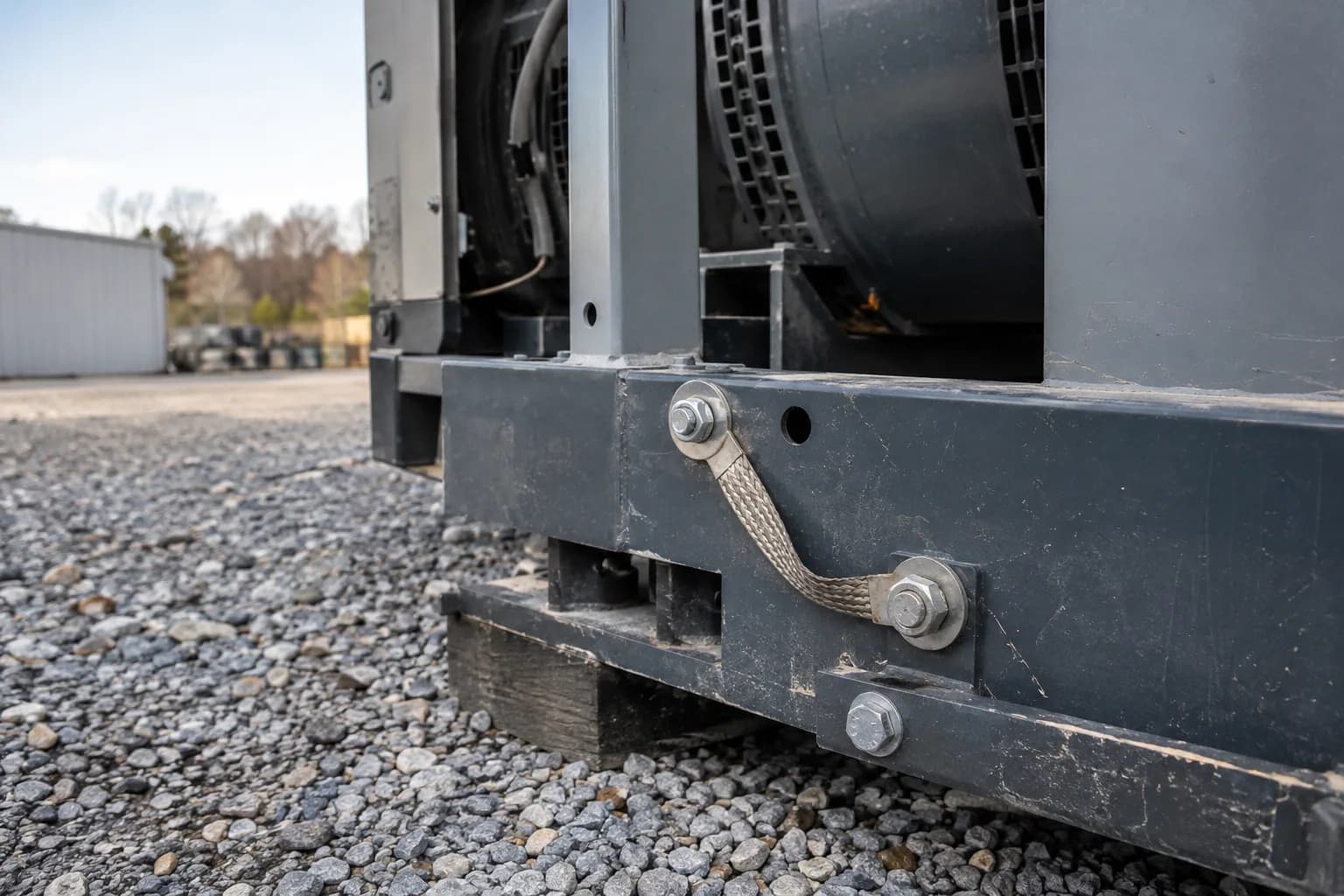
OSHA’s portable-generator fact sheet explains the construction-site conditions under which the frame need not be connected to earth. The generator must supply only equipment mounted on it or cord-and-plug equipment through receptacles mounted on the generator. The noncurrent-carrying metal parts and the receptacle equipment-grounding terminals must be bonded to the frame.
Both conditions matter. The exception is not based on generator size, convenience, or the presence of a three-prong outlet by itself. Grounding continuity also has to continue through an intact equipment-grounding conductor in the cord and connected equipment.
| Use case | Primary question | Next step |
|---|---|---|
| Loads plugged into generator receptacles | Are required metal parts and grounding terminals bonded to the frame? | Follow the manual and verify cord grounding continuity |
| Generator connected to a structure | How do transfer equipment, neutral, bonding, and the electrode system interact? | Use approved equipment and qualified installation |
| Bonding status unknown | Is the neutral bonded or floating on this exact model? | Stop and obtain the manual or manufacturer answer |
| Damaged ground pin or cord | Is the equipment-grounding path intact? | Remove the equipment from service |
A structure connection changes the grounding review
When a generator supplies building wiring, it becomes part of a larger electrical system. OSHA’s fact sheet directs structure connections through approved transfer equipment and says the generator must be connected to the grounding-electrode system. The transfer switch and installation have to follow manufacturer instructions and be completed by qualified personnel.
The transfer design also determines whether the neutral is switched and whether the generator is treated as a separately derived system. Those details affect where neutral-to-ground bonding belongs. Do not add or remove a bonding jumper, neutral connection, or ground rod from a generic diagram.
A ground rod is not a universal shock-protection upgrade
A ground rod can be required as part of a defined system, but installing one without understanding the generator and transfer arrangement can leave the actual fault path unchanged or create an arrangement that conflicts with the equipment instructions. Earth is not a substitute for the equipment-grounding conductor that runs with a cord or circuit.
GFCI protection, bonding, grounding, overcurrent protection, and equipment-grounding conductors are separate layers. Keep every required layer in place. If a GFCI trips, investigate the generator, cord, environment, and load rather than bypassing the device or changing bonds at random.
Do not choose a ground rod from a plug-in tester result
An open-ground indication does not, by itself, identify a missing earth electrode. WEN explains that some polarity testers do not read floating-neutral generators as intended and directs owners to check tester compatibility. A damaged equipment-grounding path is a different problem. Record the tester model, generator configuration and actual loads before drawing a conclusion.
For example, a refrigerator supplied directly through an intact approved cord and the same refrigerator supplied through house wiring are different system reviews. OSHA’s construction-site frame exception has defined conditions for generator-mounted equipment and receptacle-fed cord loads. A home inlet brings the transfer, neutral and grounding-electrode system into the decision. Neither a tester light nor the presence of a ground rod establishes that complete design.
| Observation | It does not establish | Next check |
|---|---|---|
| Tester reports open ground | That a new rod is the solution | Tester suitability, documented neutral configuration and grounding continuity |
| Cord has three prongs | That every grounding contact and conductor is intact | Condition and manufacturer-required continuity verification |
| Rod is already present | That bonding and fault paths are correct | Complete generator and transfer documentation |
| Switching from cords to a home inlet | That the cord-only grounding decision still applies | Qualified review of the installation and neutral switching |
Verify the actual generator and connection plan
Record the generator model, receptacle types, neutral-bonding status, manual instructions, intended loads, cord construction, transfer-switch type, and grounding-electrode connection. For home use, confirm the installation with the equipment manufacturer, qualified electrician, and local authority that accepts the work.
Stop when a manual is missing, labels conflict, a ground pin is absent, a cord is damaged, the bonding status is unknown, or a structure connection lacks approved transfer equipment. Those are design or maintenance problems, not reasons to guess with a temporary rod.
- Exact generator model and current manual
- Neutral bonded or floating, as documented by the manufacturer
- Intact equipment-grounding conductors and plug pins
- Approved transfer equipment for any structure connection
- Grounding-electrode and bonding plan accepted for the installation
Frequently asked questions
Common questions
Does every portable generator need a ground rod?
No. Under OSHA’s stated conditions, the generator frame may serve as the ground for equipment mounted on the generator or cord-and-plug loads supplied from its receptacles. The manual and actual bonding still have to be verified.
Does a generator connected to a house need grounding?
A structure connection requires approved transfer equipment and a coordinated grounding, bonding, neutral, and electrode design. Follow the equipment instructions and use qualified installation.
Is grounding the same as bonding a generator neutral?
No. Grounding is a connection to earth. Bonding connects conductive parts to create an effective fault-current path. Neutral bonding is system-specific.
Can I use a ground rod instead of a grounded extension cord?
No. A ground rod does not replace the equipment-grounding conductor and intact grounding contacts in a suitable cord.
Does an open-ground tester light mean my generator needs a ground rod?
Not by itself. Check whether the tester is suitable for the generator’s documented neutral configuration and have the equipment-grounding path checked as required. A rod does not repair a damaged cord or establish a compatible transfer and bonding design.
Primary references
CordFind summarizes connector specifications and public safety guidance. Always follow the instructions supplied with your equipment.
- OSHA: Grounding Requirements for Portable Generators
- OSHA: Portable Generator Grounding Standard Interpretation
- OSHA: Electrical Grounding Rule 1926.404
- OSHA: Using Portable Generators Safely
- WEN: Generator FAQ, Floating-Neutral Tester Readings