Quick answer
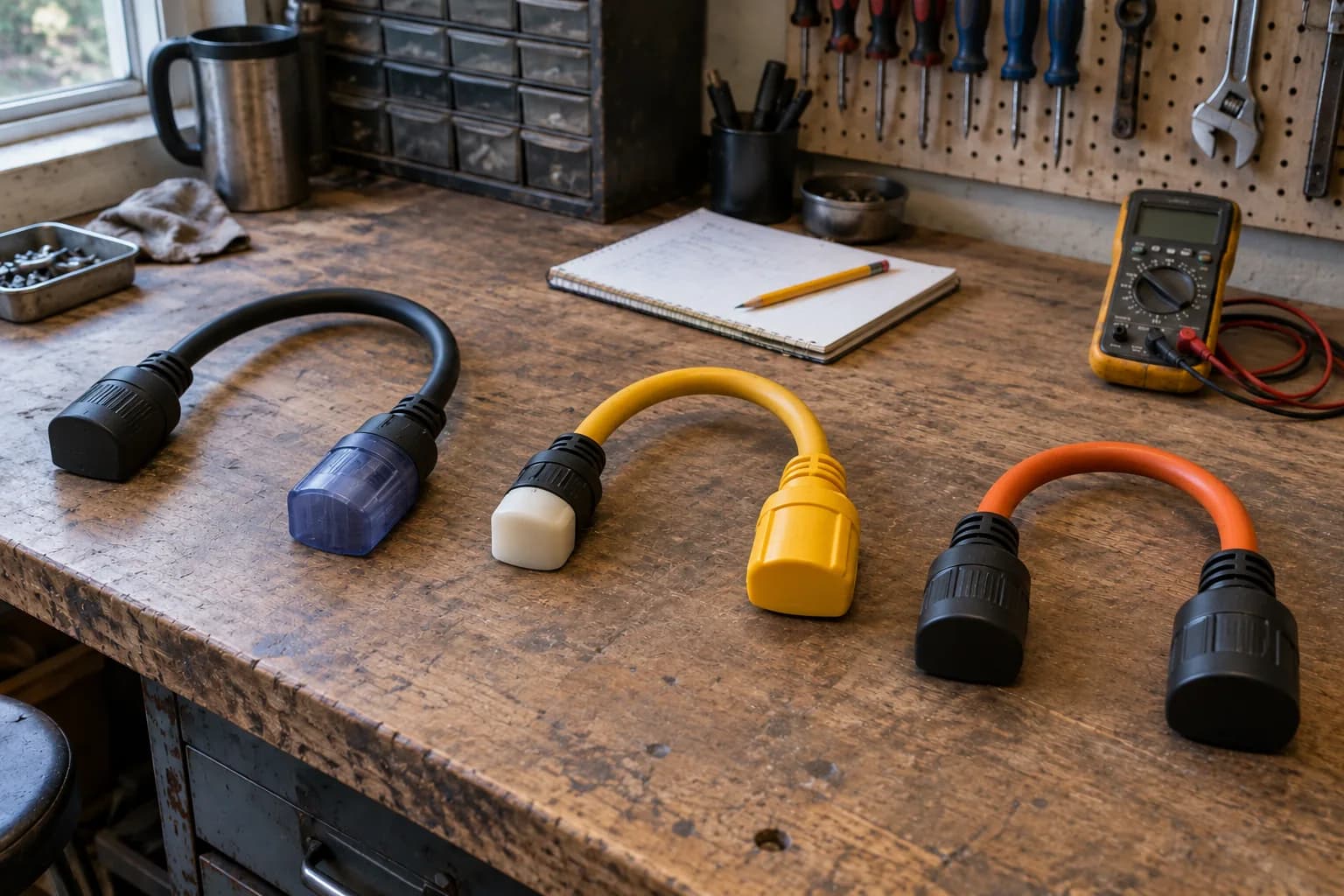
An adapter is only a candidate when the source voltage, destination voltage, grounding path, conductor arrangement, and intended use remain compatible. A 20A source stays limited to 20A after a 30A or 50A adapter. A 125V source does not become 125/250V. Stop when the adapter description does not identify both connector designations and every electrical rating.
Check compatibility in a fixed order
Begin with the designation molded beside the generator receptacle. Record the suffix, voltage, amperage, pole count, wire count, and whether the device is locking or straight-blade. Then record the corresponding information at the destination. Photos and prong counts are useful confirmation, but they are not substitutes for the marked configuration.
Compare voltage before amperage. A TT-30 and an L14-30 can both carry a 30A label, yet TT-30 is a 125V, three-wire RV configuration while L14-30 is a 125/250V, four-wire locking configuration. Equal current ratings do not make the electrical systems interchangeable.
- Identify the complete source receptacle code
- Identify the destination inlet or plug code
- Compare voltage and conductor arrangement
- Keep the lowest current rating as the limit
- Verify the adapter listing and intended application
Common adapter paths have different boundaries
An L5-30 generator outlet can sometimes supply a TT-30 RV through a listed L5-30P to TT-30R adapter because both systems are 125V and use a grounding path. The RV still cannot draw more than the generator outlet, adapter, cord, or generator can supply. Air-conditioner starting demand and the RV converter load remain separate checks.
A 14-50 generator receptacle can connect to a compatible 50A RV path or listed distribution equipment only when the complete 125/250V, four-wire configuration is preserved. A physical 14-50 match does not prove that the generator can supply 50A continuously or that both legs have the required capacity.
| Source and destination | Typical status | Controlling check |
|---|---|---|
| L5-30R to TT-30 RV | Adapter may be possible | 125V path, 30A source limit, RV load |
| 5-20R to TT-30 RV | Limited adapter path | 20A source remains the maximum |
| L14-30R to TT-30 RV | Listed adapter required | Correct 125V leg selection and 30A limit |
| 14-50R to 50A RV | Verify direct configuration | Generator output and per-leg load |
| TT-30R to 120/240V house inlet | Stop | 125V source cannot supply a 125/250V inlet |
A larger destination does not increase source capacity
A 5-20 source connected to a TT-30 or 14-50 receptacle through an approved adapter remains a 20A, 125V source. The larger destination shape only lets a compatible plug connect. It does not change the generator breaker, winding, receptacle, cord, or adapter rating.
Plan the load from the smallest rating in the complete path. Include steady load, starting demand, branch protection, adapter rating, cord rating, and generator receptacle limit. If the destination normally serves a larger system, use load management instead of assuming the adapter makes the full service available.
Building inlets require a complete transfer plan
A cord or adapter that physically reaches a power inlet is only one part of a building connection. The inlet, transfer equipment, generator output, neutral and grounding arrangement, overcurrent protection, conductor ratings, and operating procedure must work as one approved system.
Never use an adapter to energize a household receptacle or build a cord with exposed male contacts at both ends. Source isolation cannot be added by a switching sequence or by turning off a main breaker. Use approved transfer equipment and qualified installation.
Reject vague adapter listings before purchase
A useful product description names the source plug, destination receptacle, voltage, amperage, conductor arrangement, environment rating, and applicable listing. Terms such as universal, heavy duty, or generator ready do not replace those specifications.
Inspect the adapter before every use. Stop for bent contacts, cracked housings, loose strain relief, heat discoloration, corrosion, missing grounding features, or an unclear label. Keep connections dry and supported so the cable weight does not strain the devices.
Frequently asked questions
Common questions
Can I use a 30 amp to 50 amp generator adapter?
A listed adapter may connect compatible systems, but the available power remains limited by the 30A source, its voltage, and its conductor arrangement. Verify the exact source and destination codes.
Does a 20 amp to 30 amp adapter provide 30 amps?
No. The generator receptacle and breaker still limit the connection to 20A, and the connected load must stay within every component rating.
Can an adapter change 120 volts into 240 volts?
No. A passive connector adapter does not create another energized conductor or a different source voltage.
Can I adapt a generator outlet to a home dryer receptacle?
No. A household receptacle is not a generator inlet, and backfeeding can energize utility wiring and expose contacts. Use a dedicated inlet and approved transfer equipment.
Primary references
CordFind summarizes connector specifications and public safety guidance. Always follow the instructions supplied with your equipment.
- Honda: Generator Receptacle Selection
- Honda: Generator Accessories and RV Adapter
- Leviton: L5-30R Technical Information
- Hubbell Bryant: CS6365 50A Male Plug Specifications
- CPSC: Male-to-Male Extension Cord Warning