Quick answer
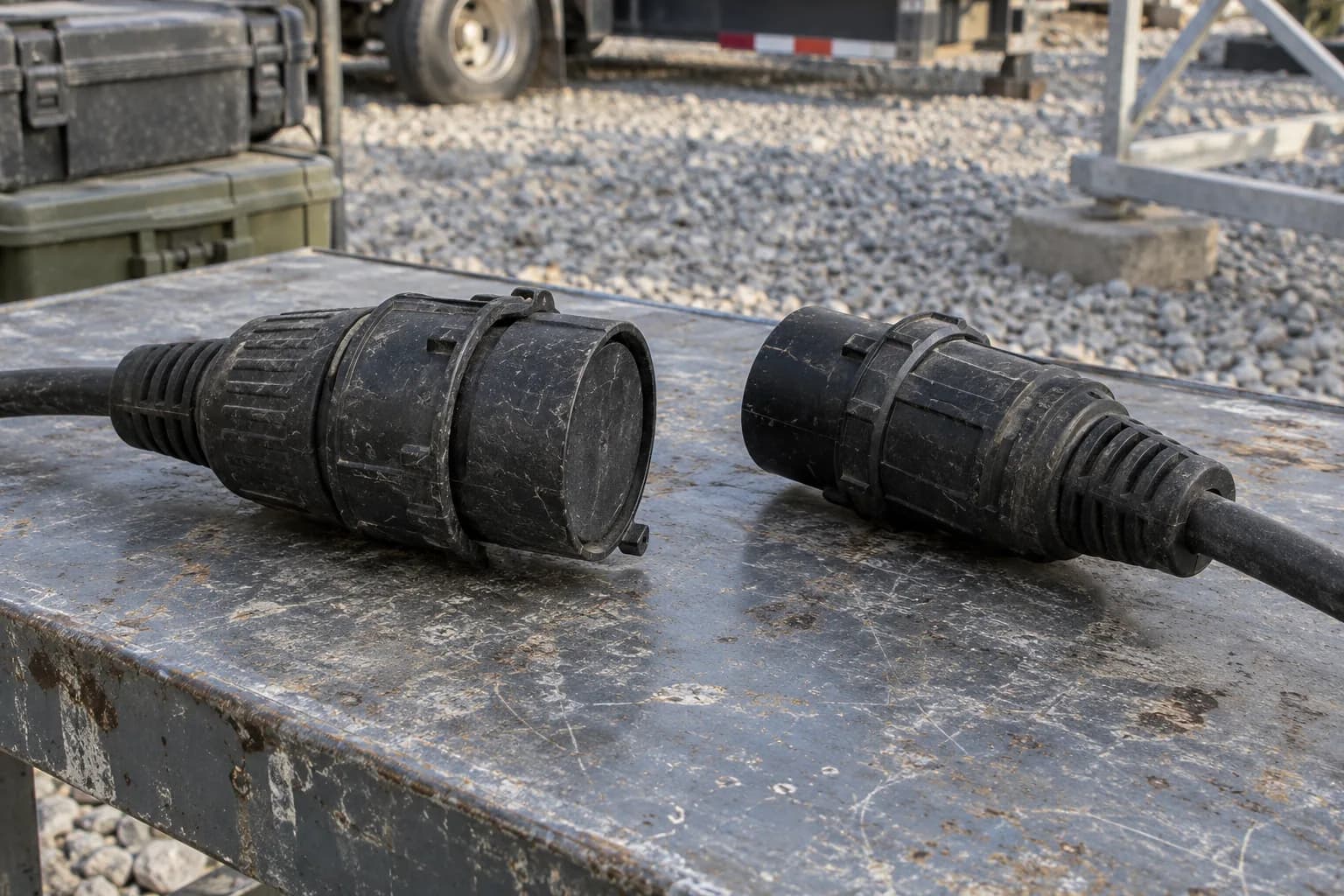
CS6365 identifies a cord-mounted male plug and CS6364 identifies a cord-mounted female connector body in the common 50A, 125/250V, three-pole, four-wire grounding family. Related receptacle and inlet catalog numbers are different. Read every device marking and confirm the generator outlet, both cord ends, inlet, transfer equipment, environmental rating, and complete system listing.
Catalog numbers separate plug, connector, receptacle, and inlet roles
Hubbell identifies CS6364 as a cord-mounted female connector body rated 50A at 125/250V with three poles and four-wire grounding. Its CS6365 documentation identifies the mating cord-mounted male plug. Related panel receptacles and flanged inlets use other catalog numbers such as CS6369 and CS6375.
A product title that says only “50 amp generator cord” is incomplete. Record the catalog number on every endpoint and confirm which side supplies power. A building inlet receives power from a cord connector and remains protected by its cover when not in use.
| Catalog family | Typical role | Verification point |
|---|---|---|
| CS6365 | Cord-mounted male plug | Source receptacle and shroud compatibility |
| CS6364 | Cord-mounted female connector | Destination inlet or equipment input |
| CS6369 | Single receptacle | Panel and enclosure listing |
| CS6375 | Flanged power inlet | Transfer-system and weather installation |
The CS family is not a NEMA 14-50 connection
A NEMA 14-50 device and a CS6364 or CS6365 device can both be associated with 50A, 125/250V systems, but their physical designs and roles differ. A cord may legitimately use a 14-50P at a compatible generator outlet and a CS6364 connector at a compatible inlet. That does not make the two device families directly interchangeable.
Use a complete listed cord assembly for the exact endpoints. Do not build an adapter from color assumptions or internet pin diagrams. Confirm line conductors, neutral, equipment ground, polarity, strain relief, conductor range, enclosure, and environmental protection.
A 50A connector does not guarantee 12,000 watts of generator output
The nominal connector arithmetic is 50 amperes multiplied by 240 volts, but the generator continuous rating, receptacle breaker, per-leg limit, fuel-specific rating, altitude, temperature, and load starting behavior may impose a lower limit. The lowest verified limit controls the path.
Load planning must also protect the transfer equipment, inlet, conductors, cord, and connected circuits. A larger inlet does not upgrade a smaller generator source, and a high marketing surge rating does not become a continuous connection rating.
Inspect locking and environmental features before every connection
Check the shell, center guide, blades, contacts, locking ring, cord grip, boot, cover, fasteners, and markings while de-energized. Stop for cracks, corrosion, discoloration, heat, loose parts, missing hardware, water entry, or a connection that will not fully seat and lock.
Heavy-duty construction does not make a dry-location connector weatherproof by itself. Use the exact boots, covers, enclosures, and operating instructions required for the location. Keep generator exhaust and carbon monoxide placement rules separate from cord weather protection.
Frequently asked questions
Common questions
What is the difference between CS6364 and CS6365?
CS6364 is commonly the cord-mounted female connector body. CS6365 is the cord-mounted male plug in the same 50A, 125/250V family.
Is CS6365 the same as NEMA 14-50?
No. Their ratings may overlap, but they are different physical connector families and do not directly mate.
What connector is used on a 50 amp generator inlet cord?
It depends on both endpoints. Some assemblies use a 14-50P at the generator and a CS6364-style female connector at a compatible flanged inlet. Read the actual labels.
Does a 50 amp cord let a smaller generator supply more power?
No. Generator output, source breaker, per-leg limits, and every downstream component remain controlling limits.
Primary references
CordFind summarizes connector specifications and public safety guidance. Always follow the instructions supplied with your equipment.
- Hubbell Bryant: CS6364 Connector Specifications
- Hubbell: CS6365C Plug Specification Sheet
- Leviton: CS6365C 50A Locking Plug
- OSHA: Use of Equipment, 1910.334