Quick answer
Use a grounded, heavy-duty cord designed for the environment and rated above the connected load. Longer runs may require heavier conductors because voltage drop increases with distance. Inspect the entire cord and never use a damaged, undersized, or male-to-male assembly.
Add the loads connected to each cord
Start with the nameplate watts or amps for every device connected to that cord. Motor-driven loads can draw additional current while starting, so a running-watt total may not describe the full demand.
A multi-outlet cord does not increase the circuit capacity. The total load on the cord still has to remain within the ratings of the generator receptacle, plug, cord, connectors, and distribution equipment.
Gauge and length work together
In American Wire Gauge, a lower gauge number generally describes a larger conductor. Larger conductors have lower resistance, but the correct choice still depends on load, distance, temperature, cord construction, and the product listing.
Avoid universal charts that ignore the connected equipment or promise one gauge for every generator. Use the cord manufacturer’s rating and the equipment instructions, and obtain qualified help when a long run or motor load makes the result uncertain.
Choose construction suited to generator use
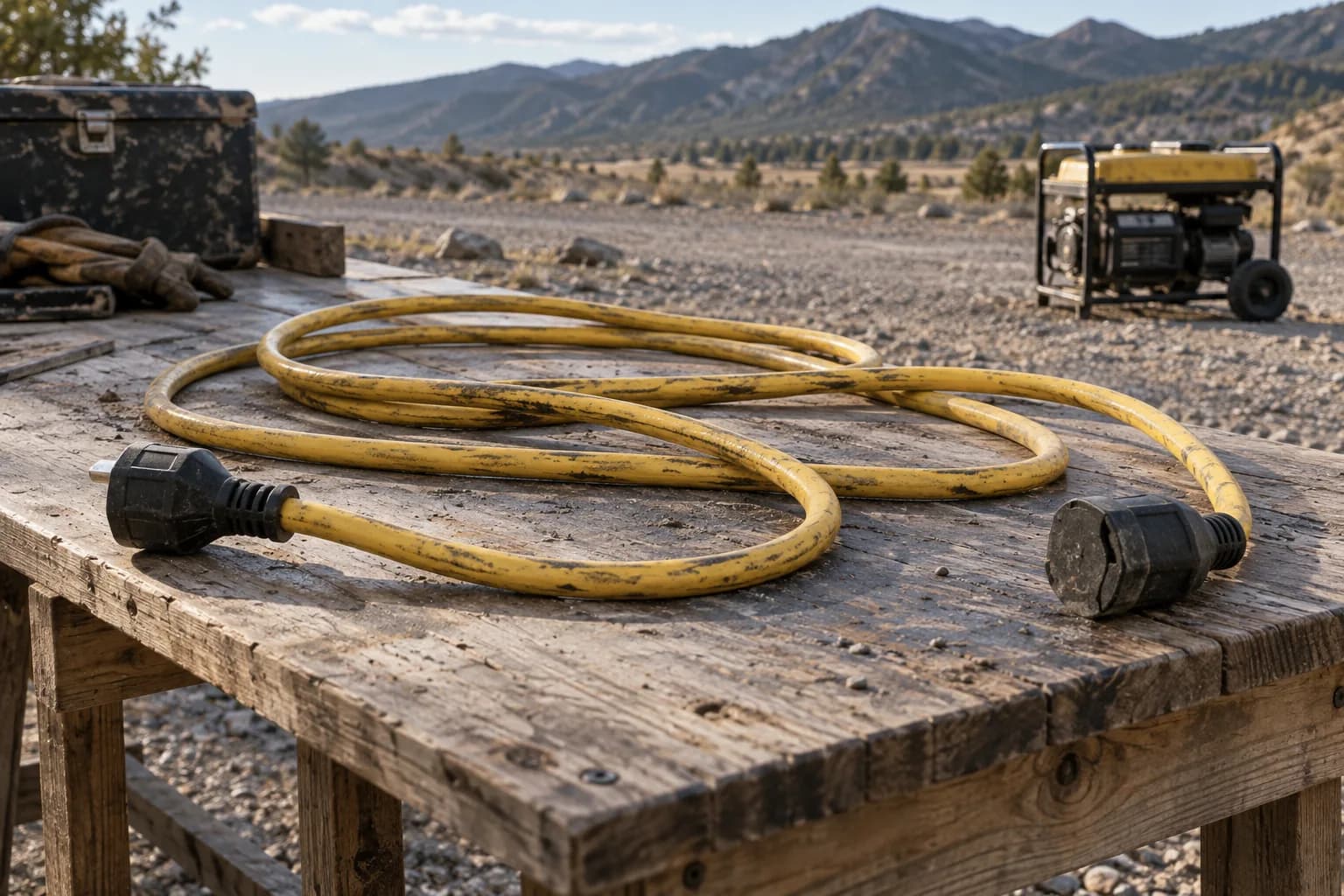
CPSC recommends heavy-duty extension cords specifically designed for outdoor use when connecting appliances to a portable generator. The cord should be long enough to support safe outdoor generator placement, with all grounding prongs intact.
Keep the cord away from standing water, sharp edges, vehicle traffic, hot exhaust, and locations where doors or windows can crush it. Do not cover or coil a heavily loaded cord in a way that traps heat.
Product to compare
Amazon · paid linksSouthwire 2588SW0002 — 50 ft outdoor extension cord
Compare this grounded outdoor cord for compatible appliance connections after checking the load, source receptacle, and appliance plug.
- 5-15P → 5-15R
- 50 ft
- 12/3 copper SJTW
- 15A / 125V · lighted end
Amazon product code (ASIN): B00004SQF4
See the current price and available sellers on Amazon.
Advantages
- 50 ft of reach for compatible appliance connections.
- 12/3 copper conductors with an outdoor SJTW jacket.
- Yellow jacket and a lighted connector for visibility.
Limitations
- The complete assembly is rated 15A, even with 12 AWG wire.
- Long runs and motor starts require a voltage-drop check.
- This is an appliance extension cord, not a building-inlet cord.
Check before buying: The complete cord assembly is rated 15A, despite its 12 AWG conductors. Check motor-starting demand and voltage drop; conductor size alone does not establish a safe load.
Based on manufacturer specifications; not independently field-tested by CordFind. Confirm the model and both connector labels before buying.
Appliance extension cords and inlet cords are different
An appliance extension cord carries power directly from a generator receptacle to one or more compatible loads. A generator inlet cord connects a generator outlet to approved transfer equipment through a building power inlet.
Do not improvise a building connection with adapters or a double-male cord. If the intended destination is home wiring, use the dedicated house-connection workflow and a qualified electrician.
Frequently asked questions
Common questions
What gauge extension cord should I use with a generator?
There is no single gauge for every setup. Determine the connected load, run length, generator receptacle rating, starting requirements, and the cord manufacturer’s published amp and environment ratings.
Can I connect several appliances to one generator cord?
Only when the cord and distribution equipment are designed for it and the combined load stays within every component rating, including starting loads.
How long can a generator extension cord be?
Use only the length needed for safe generator placement. Longer runs increase voltage drop and may require a different cord or connection plan.
Primary references
CordFind summarizes connector specifications and public safety guidance. Always follow the instructions supplied with your equipment.
- CPSC — Portable Generator Hazards
- OSHA — Using Portable Generators Safely
- OSHA — Wiring Methods, 1926.405