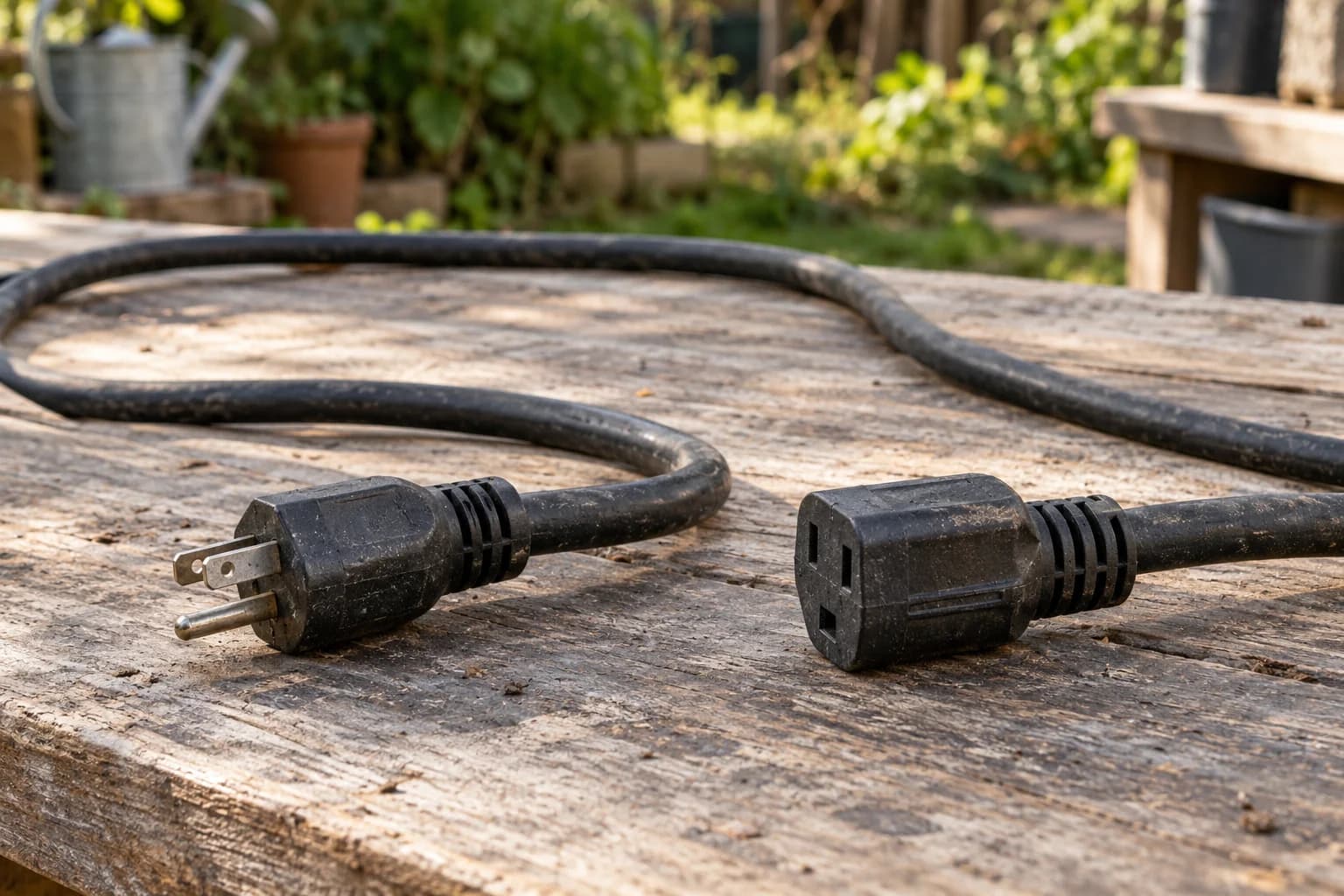
Quick answer
Stop unusual heat, odor, discoloration, melting, smoke or arcing and safely isolate the source without touching damaged equipment. After de-energizing and cooling, inspect the full cord and mating ends. Record ratings, length, load and heat location; replace damage or obtain qualified evaluation before reuse.
Stop first; do not inspect a hot energized connection
Unusual heat is a reason to stop. CPSC’s extension-cord alert identifies heating at plugs, sockets and along the cable, and calls hot parts a possible overload warning. Do not keep gripping a connector to judge it or wait for a breaker to trip.
Follow the equipment’s safe shutdown procedure from a safe position. Do not pull on a melting, smoking, wet or arcing plug. Keep people away and seek appropriate emergency help for fire or an immediate electrical hazard. Inspect only after the source is safely isolated and the equipment has cooled. For a building inlet connection, use its installed transfer and isolation procedure; unplugging one visible cord is not a complete system isolation plan.
Record where the heat appeared and what changed
Describe the location already observed; do not re-energize the fault to map it by hand. Note the interface, covered cable, operating time, connected loads and any recent start. Preserve photographs of visible damage only when safe.
Localized connection heating can accompany deteriorated contact or termination conditions. Distributed cable heating calls for review of the load, conductor selection and heat-dissipation conditions. The table separates useful inspection paths, not confirmed causes. More than one problem can exist at the same time.
| Observed pattern | Record | Next review |
|---|---|---|
| Heat concentrated at plug or adapter | Exact interface, looseness, odor or discoloration | Both mating components and their condition |
| Heat spread along cord | Length, full jacket/assembly label and total load | Rating, voltage drop and routing |
| One section under a mat or coil | Covered length, reel instructions and nearby heat | Permitted deployment and cooling conditions |
| Heat after a new load starts | Before/after load group and protective indication | Running current, start event and source response |
| Recurring trip with heat | Which device trips and exact error | Qualified fault evaluation; no repeated resets |
Read the rating of the assembly, not just the outlet
Record voltage, amperage, conductor count, wire gauge, jacket type, manufacturer, length and both connector designations. Find the complete cord’s rating and instructions. A cable jacket alone may not establish what its attached plugs, connectors or reel allow. An adapter and a distribution device each add another component whose rating and condition need review.
A 20A source does not turn a 15A-labeled assembly into a 20A cord. A larger breaker is not permission to exceed a smaller component’s rating. A heavy inlet cord with the wrong voltage or conductors is still unsuitable. Use the generator adapter compatibility chart, then confirm the actual route.
Worked example: a modest-looking extra load can change the result
Consider a hypothetical nominal 120V cord supplying a 1,200W resistive heater and 300W of lighting. Assume power factor is 1 for both solely to simplify the arithmetic. Their total is 1,500W, corresponding to 1,500 ÷ 120 = 12.5A. Adding another 600W resistive load raises demand to 2,100W, or 17.5A. If the complete cord assembly is labeled 15A, that new load exceeds the stated current rating.
The first 12.5A total is not automatic permission to operate. Continuous-use conditions, connections, protection, routing and voltage drop still need confirmation. For motors or electronics, use documented current or VA and starts rather than assuming watts divided by volts always gives current.
In a simplified example, assume total supply-and-return conductor resistance of 0.30 ohm. At 10A, I²R heating is 30W and IR voltage drop is 3V. At 20A, those become 120W and 6V. These hypothetical calculations show the current relationship, not a rating for any cable gauge or length.
Inspect the mating receptacle as well as the cord
After isolation and cooling, inspect for cuts, crushing, abrasion, exposed conductors, damaged grounding, loose housings, distorted plastic and failed strain reliefs. Examine accessible mating faces without dismantling equipment. Poor retention, heat damage or odor needs removal from use and evaluation.
CPSC calls for replacing damaged extension cords and warns against inadequate taped repairs or altered plug blades. A new cord cannot repair a damaged generator receptacle, adapter or inlet. Have the affected mating equipment reviewed too. Do not scrape, bend or squeeze contacts to create a temporary tighter fit, and do not open a panel to retighten terminals from generic advice.
- Keep the suspect assembly out of service so another operator cannot reuse it.
- Record the exact damaged end and the component it was mated to.
- Replace a damaged extension assembly with a correctly specified listed product.
- Use qualified service for receptacles, inlets, internal wiring and unresolved faults.
Correct the route and select a replacement from verified inputs
Use the generator cord size calculator to screen documented current, voltage and distance, then verify the result against the equipment and cord instructions. Retain enough length for safe outdoor generator placement. Shortening the route by bringing the engine close to an occupied structure introduces a different serious hazard.
Keep the cord clear of exhaust, sharp edges, standing water, crushing and pedestrian traffic. Follow any reel or manufacturer deployment restrictions; do not trap a loaded cable under a cover to conceal it. Where a crossing cannot be avoided, the generator cable protector ramp guide adds the separate fit and traffic checks. A protector does not upgrade cord ampacity or repair heat damage.
Use Cord Finder to organize connector and assembly specifications. Its selection result does not prove the previous symptom is resolved. Keep the mating-component findings and revised load plan with the replacement record.
Return to service only after the cause and limits are addressed
A corrected arrangement needs a clear reason for acceptance: damaged components replaced, permitted current and length confirmed, route corrected, and any required service completed. Observe an approved operating session under the intended load plan. Do not deliberately repeat an overheating event or rely on a lower load to disguise a damaged connection.
If unusual heating, odor or a trip returns, stop and request evaluation. Record what changed. Qualified temperature measurements can assist investigation, but this guide supplies no universal touch or surface-temperature threshold that declares every cord safe.
Frequently asked questions
Common questions
Is it normal for a generator cord to feel warm?
This guide gives no touch-based safe limit. Unusual heat is a warning to stop and review rating, load, condition and routing. Odor, discoloration, melting, smoke or arcing requires immediate removal from service and safe isolation.
Why is only the generator plug getting hot?
Localized heat can accompany a deteriorated connection or termination, but appearance alone does not establish the cause. After isolation, inspect both mating components and have damaged receptacles or unresolved faults professionally evaluated.
Will a thicker cord fix overheating?
It may reduce conductor resistance when correctly selected, but it cannot repair a damaged plug, receptacle, adapter or inlet. Identify the heat location, condition and complete load before choosing a replacement.
Why does the cord overheat without tripping the generator breaker?
A breaker does not certify the condition of every contact or smaller downstream component. A cord can be underrated for the load, or a connection can deteriorate, without the event producing an immediate upstream trip.
Can I tape a burned section and keep using the cord?
No. Remove a heat-damaged extension assembly from use. Tape does not restore the conductor, insulation, connector retention or original assembly rating. Check the mating equipment before fitting a correctly specified replacement.
Primary references
CordFind summarizes connector specifications and public safety guidance. Always follow the instructions supplied with your equipment.
- CPSC: Household Extension Cords Can Cause Fires, heat location and damage
- CPSC: Portable Generator Hazards, outdoor cord ratings and inspection
- OSHA: Using Portable Generators Safely, damaged cords and overload
- WEN: Safe generator use, model-specific cord gauge and length