Quick answer
First try to avoid traffic. For an unavoidable crossing, verify cable diameter, keep unsupported connectors out, and match the protector to documented traffic conditions. Confirm rating basis, ground support and access requirements. A ramp does not increase electrical capacity or create a weatherproof connection.
Avoid the crossing before choosing a ramp
Draw the generator, distribution point and load locations, then mark pedestrian routes, delivery access and any vehicle movement. Look for an approved route around the traffic rather than automatically placing a ramp in its center. The generator’s safe outdoor location still determines where the power route can begin; reducing cable exposure does not justify moving the engine toward occupied spaces.
Record ground condition, duration, lighting and traffic control. Include setup and removal, when delivery traffic may be heavier. Keep the crossing decision with the wider distribution plan in the temporary event power planner.
Measure the jacket and check usable channel dimensions
Cable gauge identifies conductor size, not the finished assembly’s outside diameter. Read the cable manufacturer’s dimensions or measure the de-energized cable without compressing its jacket. Check every different cord or hose intended for the protector, and compare against the exact product’s maximum outside diameter and usable channel width and height.
Checkers explains that channel dimensions, ribs and lid structure jointly affect capacity. Channel count alone is not a fit check. Do not stack lines or force closure unless expressly permitted. Preserve the cable’s bend radius at entries and transitions.
| Crossing item | Record | Decision |
|---|---|---|
| Cable jacket | Outside diameter and permitted bend radius | Within usable channel and entry geometry |
| Additional cord or hose | Its own dimensions and permitted grouping | Separate channel or documented grouping |
| Plug, connector or splice body | Largest body and strain-relief dimensions | Keep out of crossing unless explicitly supported |
| Ramp channel | Usable width, height and maximum line diameter | Confirm exact part specification |
| Lid and section ends | Closure, interlocks and approved transitions | No pinching or improvised assembly |
Worked fit example: a fitting cable can have an oversized connector
Consider hypothetical cord A with a 0.65-inch outside diameter. Candidate ramp X permits a maximum cable diameter of 0.50 inch, so it fails the dimensional screen. Candidate Y permits 0.75 inch and has adequate usable width and height, so the jacket passes that screen. Neither result establishes traffic approval or electrical suitability.
Now suppose cord A has a connector body 1.50 inches high. That body does not fit candidate Y’s 0.75-inch channel merely because the cable does. Arrange an approved connection location away from the crossing, or obtain a protector and installation explicitly designed for it. Do not leave the lid open over the connector or put a board over the hump.
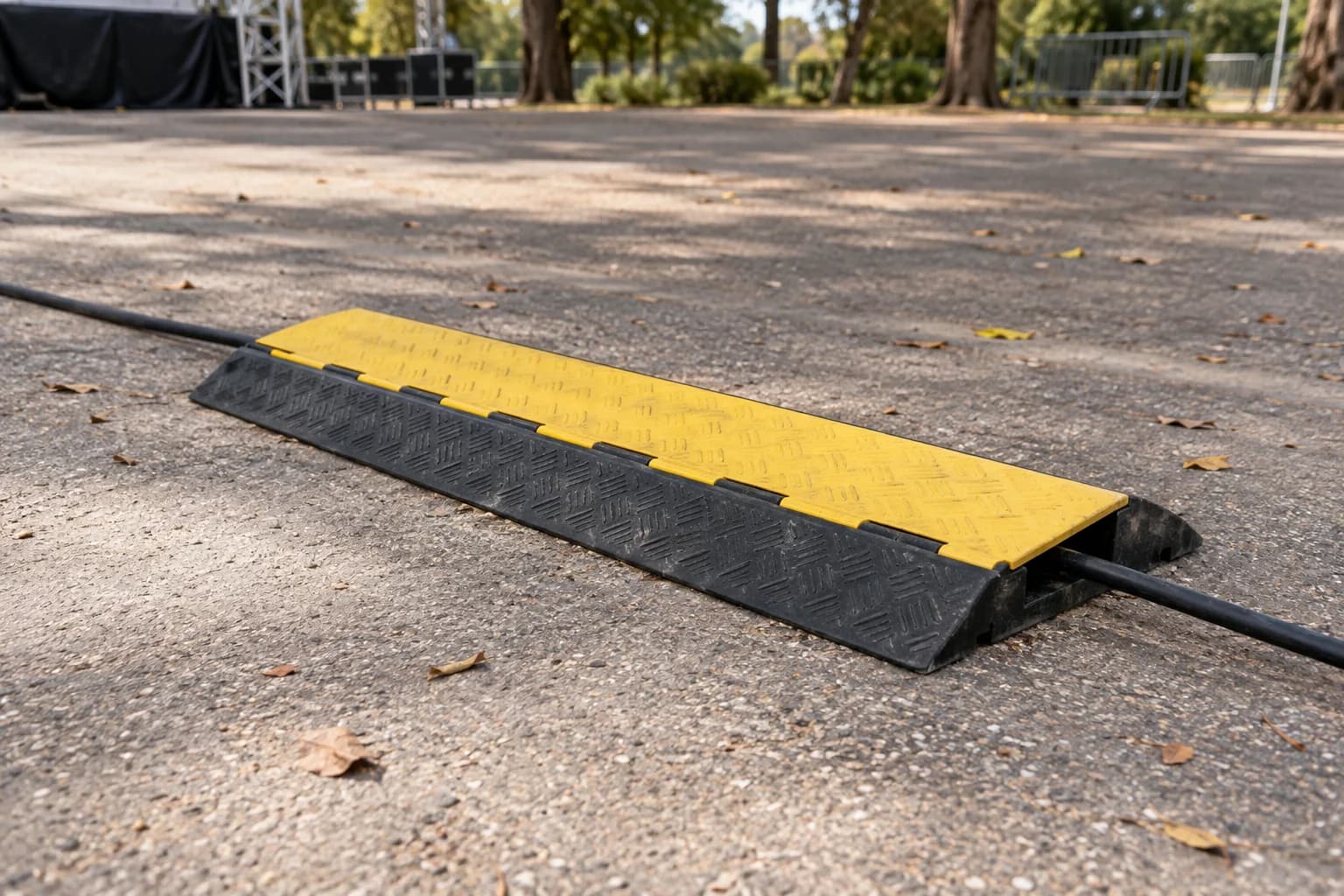
Adding a hypothetical 0.40-inch second line does not authorize sharing the first cable’s channel. Recheck permitted grouping. These invented dimensions explain the process; they are not fitment recommendations for the pictured ramp.
Read the load-rating basis instead of comparing headline weights
Ask whether the stated capacity applies per tire, per axle or to another test arrangement, and which installation and traffic conditions accompany it. Vehicle total weight is not the same as the load delivered by a tire or axle. Turning, braking, narrow wheels, repeated crossings and poor ground support may require separate manufacturer review.
Checkers’ load-capacity explanation says its stated ratings are based on testing an empty protector, so correctly sized lines are protected when the stated limits are observed. Attribute that basis to this manufacturer; do not assume every brand publishes or tests ratings identically. Its product specifications also distinguish per-tire and per-axle values.
A hypothetical 12,000-pound per-axle rating versus a documented 10,500-pound axle load passes only an initial numerical screen. The manufacturer must still accept tires, support and crossing conditions. A pedestrian cover without vehicle approval remains unsuitable for a truck.
Check mobility devices and accessible routing separately
Pedestrians, strollers, wheelchairs, carts and bicycles do not use a crossing in identical ways. Consider approach space, slope, transitions, traction and the ability to follow the intended route. A heavy vehicle rating says little about whether a person using a mobility device can navigate the ramp comfortably and safely.
Checkers offers gentler approach ramps and compatible access accessories. Use the exact documented system. Have the site access lead verify the complete route and applicable requirements; a label on one component does not establish compliance of the assembled crossing.
Protection from traffic is separate from electrical protection
A ramp does not raise cord ampacity, lower voltage drop or convert a connector into a waterproof junction. Continue to check the complete assembly’s voltage, current, conductor arrangement, length and permitted environment. The generator extension cord and cord-size calculator guides address that electrical selection before the protector is added.
Confirm whether covering the cable or grouping lines changes permitted operation under the cord and protector instructions. Keep connections in their approved dry or weather-protected arrangement; an outdoor ramp’s lid is not evidence of a watertight enclosure. Avoid ground routes where water pools, equipment exhaust heats the cable or entry edges abrade it.
OSHA’s construction wiring rules address temporary flexible-cord suitability, damage protection and strain relief. Use the construction-site generator power planning guide for the broader plan, and have responsible electrical and site personnel resolve uncertain applications.
Keep a crossing acceptance and inspection record
Before use, record the ramp part numbers, cable measurements, permitted traffic, rating basis, ground support, connection locations and access arrangement. Install sections, end pieces and accessories according to the exact instructions. Assign someone to maintain the route and prevent traffic outside the approved plan.
Inspect for shifted sections, open lids, debris, damaged hinges, exposed cable and changed conditions. Isolate power before handling cable or correcting an electrical defect. Close the crossing or reroute power when protection no longer matches the site.
- Keep the current protector instructions and documented traffic approval with the site plan.
- Confirm lids close without pinching and supported sections remain in their permitted arrangement.
- Keep connectors and service access clear of the crossing.
- Recheck after rain, deliveries, layout changes or any visible movement or damage.
Frequently asked questions
Common questions
What size cable ramp do I need for a generator cord?
Use the finished cable’s outside diameter and required bend radius, then verify usable channel dimensions and any grouping restrictions. Generator watts and conductor gauge alone cannot establish ramp fit.
Can a car drive over a generator cable protector?
Only if the exact protector and installation are documented for the actual vehicle and crossing conditions. Verify rating basis, tire or axle loads, support and restrictions. A pedestrian cover is not vehicle approval.
Can I place a generator plug inside the ramp?
Only if the manufacturer explicitly supports that connector and arrangement. Connector bodies and strain reliefs can be much larger than the jacket. Keep an unsupported connection out of the crossing rather than leaving the lid open.
Does a cable ramp make the cord weatherproof?
No. Confirm the cord and connection’s own environment ratings and approved weather protection. A hinged traffic protector does not establish a waterproof junction or permission to use the equipment in standing water.
Is every low-profile ramp suitable for wheelchair access?
No. Check the complete documented approach system, transitions and surrounding route with the site access lead. Height or a vehicle load rating alone does not establish a suitable accessible crossing.
Primary references
CordFind summarizes connector specifications and public safety guidance. Always follow the instructions supplied with your equipment.
- Checkers: Understanding load capacities and empty-channel testing basis
- Checkers: YJ2-400-Y/B dimensions and per-tire/per-axle specification example
- Checkers: Pedestrian approach ramps and compatible access accessories
- OSHA: 1926.405 wiring methods, temporary wiring and flexible cords
- CPSC: Portable Generator Hazards, cord routing and outdoor placement