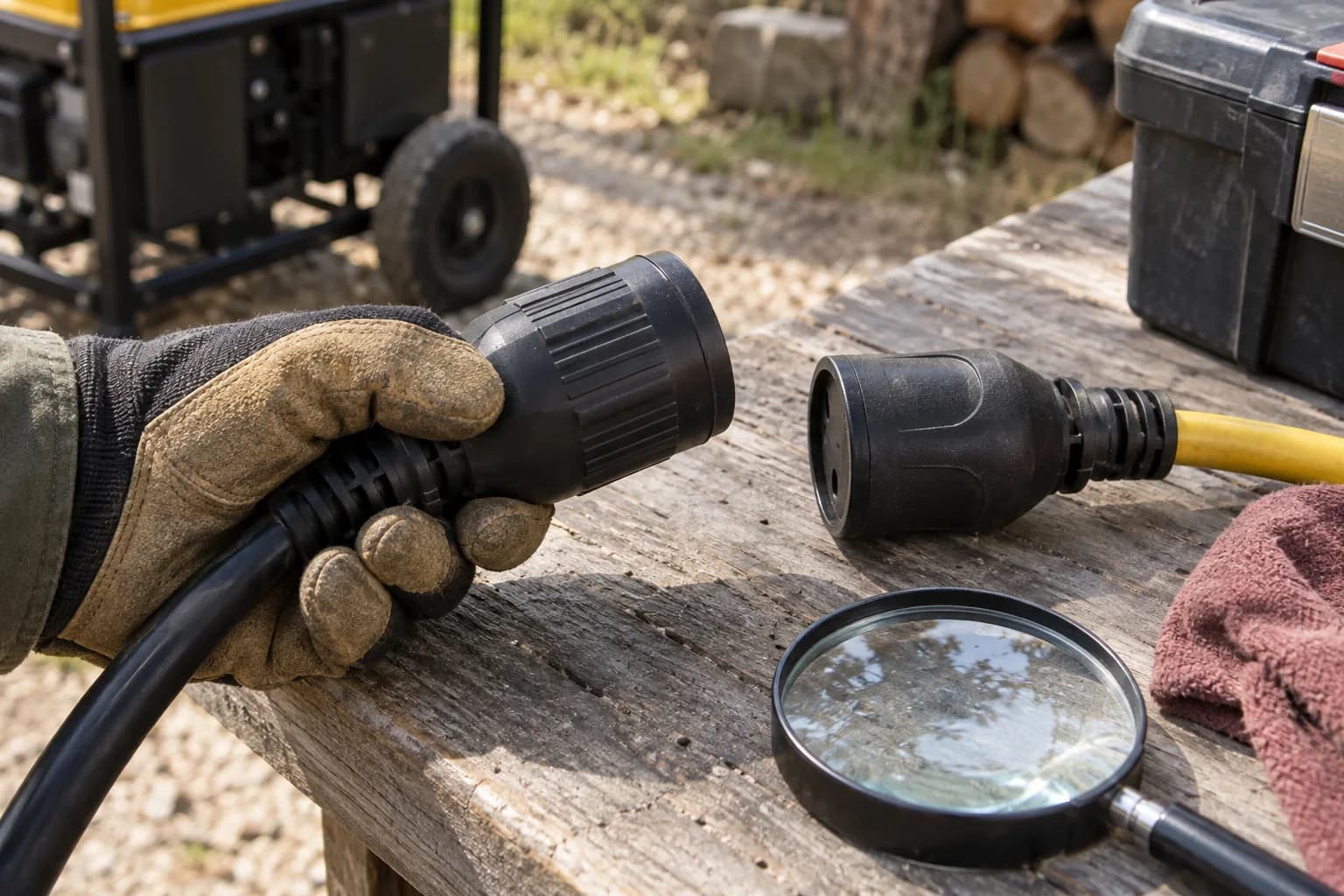
Quick answer
Record the full code, including letters and the P or R suffix. P denotes a plug and R denotes a receptacle. An L prefix identifies a locking family. Then verify voltage, amperage, pole and wire count, grounding, and the destination equipment.
Connector library
Common generator connector families
Use the stamped code first. If the complete label is readable, enter it below. Voltage and wire count narrow candidates but never prove a match by themselves.
L14-30 generator outlet
Manual-transfer home backup and 120/240V distribution equipment.
- Voltage
- 125/250V
- Amperage
- 30A
- Wiring
- 4-wire
L14-20 generator outlet
20A split-phase generators, legacy inlet systems, and matching 125/250V equipment.
- Voltage
- 125/250V
- Amperage
- 20A
- Wiring
- 4-wire
L6-30 250V locking outlet
Verified 240V equipment that does not require a neutral.
- Voltage
- 250V
- Amperage
- 30A
- Wiring
- 3-wire
14-50 generator outlet
Large portable generators, 50A RVs, and matching inlet equipment.
- Voltage
- 125/250V
- Amperage
- 50A
- Wiring
- 4-wire
CS-family 50A locking outlet
Heavy-duty generator cords, temporary distribution, and compatible 50A inlets.
- Voltage
- 125/250V
- Amperage
- 50A
- Wiring
- 4-wire
L5-30 generator outlet
30A, 125V RV adapters, selected-circuit equipment, and listed distribution devices.
- Voltage
- 125V
- Amperage
- 30A
- Wiring
- 3-wire
TT-30 RV outlet
30A travel-trailer shore-power connections.
- Voltage
- 125V
- Amperage
- 30A
- Wiring
- 3-wire
5-20 household-style outlet
Single appliances and listed outdoor extension cords.
- Voltage
- 125V
- Amperage
- 20A
- Wiring
- 3-wire
Read every part of the connector designation
A designation such as L14-30R communicates more than amperage. The family identifies the electrical configuration, 30 identifies the current class, and R identifies the receptacle side.
A matching cord end needs the correct mating designation, not merely the same number of visible blades. Verify the product documentation when labels are worn or unclear.
Common generator connector families
Portable generators frequently include standard 5-15 or 5-20 receptacles for smaller loads and locking connectors such as L5-30 or L14-30 for higher-current applications. Some units include 14-50 receptacles, while RV connections often involve TT-30.
The available receptacle does not automatically mean the generator can supply every load that physically fits. Generator output, breaker ratings, configured voltage, and equipment demand still apply.
Plug and receptacle direction matters
A plug has exposed blades designed to enter a compatible receptacle or connector. A proper cord assembly keeps energized contacts enclosed as intended.
Never use a male-to-male cord. CPSC warns that these backfeed cords can expose energized blades and create electrocution, fire, and carbon-monoxide hazards.
Use photos only as a confirmation step
Connector diagrams help distinguish straight-blade and locking patterns, but perspective and similar shapes can mislead. The stamped NEMA designation and manufacturer documentation should decide the match.
If the label cannot be read, stop. Replacing or professionally identifying a damaged connector is safer than ordering from a visual guess.
Frequently asked questions
Common questions
What do P and R mean on generator plugs?
P identifies a plug and R identifies a receptacle. The complete family code and electrical ratings must also match.
What does L mean in L14-30?
The L prefix identifies a locking connector family.
Can two plugs with the same amperage be connected?
Not necessarily. Voltage, connector family, conductor count, grounding, and intended application must also be compatible.
Primary references
CordFind summarizes connector specifications and public safety guidance. Always follow the instructions supplied with your equipment.
- Leviton — Industrial Wiring Devices Catalog
- CPSC — Male-to-Male Extension Cord Warning