Quick answer
Read the L14-20R marking on the generator outlet and the L14-20P marking on an inlet or source-end plug. The family is rated 20A at 125/250V with two hot conductors, a neutral, and an equipment grounding conductor. Keep the complete connection at the 20 amp source limit even when a listed adapter leads to higher-rated downstream equipment.
Use the L14-20 marking, not the number of blades alone
L14-20 and L14-30 both use four-contact locking layouts, but their blade patterns and current ratings differ. Confirm the full designation molded into the receptacle, plug, connector, or flanged inlet. Do not force a nearly matching device or file, bend, or replace blades to make a connection.
Leviton identifies its L14-20 generator inlet kit as 20A at 125/250V. The wiring configuration provides two hot conductors, a neutral, and an equipment grounding conductor. The system can therefore serve compatible 120V loads across two legs and compatible 240V loads, subject to generator and transfer-equipment limits.
L14-20 and L14-30 share a concept but not a rating or fit
L14-20 is rated 20A, while L14-30 is rated 30A. A building inlet, cord, or adapter with a 30 amp device does not raise the capacity of a 20 amp generator outlet or the conductors and breaker protecting it. The lowest verified rating in the path remains the operating limit.
If a listed L14-20P to L14-30R adapter is considered, label the operating procedure with the 20 amp source limit. Verify that the destination accepts the same 125/250V four-wire configuration and that no operator can mistake the larger connector for additional available power.
| Check | L14-20 | L14-30 |
|---|---|---|
| Current rating | 20A | 30A |
| Voltage family | 125/250V | 125/250V |
| Conductors | Two hots, neutral, ground | Two hots, neutral, ground |
| Direct interchange | No | No |
Check total generator output and per-leg loading
A generator fitted with L14-20R may have less continuous output than the connector arithmetic suggests, and the rating may be shared with other receptacles. Read the generator nameplate, selected-fuel rating, output breaker, manual, and any voltage-selector instructions before planning loads.
When supplying mixed 120V loads, record which leg serves each load. A balanced operating plan avoids placing nearly all 120V demand on one leg while the other remains lightly loaded. A 240V load uses both legs, but its starting demand and voltage recovery still need manufacturer review.
Match an L14-20 inlet to approved transfer equipment
A flanged L14-20P inlet can be part of a generator-to-building connection when the inlet, conductors, transfer equipment, protection, source configuration, and selected circuits are designed together. The inlet alone does not provide source isolation and does not approve the panel connection.
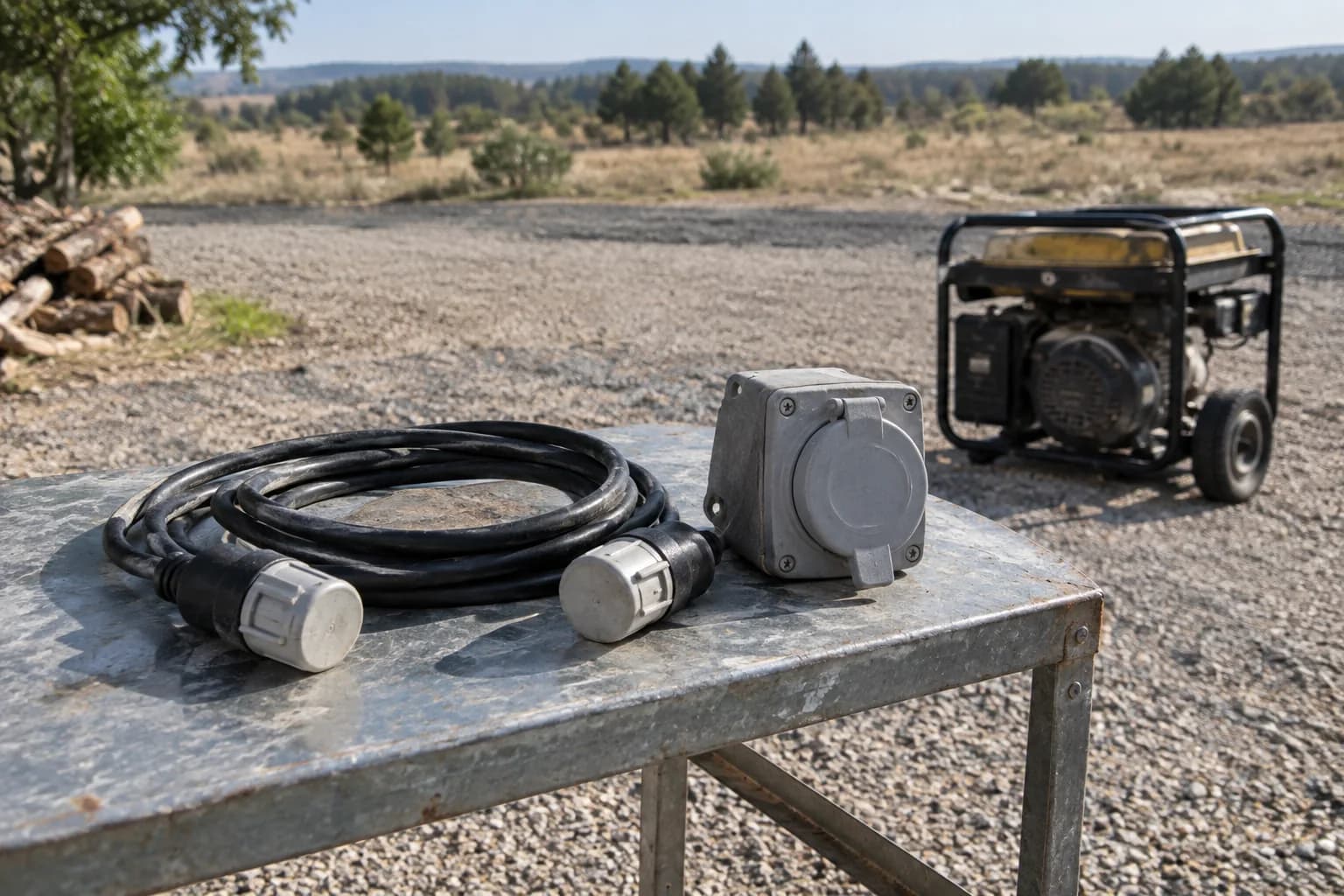
Use a listed cord assembly with an L14-20P at a generator receptacle and the connector required by the inlet. Keep portable-generator placement, cord distance, weather protection, grounding and bonding, neutral treatment, permits, and inspection within the complete installation plan.
Do not replace the receptacle merely to fit a newer cord
Changing an L14-20 receptacle to L14-30 does not upgrade generator windings, breakers, internal conductors, terminals, or available engine power. An unauthorized change can also conflict with the generator listing and create a misleading connection for future users.
If the existing connector is damaged or no longer fits the intended system, use the manufacturer replacement part and service procedure or have the complete equipment path reviewed. A new generator or transfer design may be more appropriate than modifying a legacy interface.
Frequently asked questions
Common questions
Is L14-20 the same as L14-30?
No. Both are locking 125/250V four-wire families, but L14-20 is rated 20A and uses a different pattern from the 30A L14-30 family.
Can I use an L14-20 to L14-30 adapter?
Only a listed adapter for the exact endpoints should be considered, and the entire connection remains limited to the 20 amp source. Confirm the voltage, conductors, transfer equipment, and load plan.
How many watts can an L14-20 outlet supply?
Do not size from connector multiplication alone. Use the generator continuous rating, output breaker, fuel rating, per-leg limit, and manual. The connector is one system limit, not a generator output promise.
Can L14-20 connect a generator to a house?
It can be part of an approved 20 amp 125/250V inlet and transfer system. The building connection still requires compatible transfer equipment, conductors, protection, neutral and grounding review, and qualified installation.
Primary references
CordFind summarizes connector specifications and public safety guidance. Always follow the instructions supplied with your equipment.
- Leviton: L14-20 Generator Inlet Kit 37820-KT
- Leviton: Generator Inlet Box Kits Bulletin
- OSHA: Grounding Requirements for Portable Generators
- CPSC: Male-to-Male Extension Cord Warning