Quick answer
Move a portable unit to its approved outdoor location, disconnect loads, and read the display or fault indicator before clearing it. Follow the exact startup sequence and check fuel, oil level, battery state, valves, switches, output breaker, GFCI, cords, and connected loads using the manual. Attempt only a permitted single reset. Stop for fuel leaks, smoke, arcing, severe vibration, overheating, damaged wiring, repeated trips, abnormal voltage, or a fault that returns. Never increase breaker size or bypass a GFCI, low-oil, carbon-monoxide, or transfer protection.
Make the machine safe before diagnosing it
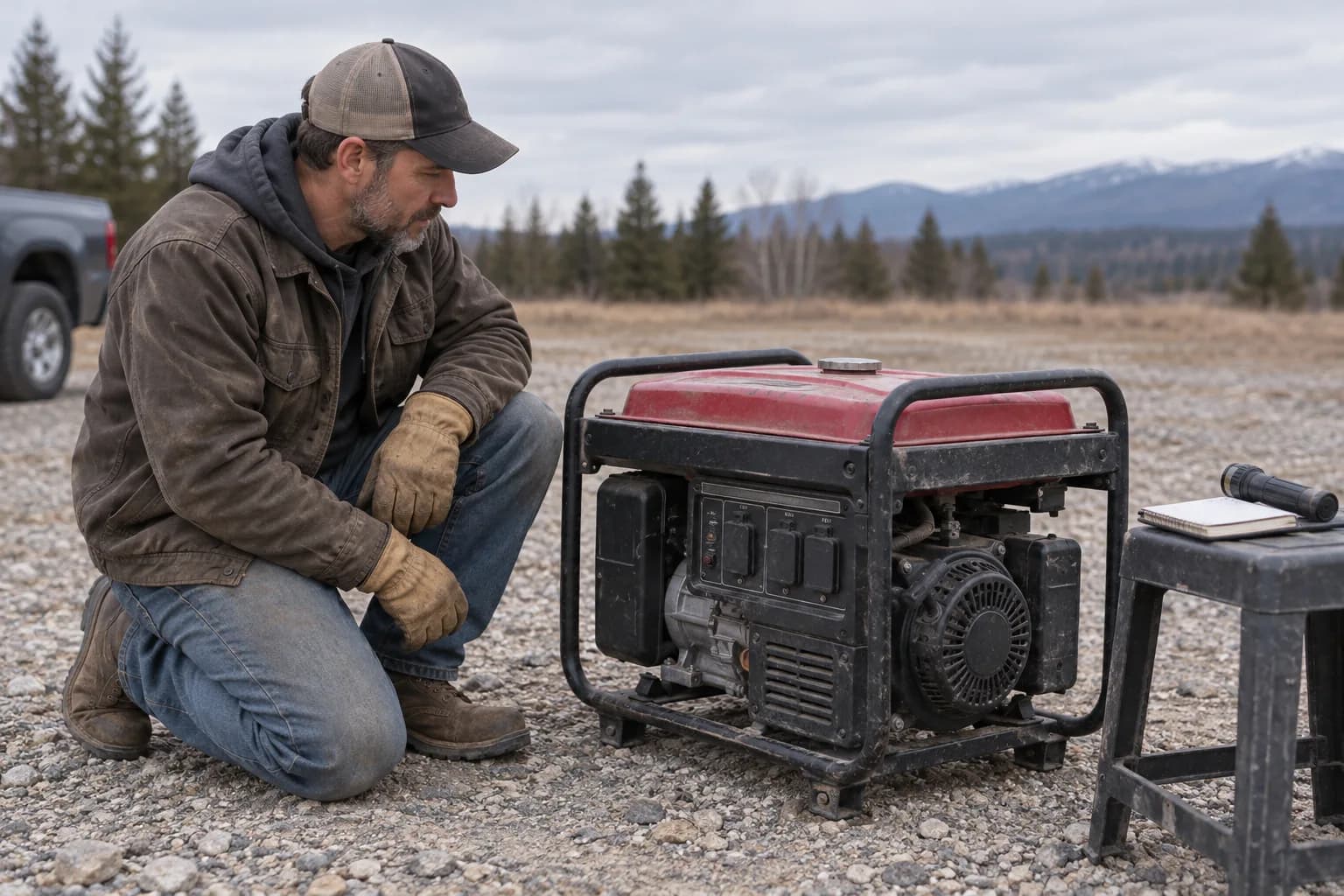
Never run a portable combustion generator indoors for testing. Place it outside at the required distance with exhaust directed away, protect it from wet conditions according to the manual, and keep carbon-monoxide alarms active. Remove electrical loads and note the fuel level, oil level, visible damage, leaks, odor, loose parts, and recent maintenance.
For automatic standby equipment, prevent unintended starting using the manufacturer’s disable procedure before opening any access panel. Transfer equipment can contain utility voltage even when the generator is stopped. Owner checks should remain outside guarded electrical and fuel-system areas unless the manual expressly defines a user procedure.
When the engine will not start
Confirm the manual’s control positions, fuel valve, tank vent, choke or electronic-start procedure, battery connection, and output-breaker position. Check fresh approved fuel and the oil level using the correct dipstick method. A low-oil sensor may prevent running when the unit is tilted or underfilled. Read any carbon-monoxide shutdown or other fault indicator rather than repeatedly pulling or cranking.
If fuel has been stored beyond the model’s procedure, it may be stale or the carburetor may require service. Do not use starting fluid unless the manufacturer expressly approves it. Stop cranking according to the starter duty limit. Fuel leaks, damaged wiring, a hot starter, repeated fuse failure, or an unexplained shutdown require service.
| Symptom | Owner-level checks | Stop and service when |
|---|---|---|
| Will not start | Fault code, controls, approved fuel, oil level, battery, manual sequence | Leak, damage, repeated fault, internal fuel or ignition work |
| Runs, no outlet power | Output breaker, GFCI, one known-good compatible low load | No output after permitted reset, abnormal voltage, internal access needed |
| Breaker or GFCI trips | Disconnect all loads, inspect cords, reconnect one load at a time | Trip repeats, moisture or damage is present, cause is unclear |
| Surges or hunts | Remove load, check fuel age, overload indication, air-filter schedule | Instability persists unloaded or sensitive loads are affected |
| Overload light stays on | Remove every load and use one permitted reset | Alarm returns with no load or output stays off |
| Only runs with choke | Warm-up sequence, fresh fuel, valve, vent and air filter | Warm engine still stalls in run or fuel work is internal |
| Bogs down under load | Running load, largest start, fuel, vent and air path | Small verified load causes bogging or output becomes abnormal |
| One leg has no power | External selector, breaker, cord and transfer indicators | Partial building power or any live equipment access |
| Low-oil warning returns | Level surface, exact oil-check method, correct oil and leaks | Level is correct, alarm repeats, smoke or leakage appears |
| Backfires or afterfires | Record timing, fuel, choke, load and shutdown sequence | Fuel odor, flame, smoke, damage or recurrence |
| Overheats or shuts down | Load, airflow, oil, ambient limits, maintenance status | Smoke, severe heat, blocked internal cooling, repeated shutdown |
When the engine runs but outlets have no power
Disconnect and switch off every load. Check whether the generator output breaker is open and whether an accessible GFCI has tripped. Follow the manual for one reset. Inspect the cord and device before connecting a single known-good, compatible low load. Confirm that any economy, voltage-selector, or receptacle control is in the approved position for the test.
If the breaker or GFCI trips again, do not hold it on, replace it with a larger device, or bypass it. The cause may be overload, a ground fault, moisture, damaged equipment, incorrect neutral behavior, or an internal fault. A running engine does not prove correct voltage or frequency.
Surging, low power, and unstable output need a load-free comparison
Remove the load and observe whether the engine and indicators stabilize. If they do, add verified loads one at a time and compare the total with continuous and starting ratings. A motor start, overloaded outlet, long undersized cord, or wrong voltage can cause a problem even when total marketing watts appear sufficient.
If instability remains with no load, review fuel freshness, fuel selection, tank vent, air-filter condition, altitude settings, temperature, maintenance, and any error code. Do not connect sensitive electronics until output quality is verified. Carburetor, governor, inverter-module, alternator, and regulator diagnosis requires the service information and appropriate instruments.
A standby failure may be outside the generator engine
An automatic system can fail to start, fail to transfer, shed a load, or retransfer unexpectedly. Record controller status, utility condition, exercise history, battery age, fuel availability, transfer-switch indicators, and the exact time of the event. Do not manually operate transfer contacts unless the manufacturer procedure and qualified role allow it.
Keep fault history intact for the service technician. Note whether the generator started, whether its breaker was closed, whether some circuits received power, and whether the problem ended when utility returned. This separates engine, generator output, transfer, load-management, and building-circuit symptoms without opening energized equipment.
Turn a one-time fix into a readiness record
After resolving a permitted owner-level issue, document the symptom, fault code, weather, fuel, load, running hours, action, and result. Complete overdue maintenance and perform the model’s approved functional test. A reset that makes the light disappear is not a diagnosis if the condition returns.
Schedule qualified service for repeated faults, abnormal output, transfer problems, fuel or exhaust damage, insulation damage, internal electrical work, or any condition the manual marks for a dealer. Keep the generator unavailable until the safety boundary is restored.
Frequently asked questions
Common questions
Why is my generator running but not producing power?
Possible causes include an open output breaker, tripped GFCI, load or cord fault, incorrect control setting, or an internal output problem. Disconnect loads, follow one permitted reset, and arrange service if output does not return.
Why will my generator not start after storage?
Check the manual sequence, approved fresh fuel, oil level, battery, valves, switches, and fault indicators. Stale fuel or internal fuel-system service may require qualified work.
Can I replace a generator breaker with a larger one?
No. The breaker protects conductors and equipment. A repeated trip requires load, cord, ground-fault, moisture, and equipment diagnosis.
When should I stop troubleshooting?
Stop for leaks, smoke, arcing, severe vibration, overheating, damaged wiring, repeated protection trips, abnormal voltage, transfer-equipment work, or any step requiring guarded internal access.
Primary references
CordFind summarizes connector specifications and public safety guidance. Always follow the instructions supplied with your equipment.
- Generac: Portable Generator FAQ and Troubleshooting
- Honda: Generator Operation
- Briggs & Stratton: Loss of Generator Power Troubleshooting
- CPSC: Generators and Engine-Driven Tools