Quick answer
Use only listed distribution equipment whose input configuration and ratings match the generator and whose outputs match the loads. Confirm feeder protection, conductor ratings, grounding continuity, GFCI requirements, environment rating, cable routing, and load balance. Temporary construction wiring must be installed, inspected, and removed under the applicable rules; uncertain designs need a qualified electrical professional.
What a generator distribution box actually does
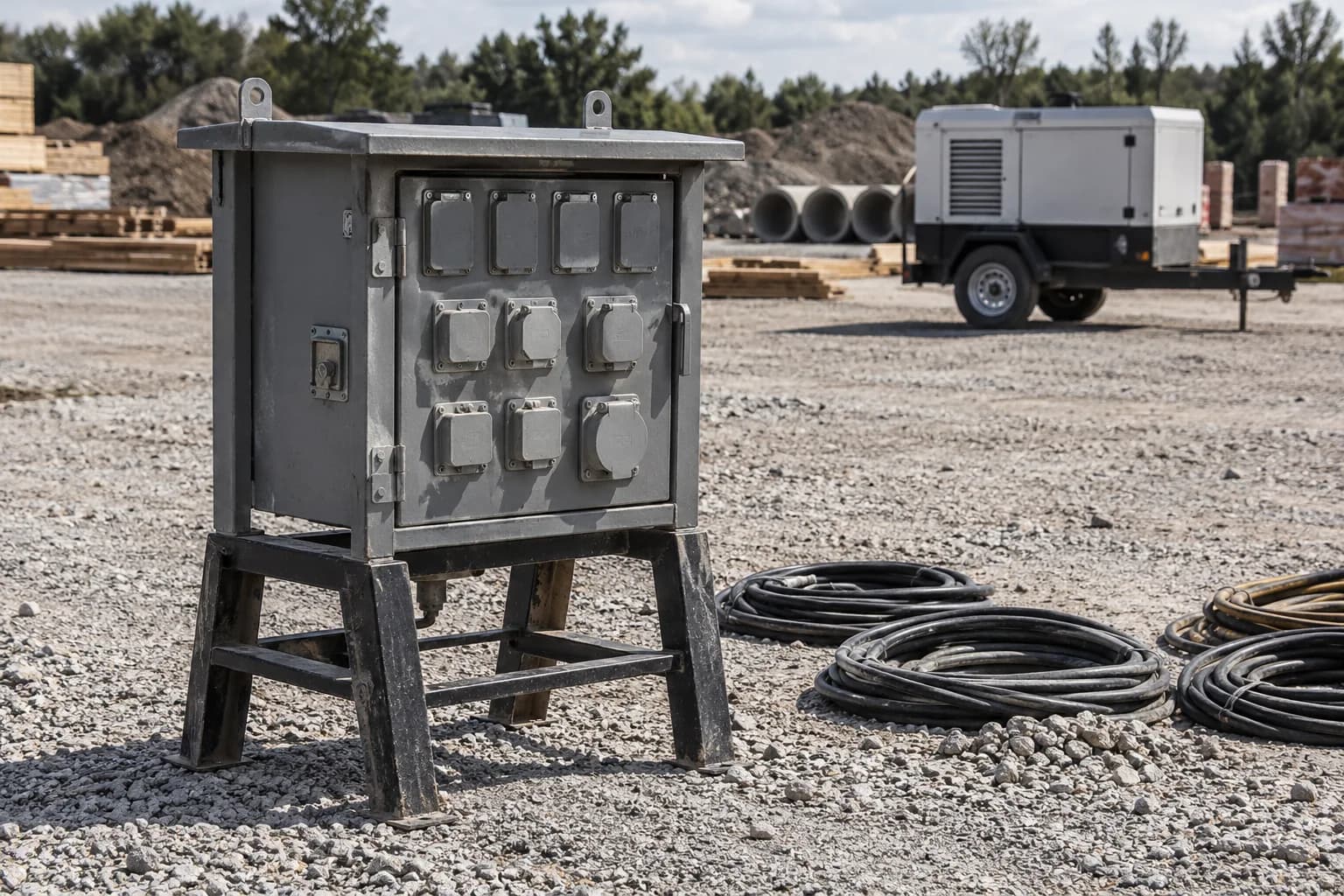
A portable distribution box, sometimes called a spider box, provides several protected outlets from one compatible feeder. It can improve cable organization and place connection points near work areas, but the total usable power remains limited by the generator, the source outlet, the feeder, and the box input. Six receptacles on a box do not create six independent generator supplies.
Treat the system as a chain. Record the generator output voltage, phase, frequency, neutral and grounding arrangement, receptacle or terminal configuration, and overcurrent rating. Then record the feeder assembly, distribution box input, every branch outlet, and the connected equipment. The lowest applicable electrical rating controls that part of the system.
| Stage | Record | Reason |
|---|---|---|
| Generator source | Rated voltage, phase, amps, frequency, neutral and bonding information | Defines the supply the distribution system must accept |
| Feeder | Connector, conductor count, amp rating, length, jacket and listing | Carries the combined downstream load |
| Distribution box | Input rating, outlet ratings, breakers, GFCI and environment rating | Divides power into protected branch connections |
| Final loads | Running amps, starting demand, voltage, duty cycle and location | Determines capacity, balance and branch assignments |
Match voltage, phase and conductors before connector shape
A plug that appears to fit is not enough. A distribution box intended for a 120/208-volt three-phase source is not interchangeable with a 120/240-volt single-phase source. A four-wire assembly can serve different systems depending on its listing and configuration. Confirm the complete designations and the equipment diagrams instead of inferring the circuit from conductor count or color alone.
Some mobile generators offer several selectable output arrangements or terminal connections. Changing those settings changes available voltage and current. Only trained and authorized personnel should configure equipment or make feeder terminations. Lockout, shutdown, verification, and manufacturer procedures apply before opening guarded connection areas.
- Use the generator nameplate and connection diagram
- Use the feeder assembly label, not a visual estimate of cable size
- Confirm the box input voltage, phase, amperage and wiring diagram
- Do not modify connectors to bridge incompatible systems
Coordinate overcurrent and ground-fault protection
The source breaker, feeder rating, box input protection, branch breakers, receptacle ratings, and final cords must work together. An upstream breaker does not automatically provide the right protection for every smaller downstream conductor. Likewise, a downstream breaker cannot correct an undersized feeder or an incompatible source connection.
OSHA construction rules require ground-fault protection for specified temporary receptacle circuits through GFCIs or an assured equipment grounding conductor program that meets the standard. The choice is not a casual field substitution. Document which method applies, test at the required intervals, and keep the records and competent-person responsibilities the selected program requires.
Build a branch schedule and balance the source
List every load by operating voltage, running current, starting current, duty cycle, and expected overlap. Assign each load to a specific branch. For multi-leg or three-phase supplies, review current on each line rather than relying only on total kilowatts. A poorly balanced set of single-phase loads can overload one leg while the arithmetic total still appears acceptable.
Motor starting, welders, battery chargers, variable-frequency drives, lighting drivers, and other nonlinear or intermittent loads can affect voltage stability and generator sizing. Use manufacturer application data for these loads. Leave a documented operating reserve and define which noncritical loads must be shed if measured current, voltage, or frequency moves outside the plan.
Inspect the temporary system as conditions change
Protect cables from vehicles, sharp edges, water, heat, pinching, and physical damage. Close unused covers, support connections so cable weight does not strain devices, and keep boxes in the orientation and environment permitted by their instructions. Temporary wiring must be removed when the construction or purpose for which it was installed is complete.
Before each shift or use, look for damaged jackets, loose hardware, missing grounding features, heat discoloration, water entry, nuisance trips, and altered labels. Stop using damaged equipment. Recalculate the plan after adding a tool, moving a box, extending a feeder, changing a generator setting, or replacing a connector.
Frequently asked questions
Common questions
Can a generator power distribution box increase available amperage?
No. It divides the source into branch connections. Generator, outlet, feeder, box, and protection ratings still limit the total and each branch.
Can I connect a spider box to any 50 amp generator outlet?
No. Confirm the complete source and input configurations, including voltage, phase, conductors, grounding, and the listed connector designations. An amperage label alone does not establish compatibility.
Does every jobsite distribution box need GFCI protection?
Applicable construction rules require GFCI protection or a compliant assured equipment grounding conductor program for specified circuits. The exact system must be planned and administered under the governing rule.
How many tools can one distribution box run?
That depends on source capacity, branch ratings, running and starting current, duty cycle, phase balance, feeder voltage drop, and which tools operate together. Count loads, not receptacles.
Primary references
CordFind summarizes connector specifications and public safety guidance. Always follow the instructions supplied with your equipment.
- OSHA 1926.404: Wiring Design and Protection
- OSHA 1926.405: Wiring Methods, Components, and Equipment
- OSHA: Construction Electrical Incidents eTool
- Caterpillar: Rental Power Planner