Quick answer
Create a verified load list and operating sequence, classify the required generator duty, and have the manufacturer or qualified designer model motor starting, nonlinear loads, voltage dip, frequency response, site derating, and future growth. Scope transfer equipment, fuel, permits, emissions, placement, maintenance, testing, monitoring, and redundancy before comparing purchase prices.
Translate business continuity into an electrical scope
List the operations that must continue during a utility interruption and the maximum acceptable outage for each one. Life-safety systems, refrigeration, process controls, communications, sump or fire pumps, security, lighting, HVAC, elevators, and customer systems can have different priorities and code requirements. Separate mandatory loads from business-preferred loads and deferrable loads.
Define the outage scenarios. A short utility interruption, a multi-day regional outage, scheduled service, and an off-grid prime-power application are not the same design problem. The scope should say whether the system must start automatically, whether a brief interruption is acceptable, which loads may be sequenced, and what happens after the first generator or fuel source fails.
Use the generator rating that matches the operating duty
Manufacturers publish distinct standby, prime, and continuous ratings with different permitted operating profiles. A standby rating is generally intended for emergency use while reliable utility power is unavailable. Prime and continuous applications have different load and hour assumptions. The project specification should name the applicable manufacturer rating and operating limits rather than using only an advertised maximum output.
Ambient temperature, altitude, fuel properties, ventilation restrictions, and accessory loads can reduce available capacity. Include jacket-water heaters, battery chargers, cooling fans, enclosure effects, and other parasitic loads when the manufacturer requires them. Record the rating basis so future operators know why a nominal nameplate and the usable project capacity may differ.
| Decision | Inputs | Output to document |
|---|---|---|
| Capacity | Running loads, starts, sequence, power factor, harmonics, derating | Selected set and modeled performance |
| Transfer | Utility service, critical circuits, transition needs, fault duty | Transfer topology, ratings and sequence |
| Fuel | Load profile, outage duration, storage rules, delivery resilience | Usable quantity, runtime and refill plan |
| Resilience | Downtime tolerance, maintenance windows, single points of failure | Redundancy and load-shed strategy |
Model the loads that challenge generator performance
Large motors can cause voltage and frequency dip while starting. Fire pumps, compressors, elevators, chillers, pumps, and across-the-line starts may control generator selection even when their running kilowatts are modest. Starting method, locked-rotor current, allowable voltage dip, acceleration time, and the other loads already online all matter.
Variable-frequency drives, uninterruptible power supplies, server power supplies, LED drivers, and chargers can create nonlinear current and harmonic effects. Cummins application guidance emphasizes load characteristics and transient performance in generator selection. Supply a detailed load schedule to the manufacturer sizing tool or application engineer and retain the resulting report in the project record.
Scope the complete standby system, not only the engine-generator
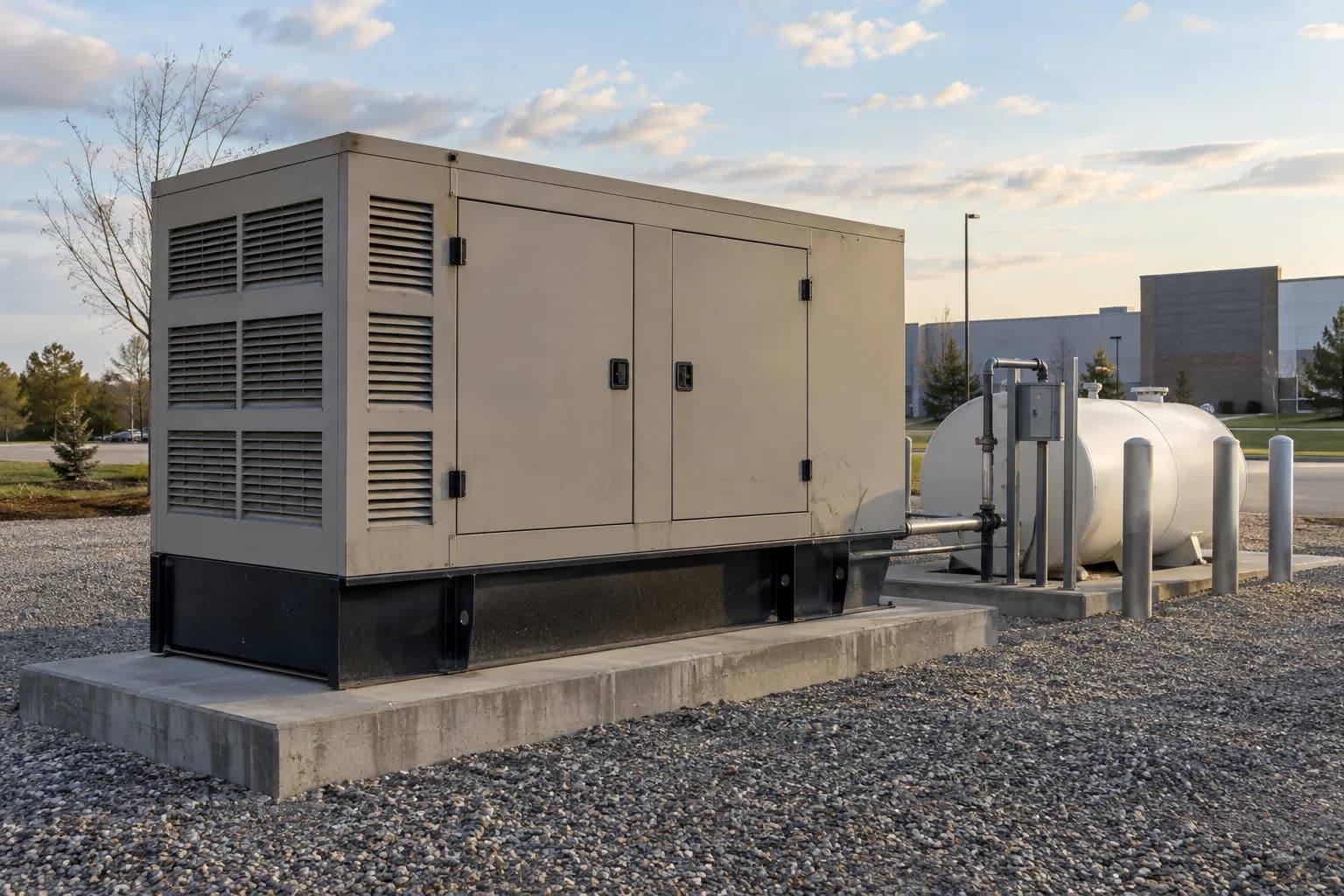
A commercial project can include automatic transfer switches, paralleling controls, switchgear, selective coordination, grounding and bonding, remote annunciation, ventilation, exhaust, starting batteries, chargers, heaters, fuel storage, leak detection, fire protection, security, sound attenuation, weather enclosures, pads, fencing, communications, and load-bank connections. Each item affects space, cost, permitting, and maintainability.
Transfer design must match the utility service, generator system, available fault current, load classification, and operational needs. Closed-transition, bypass-isolation, service-entrance, and multiple-transfer arrangements require project-specific engineering and utility or authority coordination. Do not reduce the decision to an amp rating alone.
Compare lifecycle readiness and total project cost
Compare bids using a common scope that includes design, permits, site work, equipment, delivery, installation, fuel system, commissioning, acceptance testing, training, maintenance, monitoring, consumables, warranties, service response, and eventual replacement. A lower equipment price can be misleading when critical accessories or field work are excluded.
Create a testing and maintenance program before turnover. Define exercise conditions, periodic loaded testing, fuel quality management, battery replacement, alarms, recordkeeping, spare parts, and responsible personnel. Test the actual transfer sequence and staged loads where permitted. Business continuity depends on evidence that the whole system works, not only on an engine exercise timer.
Frequently asked questions
Common questions
How is a commercial generator sized?
From verified loads, operating sequence, motor starting, power factor, nonlinear load effects, allowable voltage and frequency dip, duty rating, environmental derating, reserve, and future plans. Square footage alone is not enough.
What is the difference between standby and prime generator ratings?
They describe different permitted operating duties and limits. Use the exact manufacturer definitions and select the rating that matches the planned source availability, load profile, and hours.
Should a business back up every load?
Not necessarily. Classify required, critical, optional, and deferrable loads, then compare full backup with sequencing and load shedding. Code-required loads remain subject to their specific rules.
What costs are commonly missed in a commercial generator quote?
Design, permits, utility coordination, transfer gear, switchgear changes, fuel systems, civil work, sound or emissions controls, delivery, commissioning, testing, monitoring, training, and maintenance are common scope gaps.
Primary references
CordFind summarizes connector specifications and public safety guidance. Always follow the instructions supplied with your equipment.
- Cummins: Generator Set Application Manual
- Cummins: Gas Power Plant Application Manual
- Caterpillar: Rental Power Planner
- U.S. Department of Energy: Business Owners Prepare for Utility Disruptions