Quick answer
List the loads that must run together, enter exact running demand and additional starting demand, then verify voltage, phase, frequency and transfer arrangement. The worksheet uses simultaneous running watts plus the single largest additional start and a visible reserve. If motors can start together or the configuration is uncertain, stop for an agricultural electrical review.
Rank loads by animal, water, product and process consequences
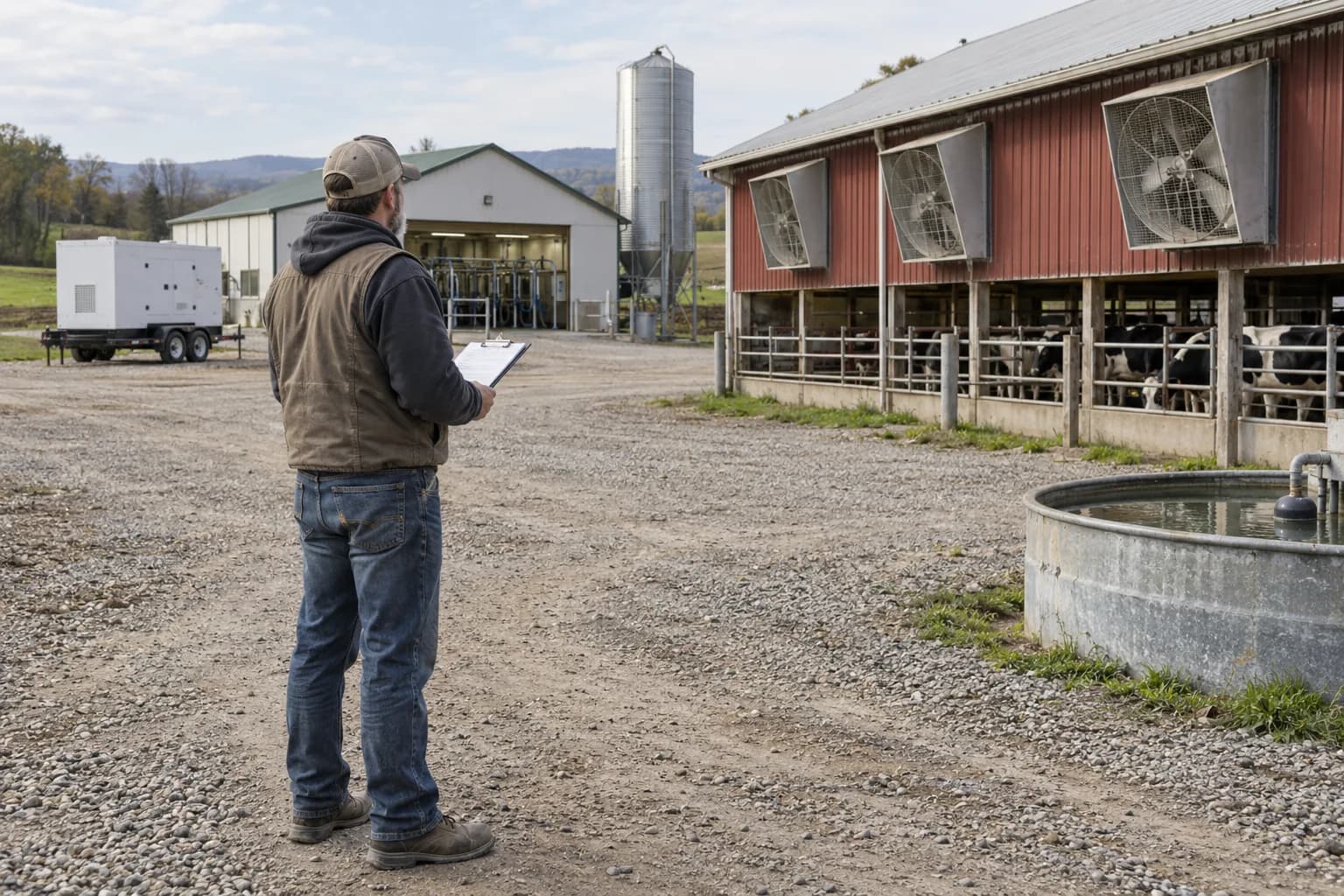
Identify which ventilation, heating controls, well pumps, watering, milking, milk cooling, refrigeration, feeding, manure handling, communications and lighting loads are time-critical. Record how long each process can be interrupted and which loads truly operate together.
A scheduled plan can be smaller and more reliable than an assumption that every connected device runs at once, but sequencing must reflect real controls and staffing. Do not defer a load whose interruption could harm animals, compromise water or ventilation, or damage stored product.
A PTO generator also requires a match to the tractor PTO power and shaft speed. Complete that mechanical check separately before using this electrical load plan.
Capture motor and controller starting behavior
Use equipment nameplates, manuals, controller records, measured starting data or supplier documentation. Record voltage, phase, frequency, running current or watts, starting current or additional starting watts, power factor when applicable and the actual start sequence.
The calculator adds the largest entered additional start to the simultaneous running load. That method is not valid when two motors can start together, a process controller creates a different sequence or voltage dip limits are stricter than generator wattage.
Match voltage, phase, frequency and distribution
A watt total cannot repair a 120V, 120/240V split-phase or three-phase mismatch. Confirm each critical load and the generator output configuration, including per-leg limits, phase balance, frequency and the transfer or temporary-distribution design.
Have a qualified agricultural electrician review grounding, neutral treatment, motor protection, transfer equipment, conductor routing, environmental exposure and connection procedures. Keep the operating sequence at the transfer location.
Test the plan under a controlled representative load
Commission the installed or temporary system with the responsible electrician and equipment operators. Observe voltage, frequency, motor acceleration, controller alarms, phase balance, fuel operation and the real load sequence. Stop for abnormal sound, heat, odor, smoke, unstable output or protection operation.
Repeat readiness checks on a documented schedule and after material equipment changes. Update the worksheet when a pump, fan, cooler, control or generator is replaced.
Frequently asked questions
Common questions
What size generator does a farm need?
There is no reliable farm-wide default. Total the critical simultaneous running loads, document starting behavior, match voltage and phase, apply the planned reserve and verify the transfer and distribution design.
Should every farm motor be added at starting watts?
Use the actual sequence. If only one motor starts while the others run, the largest additional start may be a useful screen. If multiple motors can start together, use their documented combined event.
Can a single-phase generator run a three-phase farm load?
Not directly. Wattage alone does not make the configurations compatible. Use equipment and distribution designed and reviewed for the required voltage and phase.
Can the planner approve a livestock emergency system?
No. It is an arithmetic and documentation screen. Animal-critical operations need a site-specific electrical, operational and emergency review.
Primary references
CordFind summarizes connector specifications and public safety guidance. Always follow the instructions supplied with your equipment.
- NDSU Extension: Standby Electric Generators
- Virginia Cooperative Extension: Standby Generators for the Farm
- University of Florida IFAS: Auxiliary Power for Greenhouses
- University of Kentucky: Livestock Systems Generator Resources
- Ontario: Farm Generators for Emergency Use