Quick answer
Use the tractor’s documented PTO horsepower at the required operating speed, not its engine-horsepower headline. Match the exact generator model’s PTO input RPM, shaft and driveline specifications, mounting instructions, electrical voltage and phase, rated output and starting performance. Keep tractor PTO speed separate from generator rotor speed. Have the mechanical setup and the electrical connection reviewed, then commission the actual load sequence. An approximate HP-per-kW rule is only a screening relationship.
Find the tractor’s PTO output rather than using its engine badge
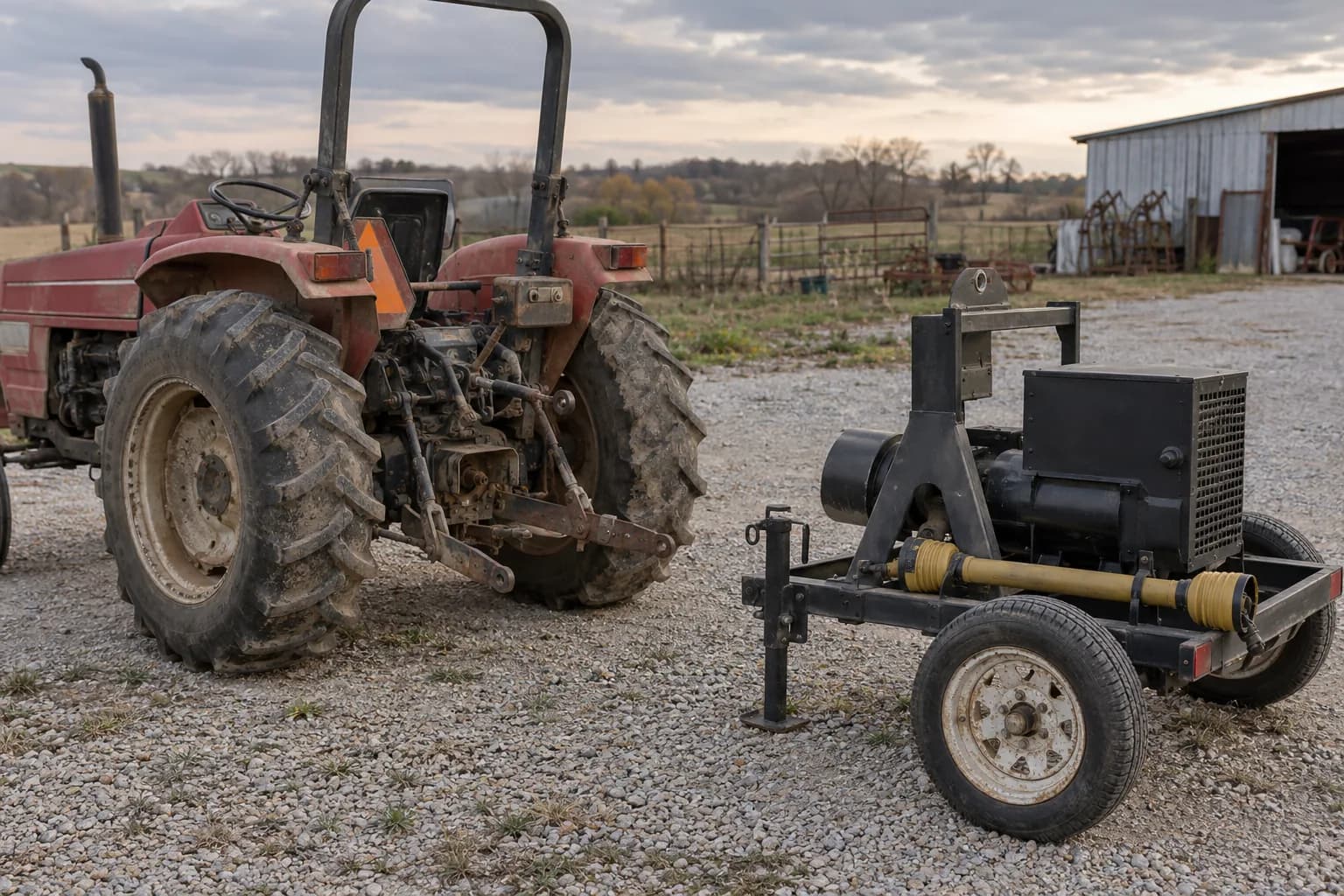
PTO means power take-off: the tractor supplies mechanical rotation to a separate generator through a shaft and drive system. Engine horsepower is a rating at the engine; PTO horsepower is available at the take-off under its stated conditions. Do not apply a guessed percentage to turn one into the other. Use the tractor specification, applicable test report and dealer confirmation for the exact model and configuration.
The Nebraska Tractor Test Laboratory distinguishes PTO performance at rated engine speed from performance at standard PTO speed. That distinction matters when a tractor offers more than one operating mode. Record which mode delivers the required shaft speed and what power is available there; an economy-PTO setting is not automatically suitable for the same electrical load.
Also decide whether the tractor will be available during the outage. A single machine assigned to feeding, snow removal or other essential work cannot perform those jobs while it remains committed to stationary generation. Put that conflict in the operating plan before treating an existing tractor as a free standby engine.
PTO input RPM and generator rotor RPM describe different parts
The mechanical path is tractor PTO → guarded driveline → generator gearbox → alternator rotor. A gearbox can change shaft speed. The tractor tachometer, the PTO input specification and the alternator speed therefore are not three names for the same reading.
For example, WINCO’s archived W10PTO support listing gives a 515-RPM PTO input. Its W10PTOS operator manual gives 3,600-RPM generator speed. The separate SP-190/B sheet for a W70PTO-3 540-RPM unit specifies 540-RPM PTO input and 1,800-RPM generator speed. These document examples demonstrate the distinction; they are not an instruction to run every PTO generator at 515, 540 or 1,000 RPM.
Match the rating plate and current manual for the actual serial range. Confirm the tractor engine setting needed to obtain the required PTO speed, and use the specified generator indicators and qualified measurements to verify voltage and frequency under load. Do not overspeed the shaft to cure a load problem or adjust the tractor governor from a generic article.
Use the exact document, including its model and revision
A product-family name can hide different voltages, phase systems, shaft speeds and connectors. Keep the generator model, catalog number, serial number and document revision together. If a webpage title and a specification table disagree, stop and obtain the correct sheet from the manufacturer rather than selecting the convenient value.
The examples below are document checks, not a current shopping shortlist. The W10 support page is explicitly archived. The larger sheet’s filename includes W70PTOS-540, while its printed model heading is W70PTO-3 and its revision is SP-190/B. That is why the printed model and document reference are included rather than treating a filename as a complete purchase specification.
| Document / equipment | Rated electrical output | Required tractor PTO power | PTO input speed | Separate generator speed |
|---|---|---|---|---|
| Archived WINCO W10PTO support; W10PTOS manual 60706-241/F | 10,000W; 120/240V single phase | 20 PTO HP | 515 RPM | 3,600 RPM in the operator manual |
| WINCO W70PTO-3, 540-RPM sheet SP-190/B | 69,000W; single phase | 138 PTO HP for full rated output | 540 RPM | 1,800 RPM |
| Your candidate’s exact plate and current sheet | Record kW/kVA, voltage, phase and duty | Copy the stated requirement at the intended duty | Copy the input-speed requirement | Record separately; do not use as the tractor setting |
A horsepower screen cannot approve motor starting
WINCO describes approximately two tractor PTO horsepower per electrical kilowatt as a simplified full-output relationship that includes conversion losses. Use the manufacturer’s stated requirement for the specific unit. Dividing a tractor’s PTO horsepower by two does not establish motor-start capability, allowable voltage dip, phase balance, power quality or suitability for every generator.
As an illustrative document comparison, a tractor documented to deliver 30 PTO HP at the required input speed exceeds the archived W10PTO’s listed 20 PTO HP requirement for full output. It does not meet the larger example’s 138 PTO HP full-output requirement. The first comparison passes only the stated horsepower screen; shaft fit, mounting, electrical demand and load response remain unresolved.
A pump or compressor start can require a large temporary current even when its running demand is small. Submit the actual motor and control information to the generator manufacturer. Keep running watts, apparent power, start current and event duration visible rather than using tractor horsepower as a substitute for the electrical calculation.
Confirm the driveline, mounting and guarded work area
Have a competent equipment professional confirm the shaft connection, spline count and dimensions, driveline speed and power rating, permitted length and overlap, alignment, shields and mounting arrangement. A connector that slides onto the shaft is not enough. Use the instructions for both the tractor and the complete generator mounting kit; do not copy another model’s alignment angle or trailer setup.
OSHA’s agricultural-equipment guidance requires guarding of PTO-driven rotating parts and emphasizes stopping the engine, isolating power and waiting for motion to stop before relevant service. WINCO’s operator instructions also prohibit using a damaged or unshielded driveline and stepping over it while it turns. Keep bystanders, children, loose clothing and access routes out of the operating area.
The tractor engine still produces exhaust and heat. Use an outdoor site that satisfies both manuals, keeps exhaust away from occupied spaces and openings, and supports approved weather protection for electrical equipment. Document parking and movement controls, footing, runoff, fire exposure and access for shutdown. A generator behind a tractor is not a reason to operate the tractor inside a barn.
Match the output to the existing electrical job
Bring the completed farm loads record to this step. The farm generator planner covers livestock, water, ventilation and other load priorities; this page adds the tractor interface. Confirm the required voltage, phase, frequency, motor-start sequence and generator duty. A three-phase generator with the wrong voltage is not rescued by having enough kilowatts.
For a building connection, the electrician must select approved transfer equipment and coordinate conductors, overcurrent protection, neutral bonding and grounding for the generator and premises. Hardwired, high-current or reconfigurable output requires qualified work. Do not assume the same grounding arrangement fits both direct cord-connected loads and a building transfer system.
Read outlet and terminal ratings separately from total generator output. The ability to make tens of kilowatts does not place that capacity at every receptacle. Use a documented distribution and protection plan; a larger adapter does not add voltage, a neutral or circuit capacity.
Build one matching record before requesting a quote
Use the table as a procurement and verification record. Enter an actual value or an unresolved question in each row. Ask the tractor dealer, generator supplier and electrical installer to resolve their portions of the same record so a sales answer about kilowatts is not mistaken for mechanical or installation approval.
For a used generator, retain the original model identity, repair history, mounting parts and manuals. Price missing guards or an uncertain driveline as work to resolve before operation. An unreadable plate or unexplained modification is a reason to pause the purchase, not permission to select specifications from a similar-looking unit.
| Check | Tractor / site evidence | Generator / system evidence | Who resolves a gap? |
|---|---|---|---|
| Power at required speed | Exact model; documented PTO HP and operating mode | Required PTO HP for rated duty and expected load | Tractor dealer and generator supplier |
| Speed and mechanical interface | PTO speed setting, shaft and guarding details | Input RPM, compatible rated driveline, mount and shields | Qualified equipment professional |
| Electrical output | Load-record voltage, phase, starts and priority | Exact output configuration, rated capacity and transient limits | Generator manufacturer and electrical designer |
| Source isolation and protection | Premises/temporary-power scope and local requirements | Approved transfer, neutral, grounding and distribution plan | Qualified electrician and applicable authority |
| Operating site and people | Tractor availability, outdoor site and supervised work area | Manual clearances, shutdown access and environmental limits | Owner/operator with professional review |
| Acceptance and upkeep | Representative load sequence and operator handoff | Commissioning results, gearbox service and inspection intervals | Installer/service provider and assigned operator |
Commission the pairing with the loads it must actually start
Arrange a controlled acceptance test through the equipment and electrical professionals. Record the tractor mode, generator input speed and output indications, site conditions, running load, each planned motor start, protective operation and recovery. A no-load reading confirms less than a test that starts the required pump while other essential loads are running. A load-bank test may answer a separate capacity question, but it does not automatically test every real motor or the premises transfer path.
Give the operator a documented startup, loading and shutdown sequence drawn from the applicable manuals and installed system. Stop for shaft chatter, movement, damaged guards, abnormal frequency or voltage, overheating, repeated trips or exhaust exposure. Do not reach toward a moving driveline or open live terminals to investigate.
Finally, separate upkeep by component: tractor engine and PTO, generator gearbox and alternator, driveline and guards, and transfer/distribution equipment. The engine-powered generator break-in routine belongs to the relevant engine product; it is not a universal operating schedule for a PTO alternator. Keep each service interval and unresolved defect with the matching record.
Frequently asked questions
Common questions
How much tractor horsepower does a PTO generator need?
Use the exact generator’s required horsepower at the tractor PTO, at the specified input speed. WINCO’s approximate two-PTO-HP-per-kW relationship is a simplified full-output screen, not a universal compatibility rule or a motor-starting guarantee. Engine horsepower is not the PTO rating.
Does every PTO generator run at 540 RPM?
No. Follow the model plate and applicable manual. The archived WINCO W10PTO example specifies 515-RPM input; other units specify different speeds such as 540 or 1,000 RPM. Generator rotor speed is a separate value after the gearbox.
Can a smaller tractor run a larger PTO generator at a light load?
Do not assume it can from the light running-watt total alone. Ask both manufacturers whether the proposed pairing and load sequence are permitted, considering speed control, starting events and the mechanical interface. It cannot be claimed to deliver full rated output when the stated PTO-power requirement is unmet.
Can a PTO generator power farm buildings or a house?
Only through an electrical system designed and installed for the source, load and premises. Confirm voltage and phase, approved transfer equipment, conductors, protection, neutral and grounding. Do not connect it to a household receptacle or energize wiring without source isolation.
Is a PTO generator maintained like a portable gasoline generator?
The service tasks are divided among the tractor, PTO driveline, generator gearbox/alternator and electrical installation. Use each component’s instructions. A generic portable-generator engine oil or break-in schedule does not describe maintenance of the PTO generator assembly.
Primary references
CordFind summarizes connector specifications and public safety guidance. Always follow the instructions supplied with your equipment.
- WINCO: Archived W10PTO 120/240V Single-Phase 515-RPM Model Support
- WINCO: W10PTOS and W15PTOS Operator Manual 60706-241/F
- WINCO: W70PTO-3 540-RPM Specification Sheet SP-190/B
- WINCO: PTO Horsepower Conversion Limits in 27PTO Product Guidance
- University of Nebraska Tractor Test Laboratory: PTO Performance at Rated and Standard Speeds
- OSHA: Agricultural PTO and Farm Equipment Guarding, 1928.57
- Cummins: T-030 Application Manual, Electrical Load and Motor-Starting Requirements