Quick answer
Disconnect every load, keep the generator dry and outdoors, and reset the GFCI only once if the manual permits it. If it holds with no loads, reconnect one inspected compatible cord and load at a time. If the trip follows a cord or appliance, remove that item from service. If it occurs with no loads or only through a transfer system, stop and have the generator neutral configuration, switched-neutral requirements, cord, inlet and transfer equipment reviewed together. Never remove the GFCI or change a neutral-ground bond from a generic instruction.
Identify whether the GFCI or the overcurrent breaker opened
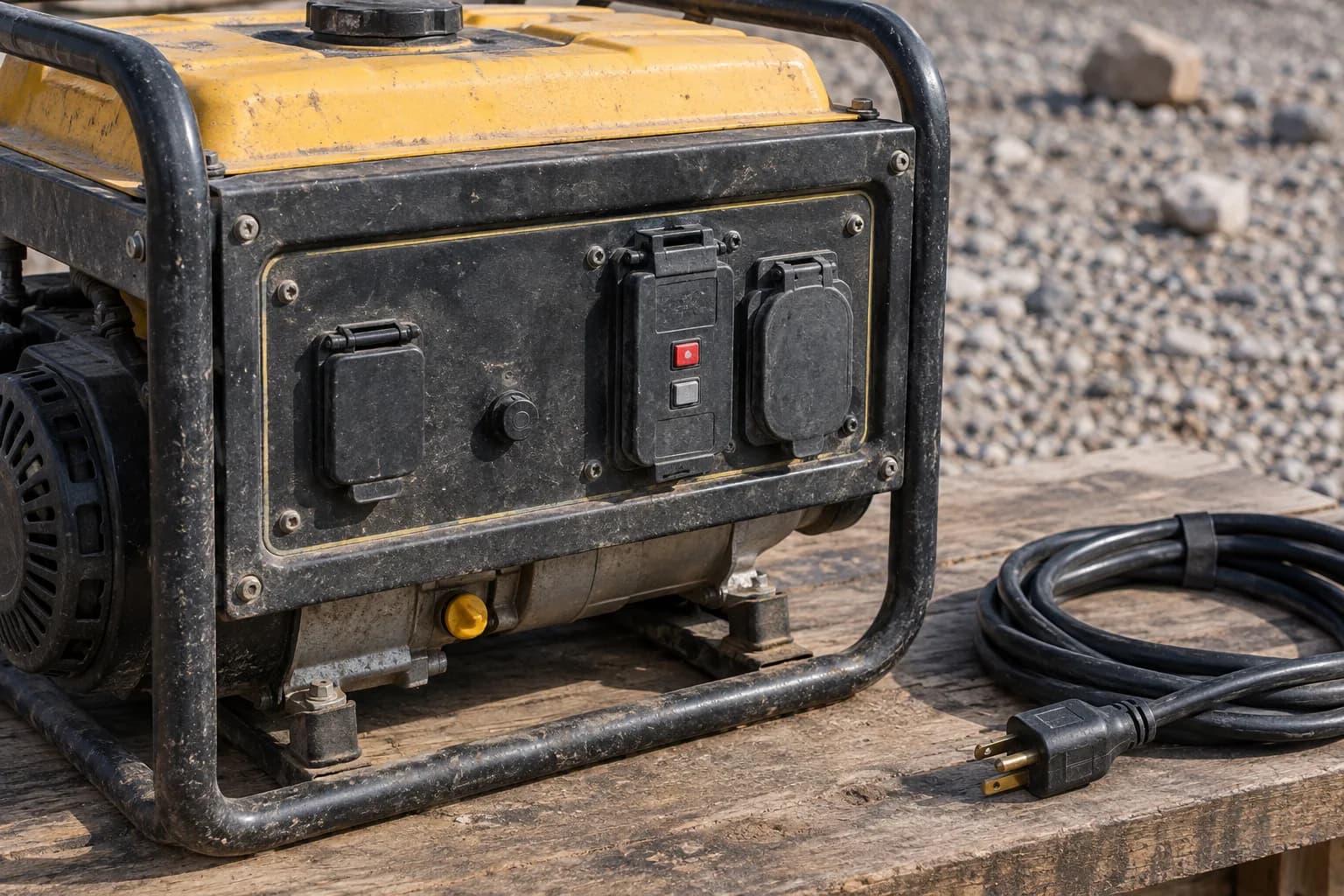
Read the label beside the device that opened. A receptacle TEST and RESET mechanism, a GFCI-marked breaker, and a standard output breaker do not report the same condition. Record which device opened, which outlet was used, whether the trip was immediate or delayed, and what equipment was connected at that moment.
Do not assume that a small load rules out a ground-fault condition. Damaged insulation, moisture, a faulty appliance, a neutral-to-ground path or a transfer-system configuration can create an imbalance without exceeding the generator’s normal ampere rating. Conversely, a standard breaker trip during a motor start may be an overload rather than a GFCI event.
| Trip pattern | Safe observation | Required response |
|---|---|---|
| Trips with nothing connected | Confirm every cord and transfer path is disconnected | Stop after one permitted reset and arrange service |
| Trips when one cord is added | Remove and inspect that cord without energizing it | Keep damaged or wet equipment out of service |
| Trips when one appliance starts | Verify the appliance and cord on an approved source | Service the load or connection if the trip follows it |
| Trips only at house connection | Record generator bond label and transfer-switch documentation | Qualified system-level neutral and transfer review |
Reconnect one dry, inspected load at a time
With the engine stopped as required by the manual, remove all extension cords, adapters and transfer connections. Inspect plug faces, jackets and connected equipment for water, contamination, crushing, cuts, loose parts, heat damage or missing grounding features. Do not dry or repair energized equipment.
If the manual permits a restart and reset, operate the generator outdoors with no load. Add one known-good compatible load and cord at a time. When the trip follows an item, label it and remove it from service. Do not keep changing outlets until one happens to hold, because that can conceal the fault path.
A transfer connection makes neutral treatment a system question
Some generators have the neutral bonded to the frame, while others use a floating neutral. Some transfer equipment switches the neutral, and some does not. Manufacturer documents show that certain combinations of a bonded-neutral generator and transfer equipment can produce nuisance GFCI tripping unless the system is designed for that configuration.
The correct response is not automatically to remove a bond. Changing the generator may affect jobsite compliance, warranty, labeling and safe use away from the house. A qualified person must review the generator manual, transfer-switch instructions, service bonding point, inlet, cord and intended operating modes as one system.
Do not replace protection with a non-GFCI device to make the trip disappear
A repeated trip is evidence that the connected system needs diagnosis. Removing the GFCI, installing a larger breaker, lifting the equipment grounding conductor, using a ground-lift adapter or altering a neutral connection can expose people to shock and can conflict with the generator listing and intended use.
If the generator is used both for direct cord-and-plug loads and for building backup, the safe configuration may depend on the mode of use and approved transfer equipment. Document those modes before any service change, and have the final arrangement labeled and tested.
Commission the complete path after the cause is corrected
A qualified final test should cover no-load operation, each intended receptacle, the actual cord and inlet path, transfer operation, representative loads and the GFCI test function. Record whether the generator neutral is bonded or floating and whether the transfer equipment switches the neutral.
Keep this record with the generator and transfer instructions. Future users should not have to infer the configuration during an outage, and a replacement generator should not be connected until its neutral and GFCI requirements are checked against the installed system.
Frequently asked questions
Common questions
Why does my generator GFCI trip with a small load?
GFCI protection responds to current imbalance, not only total load. Moisture, insulation damage, an appliance fault, a cord problem or an unintended neutral-to-ground path can trip it below the outlet ampere rating.
Why does the GFCI trip only when I connect the generator to my house?
The generator neutral configuration and transfer equipment may create a path that the GFCI detects. Stop and have the complete generator, cord, inlet, neutral and transfer arrangement reviewed.
Can I replace the generator GFCI with a normal outlet?
Do not remove or bypass listed protection to make a trip disappear. Diagnose the fault and follow the manufacturer’s approved configuration.
Should a bonded-neutral generator be converted to floating neutral?
Not from a generic rule. The answer depends on the generator design, instructions, transfer method, service bonding, jobsite use, warranty and local requirements.
Primary references
CordFind summarizes connector specifications and public safety guidance. Always follow the instructions supplied with your equipment.
- Generac: Manual Transfer Switch Installation Guidelines
- Generac: HomeLink Manual Transfer Switch Owner’s Manual
- OSHA: Portable Generator Safety QuickCard
- OSHA: Grounding Requirements for Portable Generators