Quick answer
Identify the complete receptacle code. L14-30 is a 30A, 125/250V locking, four-wire grounding configuration. TT-30 is a 30A, 125V travel-trailer configuration. L5-30 is a 30A, 125V locking configuration. These are not interchangeable.
Three common 30A families serve different systems
L14-30 uses a locking pattern and provides a 125/250V, three-pole, four-wire grounding configuration. It is common on portable generators and power inlets designed for split-phase service.
TT-30 is a straight-blade 125V travel-trailer configuration. L5-30 is a 125V locking configuration. Matching only the 30A number can therefore produce the wrong voltage or conductor arrangement.
Check the plug and connector at both ends
A generator cord commonly has a plug marked P at the source end and a connector marked R at the destination end, but the actual system may use a flanged inlet or another approved device. Record every label before selecting a cord.
Adapters should identify both the source and destination configurations. An adapter cannot create a neutral conductor, change equipment voltage requirements, or make an unsafe installation acceptable.
Product to compare
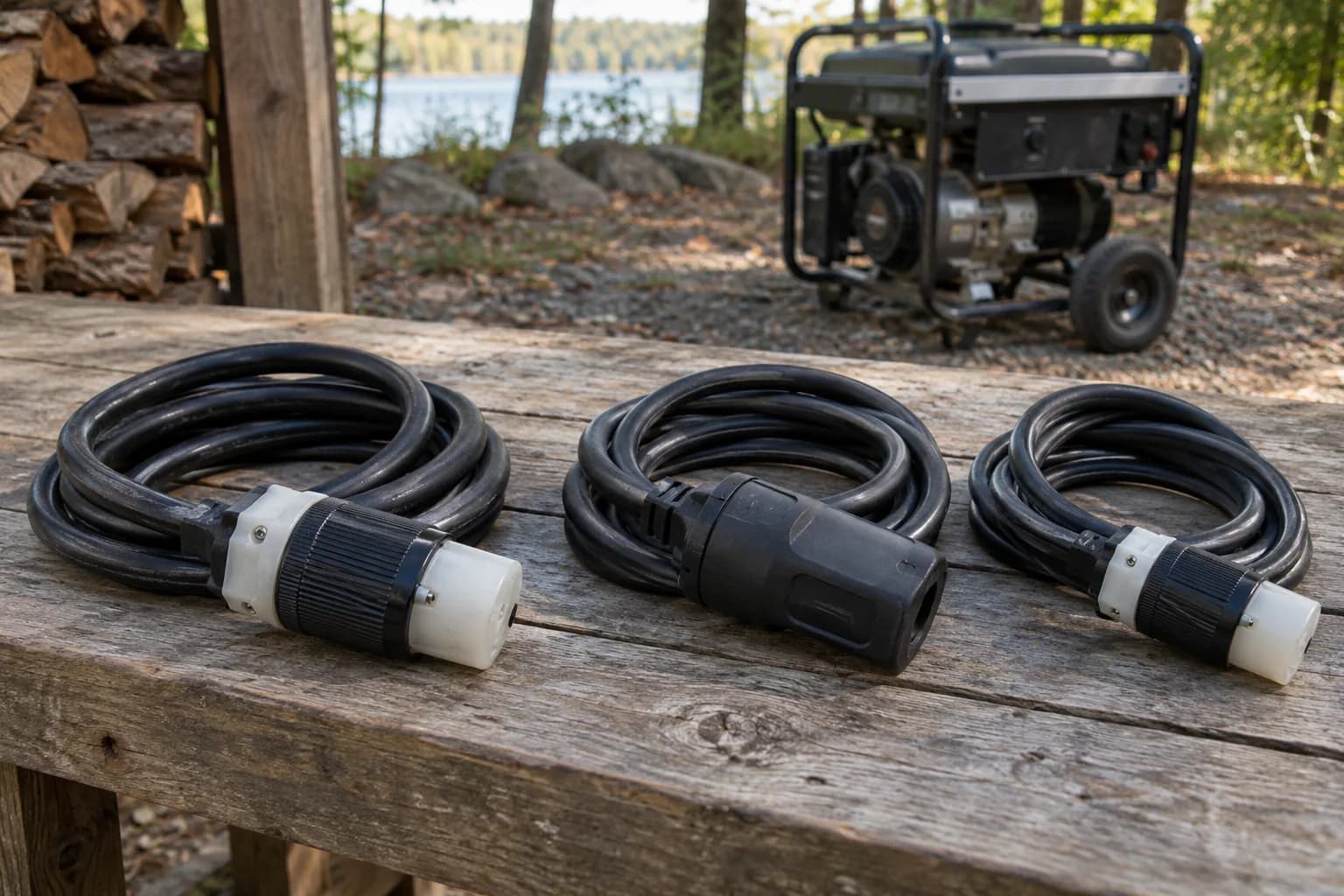
Amazon · paid linksWEN PC3025 — 25 ft L14-30 generator cord
Compare this cord after confirming an L14-30R generator outlet and a matching L14-30P destination. Read both endpoint labels before choosing a cable.
- L14-30P → L14-30R
- 25 ft
- 10/4 SJTW
- 30A · manufacturer 250V rating
Amazon product code (ASIN): B0C86KSLYX
See the current price and available sellers on Amazon.
Advantages
- Locking L14-30 connections at both ends.
- Four-conductor 10/4 cable for this connector family.
- SJTW jacket specified for outdoor use.
Limitations
- A 25 ft length may not cover your cable route.
- Does not fit TT-30 or L5-30 equipment.
- A building connection still needs the correct inlet and transfer equipment.
Check before buying: Does not fit TT-30 or L5-30 equipment. Building connections also require the correct inlet, transfer equipment, and a site-specific electrical review.
Based on manufacturer specifications; not independently field-tested by CordFind. Confirm the model and both connector labels before buying.
Select length after the configuration is correct
The cord needs enough reach to keep a portable generator outdoors and away from occupied structures. At the same time, longer conductors increase voltage drop, especially under high or starting loads.
Choose a listed cord assembly with clearly stated ratings. For long runs, uncertain loads, or building connections, get a qualified review instead of relying on a generic length chart.
A 30A inlet cord is only one part of a house connection
An L14-30 cord may connect a compatible generator receptacle to a power inlet, but the building also needs approved transfer equipment that prevents utility and generator sources from being connected incorrectly.
Never connect a generator to a household receptacle. Male-to-male backfeed cords expose energized pins and can energize utility lines.
Frequently asked questions
Common questions
Are L14-30 and TT-30 the same?
No. L14-30 is a 125/250V locking four-wire configuration; TT-30 is a 125V travel-trailer configuration.
Can I use an adapter between two 30 amp plugs?
Only if the adapter is specifically designed and listed for the two systems and the electrical requirements remain compatible. Equal amperage alone is not enough.
Is every 30 amp generator cord 10 gauge?
Do not assume a gauge from amperage alone. Check the complete cord assembly listing, conductor count, length, temperature and environment ratings, and manufacturer instructions.
Primary references
CordFind summarizes connector specifications and public safety guidance. Always follow the instructions supplied with your equipment.
- Leviton — L14-30R Product 2710
- Leviton — 20A & 30A Locking Device Instructions
- CPSC — Male-to-Male Extension Cord Warning