Quick answer
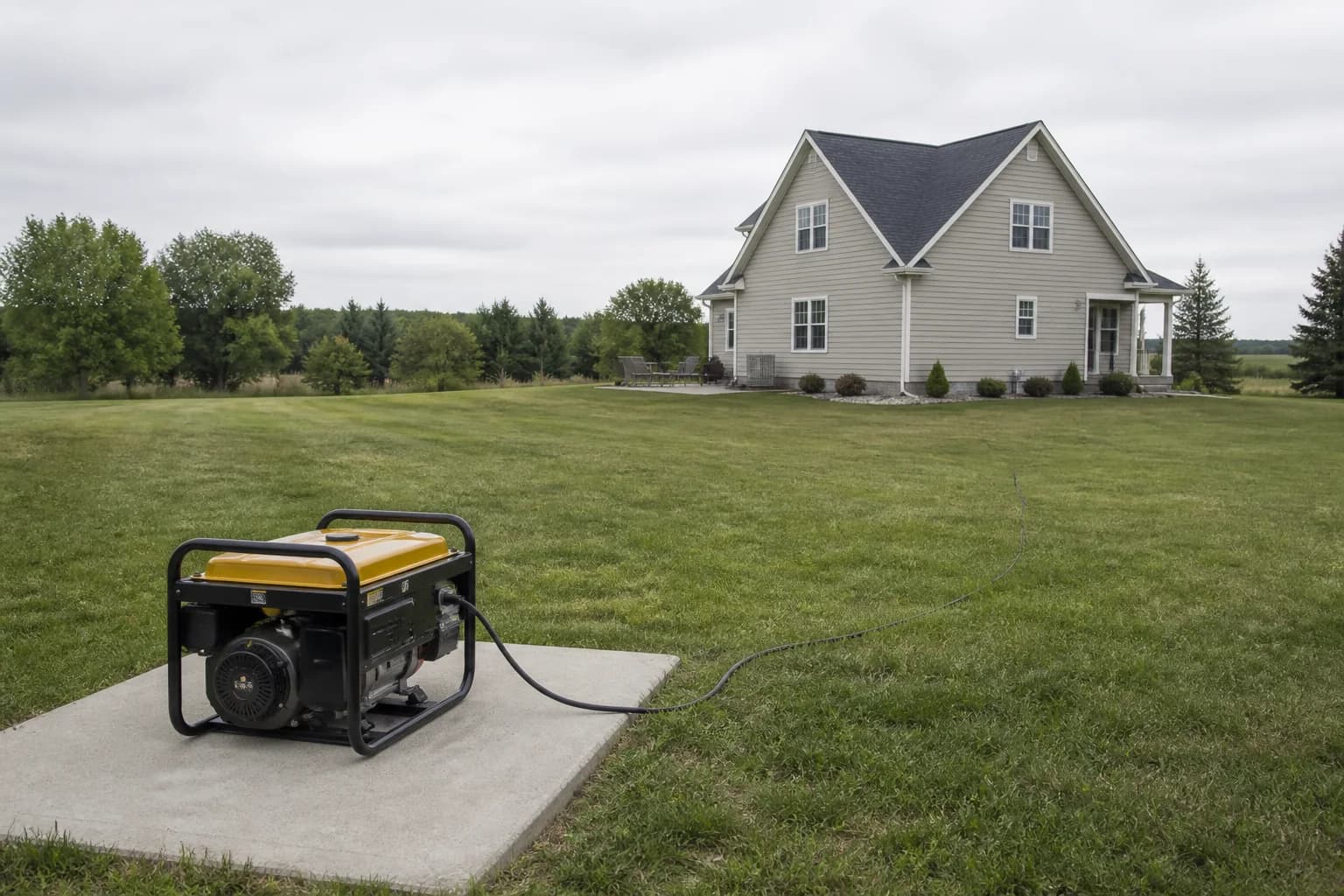
For a portable generator, CPSC guidance says to operate it outside only, at least 20 feet from the home, with exhaust directed away from the home and other buildings. A standby generator must follow its exact installation manual and the requirements accepted by the local authority having jurisdiction. Never substitute a generic online distance for either rule set.
Portable and standby clearances solve different risks
Portable generators are temporary engine-driven products that are moved into position for an outage, job, or recreational use. Their placement has to control carbon monoxide exposure, fire, electrical hazards, weather, and cord routing. CPSC’s consumer baseline is at least 20 feet from the home with the exhaust facing away.
A standby generator is permanently installed as part of a listed system. Its clearances can depend on the exact enclosure, output, fuel, wall construction, nearby openings, service panels, vegetation, property boundaries, and local requirements. Use the model-specific installation manual and an approved site plan rather than transferring portable-generator advice to a standby installation.
| Generator use | Primary placement source | Do not substitute |
|---|---|---|
| Portable generator | CPSC safety guidance plus the owner’s manual | A shorter product-advertising distance |
| Permanent standby generator | Exact installation manual, site plan, permits, and local authority | A generic portable-generator article |
| RV onboard generator | Vehicle and generator manufacturer installation instructions | Residential setback guidance |
Check the complete portable-generator location
Measure from the building, not only from one window. Look for doors, windows, soffit or foundation vents, crawlspace openings, neighboring structures, and any location where exhaust could collect or re-enter. Direct the exhaust away from buildings and keep windows and doors closed along the exhaust path.
Place the generator on a stable surface in an open outdoor area. Keep it away from combustible storage, dry vegetation, standing water, traffic, and locations where a cord can be crushed. Weather protection must follow the manufacturer’s instructions and cannot turn the location into an enclosed or partially enclosed space.
- At least 20 feet from the home for portable operation
- Exhaust pointed away from the home and other occupiable buildings
- No garage, shed, basement, crawlspace, porch, or partially enclosed area
- Working carbon-monoxide alarms on every level and outside sleeping areas
A standby-generator site review includes more than the wall distance
The installer should document the generator model, proposed pad, service and maintenance access, intake and discharge zones, nearby doors and windows, utility equipment, fuel routing, drainage, roof runoff, snow or flood exposure, and required protection from vehicles. The exact installation manual remains the controlling product document.
Local permits and inspection can add requirements based on adopted codes, zoning, fire separation, fuel-gas rules, easements, and property lines. “Code distance” is therefore not a single national number that can be safely copied without the product and jurisdiction.
Stop when the site cannot preserve the safety envelope
Do not move a portable generator closer to the house because the cord is short. Select an approved connection plan that supports safe placement. Do not use an exhaust hose, open garage door, box fan, or cracked window as a substitute for outdoor distance.
If the only available location is near an opening, under an overhang, inside a structure, exposed to flooding, or in conflict with the owner’s manual, do not operate there. Re-plan the location with the equipment manufacturer, installer, or local authority.
Frequently asked questions
Common questions
How far should a portable generator be from a house?
CPSC guidance says at least 20 feet from the home, outside only, with exhaust directed away from the home and other buildings. Also follow the generator owner’s manual.
Is there one generator distance-from-house code for every installation?
No. Portable safety guidance and permanent standby installation requirements are different. Standby clearances are model-, site-, and jurisdiction-specific.
Can I run a generator in a shed with the doors open?
No. CPSC guidance says never operate a portable generator in a shed or other enclosed or partially enclosed area.
Can I place a generator closer if the exhaust points away?
Exhaust direction is only one control. It does not replace the recommended outdoor distance, the owner’s manual, clearances, weather protection, and local requirements.
Primary references
CordFind summarizes connector specifications and public safety guidance. Always follow the instructions supplied with your equipment.
- CPSC — Carbon Monoxide Safety Center
- Honda — Generator Operation and Outdoor Space
- Generac — Product Information and Installation Manuals