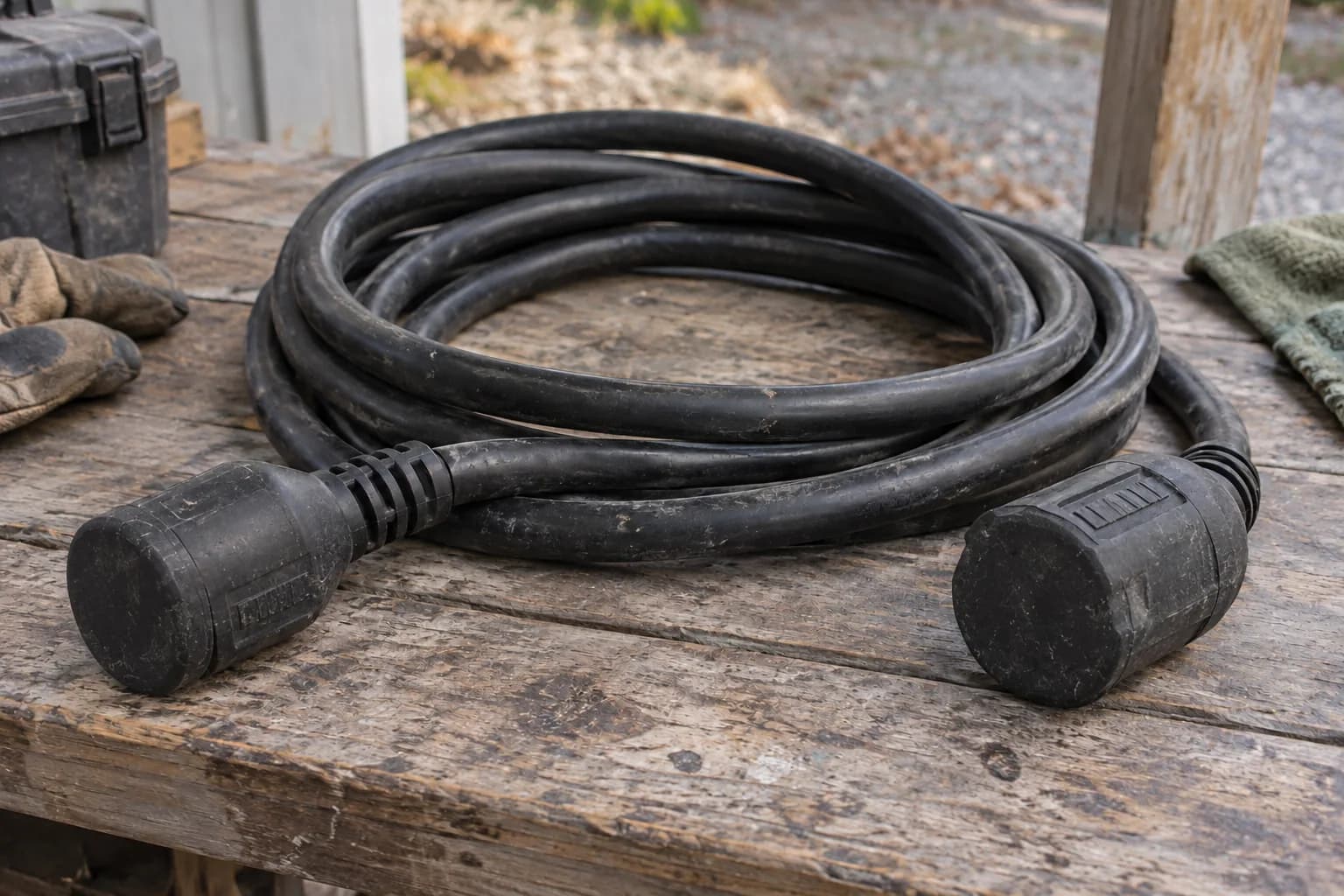
Quick answer
Match both connector designations first, then confirm that the complete cord assembly is rated for the required voltage and at least the expected current. Use grounded, intact, outdoor-rated equipment where required. A cord intended for a power inlet is not a substitute for a properly installed transfer system.
Match the connector before comparing cord length
Read the stamped designation beside the generator receptacle. Codes such as L14-30R, TT-30R, 14-50R, and 5-20R describe different electrical configurations. Similar amperage labels do not make two connectors interchangeable.
The suffix P normally identifies a plug and R identifies a receptacle. A typical cord assembly may place a plug at the generator end and a connector at the load or inlet end, but the required arrangement depends on the actual equipment. Never choose from photos alone.
- Record the generator receptacle designation.
- Record the destination inlet or appliance plug.
- Confirm voltage, amperage, grounding, and conductor count.
- Reject any product whose full configuration is not clearly stated.
Cord rating must cover the intended load
The cord assembly must be rated for the circuit and expected load. Do not treat the generator’s maximum marketing wattage as the only input; check the receptacle rating, connected equipment, surge requirements, and the generator manufacturer’s instructions.
Heavier-duty does not mean universally compatible. A higher-amp cord cannot correct the wrong connector, wrong voltage, missing conductor, or unsafe connection method.
Use the shortest suitable run
Longer cords add resistance and voltage drop. Motors, compressors, pumps, and other starting loads can be more sensitive than simple resistive loads. If a run is long, review voltage drop and equipment starting requirements instead of choosing by gauge alone.
Keep the generator outdoors and far from doors, windows, vents, and occupied spaces. The cord still needs enough length to support safe generator placement, so the objective is the shortest suitable run—not simply the shortest cord available.
Inspect the complete cord before every use
OSHA guidance calls for inspection of portable cord-and-plug equipment for damaged jackets, missing pins, loose parts, and signs of crushing or pinching. CPSC guidance likewise recommends intact, heavy-duty outdoor cords with ratings above the connected load.
Stop using a cord with cuts, exposed conductors, heat damage, loose connectors, or missing grounding features. Keep connections dry and protected according to the product instructions.
Frequently asked questions
Common questions
Can any heavy-duty extension cord be used with a generator?
No. The connector configuration, voltage, amperage, conductor count, grounding, environment rating, and length all need to suit the generator and connected equipment.
Is a thicker generator cord always better?
A heavier conductor may reduce voltage drop, but it does not solve an incompatible plug, incorrect voltage, missing conductor, or unsafe connection method.
Can a generator cord power a house through a wall outlet?
No. Backfeeding through a household outlet is dangerous. Building wiring requires properly installed transfer equipment and a suitable power inlet.
Primary references
CordFind summarizes connector specifications and public safety guidance. Always follow the instructions supplied with your equipment.
- OSHA — Using Portable Generators Safely
- CPSC — Portable Generator Hazards
- OSHA — Use of Equipment, 1910.334