Quick answer
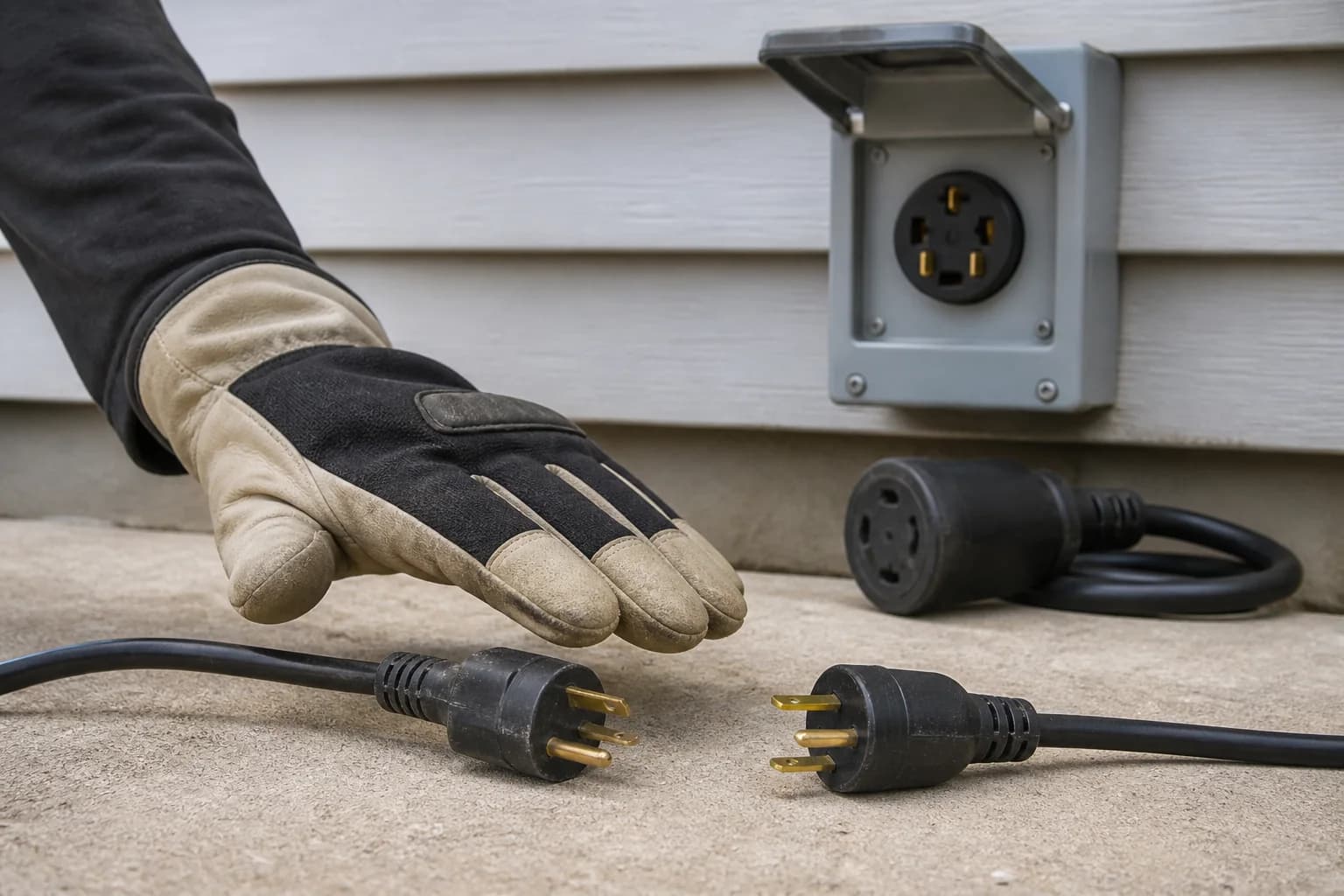
Do not buy, build, or use a male-to-male generator cord. CPSC says these products have no legitimate household use and should be stopped and disposed of. Power individual equipment with compatible heavy-duty cords, or connect building wiring through approved transfer equipment and a suitable inlet installed for the electrical system.
Why the cord design is inherently hazardous
A normal extension cord has one male plug that receives power and a female connector that covers energized contacts. A male-to-male cord has exposed prongs at both ends. When one end is connected to a source, the other end can become energized and accessible.
The danger is not removed by a switching sequence, breaker order, warning label, or experienced operator. Human error, an unexpected breaker state, another person, or a damaged receptacle can expose lethal voltage.
| Goal | Appropriate path | Do not use |
|---|---|---|
| Power one appliance | Compatible grounded cord within every rating | Male-to-male cord or improvised adapter |
| Power selected house circuits | Approved inlet and transfer equipment | Backfeed through a wall receptacle |
| Power a standby system | Compatible automatic transfer system and installed generator | Portable cord workaround |
Backfeeding defeats the required source-isolation strategy
A building can be supplied by utility power or an approved generator source only through equipment designed to prevent unsafe source interaction. Feeding a branch-circuit receptacle in reverse does not create that controlled transfer path.
Backfeed can energize wiring unexpectedly, expose utility workers and occupants, overload conductors or receptacles, and bypass protection assumptions. Turning off the main breaker manually is not a substitute for approved transfer equipment.
Use the safe alternative that matches the load
For a small number of appliances, connect each load directly to a compatible generator receptacle with intact, grounded, outdoor-rated cords whose ratings exceed the connected load. Keep the generator outdoors at a safe distance.
For building circuits, use a suitable exterior power inlet, compatible generator cord, and approved transfer equipment installed for the service and generator configuration. The equipment must coordinate voltage, amperage, neutral and grounding, overcurrent protection, and source isolation.
- Direct cord-and-plug loads for a limited appliance plan
- Manual transfer equipment and power inlet for compatible portable-generator systems
- Automatic transfer equipment for compatible permanently installed standby systems
- Qualified installation and local inspection for building wiring
What to do if you already have one
Stop using the cord. If it is energized or connected, do not touch exposed prongs; de-energize the system only through a safe procedure and obtain qualified help when the state is uncertain. Prevent anyone else from reconnecting it.
Follow current CPSC instructions for disposal and replace the setup with an approved connection plan. Do not sell, donate, relabel, or convert the cord into another adapter.
Frequently asked questions
Common questions
What is a generator suicide cord?
It is a male-to-male cord often used to backfeed a receptacle. Its exposed prongs can become energized, and the setup bypasses the approved source-isolation path.
Is a suicide cord safe if the main breaker is off?
No. A manual breaker sequence does not remove exposed-prong hazards or replace approved transfer equipment and source isolation.
What should I use instead of a backfeed cord?
Power compatible appliances directly with suitable cords, or use an approved power inlet and transfer system installed for the building wiring.
Can I keep a male-to-male cord for emergencies?
No. CPSC says these cords should not be used and have no legitimate household use. Follow current disposal guidance.
Primary references
CordFind summarizes connector specifications and public safety guidance. Always follow the instructions supplied with your equipment.
- CPSC — 2026 Male-to-Male Extension Cord Warning
- CPSC — Male-to-Male Extension Cord Product Safety Warning
- OSHA — Grounding Requirements for Portable Generators