Quick answer
Choose from an engineered load and duty profile. Air-cooled home standby units often cover smaller residential essential-load or managed-load projects with a simpler footprint. Liquid-cooled platforms extend into larger outputs and demanding duty profiles, but generally add space, coolant-system service, installation scope, and cost. Compare exact models at the same fuel, voltage, ambient condition, and rating class, then have the complete system sized and commissioned.
Cooling type changes the engine package, not the electrical requirements
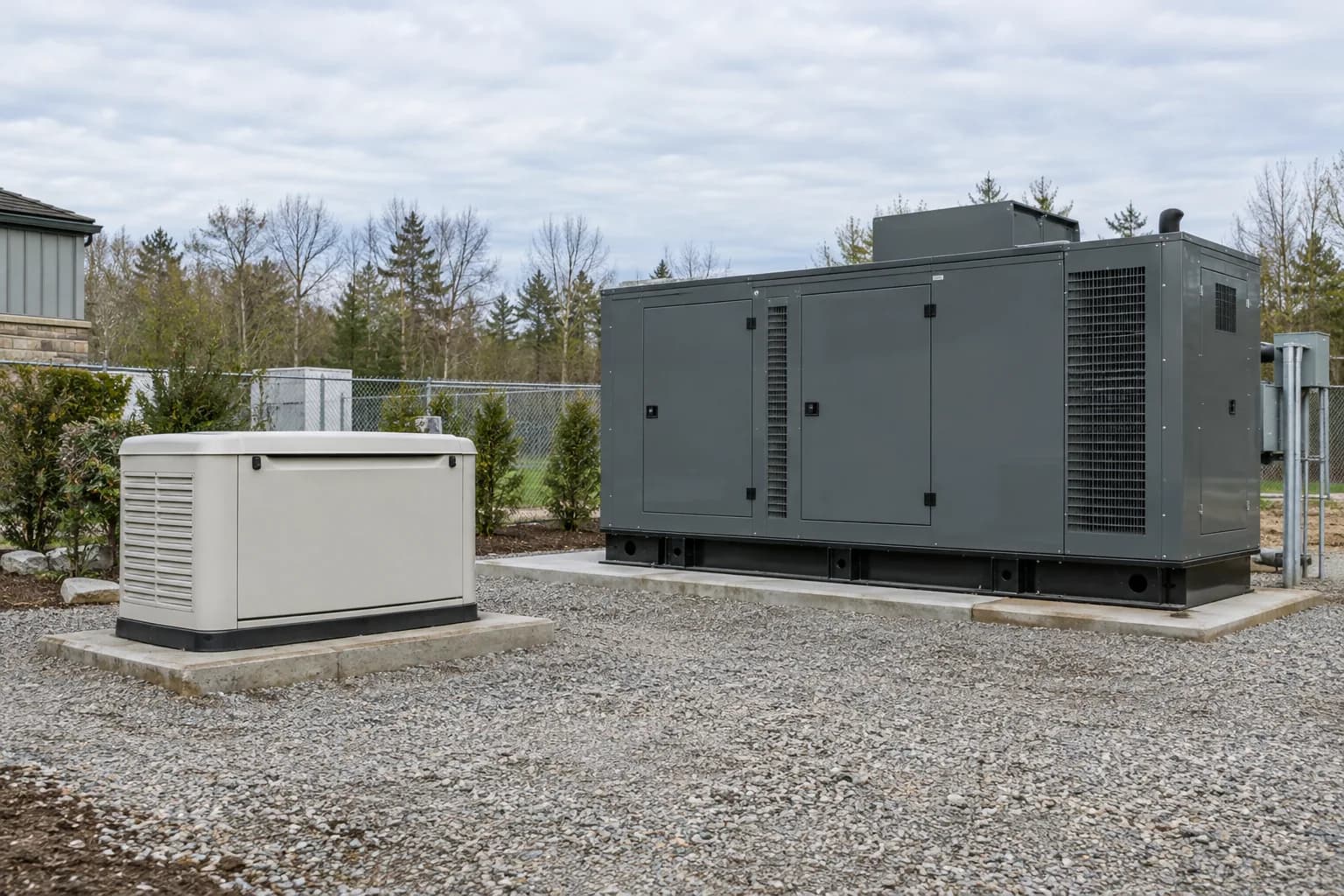
An air-cooled engine moves ambient air across hot components and depends on clear louvers, clean cooling surfaces, correct enclosure airflow, and the operating limits in its manual. A liquid-cooled engine circulates coolant through the engine and radiator system, adding hoses, coolant, a radiator, and related service points. Both still need combustion air, safe exhaust discharge, fuel supply, transfer equipment, protection, grounding and bonding, and model-specific clearances.
Do not use the cooling label as a shortcut for power quality, fuel economy, noise, or reliability. Those outcomes depend on the exact engine, alternator, controls, enclosure, load, installation, maintenance, and rating. Read the current data sheet and manual for the model and fuel under consideration.
Start with the load profile and expected duty
List the loads that can operate together, their voltage and phase, the largest permitted motor start, nonlinear loads, and load-management rules. Then describe the outage profile: short residential interruptions, repeated seasonal events, long-duration operation, or a commercial process that cannot tolerate interruption. Continuous watts and transient response both matter.
A larger liquid-cooled product can be appropriate when the calculated load, starting performance, duty, or project requirements exceed the available air-cooled platform. It is not automatically the right answer for every home. Oversizing can create cost and operating problems, while undersizing can produce poor voltage recovery, trips, and load shedding.
Compare the complete site impact
Record equipment dimensions, required working space, service-door swing, airflow path, exhaust direction, foundation, snow and flood exposure, property setbacks, opening locations, and sound restrictions. A compact enclosure may fit the plan better, but only if every manufacturer clearance and local requirement remains available after landscaping and future access are considered.
Liquid-cooled systems commonly require more installation space and a more involved service plan. Air-cooled systems still need unobstructed cooling air and regular inspection. Neither type can be placed by copying a generic online clearance. The installation manual and local authority control the approved location.
Compare fuel delivery and lifecycle cost at the same operating point
Use the fuel-consumption table for each exact model at stated load percentages and on the fuel actually available. Natural-gas pressure and meter capacity, propane vaporization and tank size, and cold-weather performance can limit output regardless of cooling type. Include the transfer switch, fuel work, electrical work, permits, pad, controls, load management, monitoring, and commissioning in the installed budget.
Lifecycle cost also includes oil, filters, spark plugs or ignition components, batteries, coolant and hoses where applicable, scheduled inspections, service travel, and eventual major repairs. A lower purchase price does not prove a lower ownership cost, and a higher equipment price does not prove a better match.
Use a side-by-side submittal review before purchase
Request exact model numbers and compare continuous or standby rating, selected-fuel output, voltage, phase, alternator and motor-start data, ambient derating, sound-test conditions, enclosure, controller, warranty, service schedule, parts support, and transfer-system compatibility. Mark every unavailable value as unresolved instead of filling it with a category assumption.
Have the designer document the load calculation, fuel calculation, placement drawing, transfer sequence, load-management behavior, and maintenance access. Commission the selected system under the permitted loads and verify voltage, frequency, transfer, alarms, cooling, fuel pressure where applicable, and return to utility operation.
Frequently asked questions
Common questions
Is a liquid-cooled generator always better?
No. It may offer the output or duty needed by a larger project, but it also changes space, service, installation, and cost. The better generator is the one verified for the actual load and site.
Are air-cooled generators only for small homes?
Air-cooled standby products cover many residential projects, especially with load management. Exact available output and application limits vary by model, fuel, climate, and installation.
Which type is quieter?
Compare published sound data at the same distance, load, test method, and operating mode. Cooling type alone does not establish the sound level at a property line or bedroom.
Does a liquid-cooled generator run longer?
Runtime is limited by the exact duty rating, load, fuel supply, maintenance schedule, ambient conditions, and manual. Liquid cooling alone is not permission for unlimited operation.
Primary references
CordFind summarizes connector specifications and public safety guidance. Always follow the instructions supplied with your equipment.
- Generac: Home Standby Generator FAQ
- Generac: Product Information and User Manuals
- Generac: Generator Control Panels and Locations
- Generac: 28 kW Air-Cooled Standby Generator