Quick answer
Find the current owner manual for the exact generator or engine. Record the required SAE viscosity by starting temperature, minimum API service category, conventional or synthetic guidance, oil capacity, filter part number, break-in change, normal interval, and extended-run checks. Do not copy another model’s oil recommendation. Check level on a level, shut-down machine using the manual procedure, avoid overfilling, and investigate leaks, fuel dilution, metal, or milky oil before returning the unit to service.
An oil recommendation contains several separate requirements
SAE viscosity describes how oil flows across temperature conditions. A grade such as 10W-30 or 5W-30 is not a quality ranking. The API service category describes performance standards for an engine class. The base-oil wording, conventional or synthetic, is another instruction. All three can matter, along with manufacturer approvals and a prohibition on additives.
The temperature chart normally uses the temperature at engine startup, not the afternoon high. If a manual offers several grades, choose the one covering the expected starting range and follow any special cold-weather instructions. A diesel-generator lubricant chart is not a substitute for a small gasoline-engine chart.
Check the generator break-in instructions separately from the normal oil-change interval. A first-service deadline does not, by itself, define a break-in load or operating schedule.
| Manual field | What to record | Why it matters |
|---|---|---|
| Engine identity | Generator model, serial range, and engine model | Similar generator housings can use different engines |
| SAE viscosity | Allowed grade for expected start temperature | Controls cold flow and operating-film behavior |
| Service category | Minimum API class or named specification | Sets the required performance level |
| Oil system | Capacity, dipstick procedure, and filter number | Prevents underfill, overfill, and wrong-filter errors |
| Schedule | Break-in, calendar, hour, and extended-run checks | Defines when level checks and changes are due |
Manufacturer examples show why generic advice fails
Honda’s EU3200i manual lists SAE 10W-30, API SJ or later, for general use and provides a temperature chart and model-specific capacity. Generac’s current portable-generator FAQ describes SAE 30 for warmer conditions, 10W-30 across another range, and synthetic 5W-30 across temperatures. A Generac home standby support article gives different current guidance for affected standby product families and specifically tells owners to confirm the exact unit and break-in rule.
These examples are evidence that recommendations vary, not a menu to choose from. Use the instruction tied to your serial range. Manuals and manufacturer support bulletins can change as products change, so save the applicable document with the maintenance record.
Check oil level with the generator safely isolated
Place a portable generator on a firm, level surface in its approved outdoor operating area. Shut it down and follow the cooling and isolation procedure. Automatic standby units can start without a person at the controls, so disable both utility and generator sources exactly as the service instructions require before opening an enclosure.
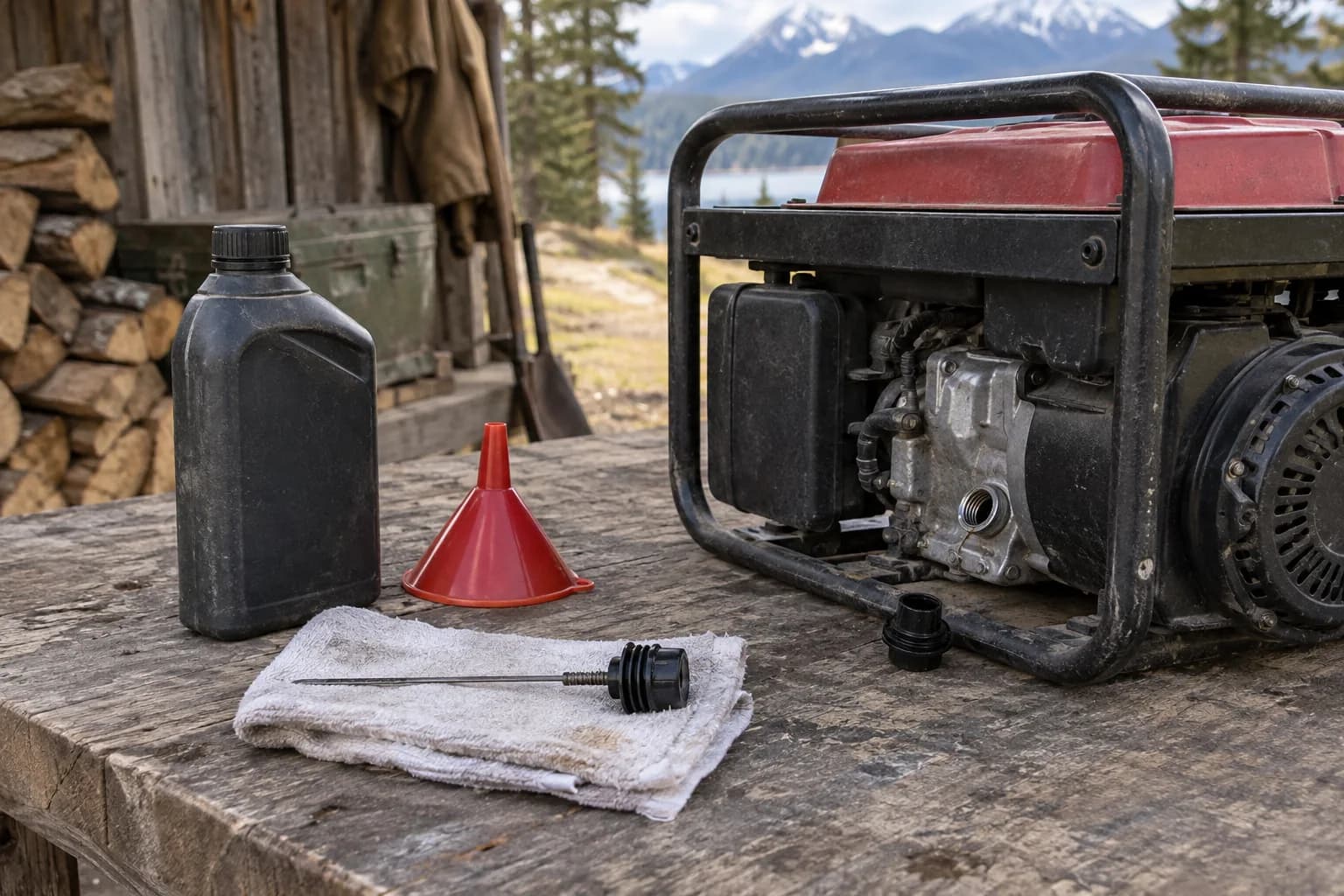
Use the manual’s dipstick method. Some engines require the dipstick to be inserted without threading; others specify a different technique. Add small amounts, recheck, and stop at the full mark. Overfilling can cause foaming, smoking, fouled plugs, leakage, or engine damage just as low oil can.
Look up oil capacity with the level-check method beside it
Oil capacity is model-specific and is not the same as the amount required for a top-up. A capacity figure cannot tell you how much oil is already in the engine. Look up the exact generator and engine, save the manual revision, and pair the capacity entry with the prescribed level-check method.
For a documented example, Honda EU3200i manual 00X31-Z45-6030 lists a maximum oil capacity of 15 oz (0.46 L). Its level check uses a stopped engine on a level surface and inserts the cleaned dipstick without screwing it in. These facts apply to that manual, not to another Honda model or an aftermarket dipstick. Use the full mark and the actual reading to determine the addition; do not pour the maximum quantity into an engine that already contains oil.
| Field | Honda EU3200i example | Your generator record |
|---|---|---|
| Model and applicable manual | EU3200i; 00X31-Z45-6030 | Model, engine, serial range and revision |
| Published maximum capacity | 15 oz (0.46 L) | Exact value and units from the manual |
| Level-check condition | Level surface; engine stopped | Required surface, shutdown and waiting instructions |
| Dipstick reading method | Insert without screwing in | Exact original or approved accessory procedure |
| Quantity actually added | Determined from the level reading | Date, hours, quantity and final level |
Read oil-change intervals from the maintenance schedule
Many engines call for an early first change after break-in and a later recurring interval based on hours or time. Dust, heat, long outage runs, and severe service may shorten the interval or require more frequent level checks. A low-oil shutdown protects against some low-level conditions; it does not measure oil condition or replace inspection.
Log date, running hours, oil specification, quantity added, filter number, and observed condition. During an extended outage, follow the manufacturer’s continuous-operation checks and shutdown procedure. Keep enough approved oil and filters for the planned runtime.
Oil condition can point to a problem that fresh oil will not fix
Stop and investigate if the level rises unexpectedly, oil smells strongly of fuel, the oil appears milky, metal is visible, pressure warnings persist, leakage is active, or consumption changes sharply. Fuel dilution can reduce lubrication. A milky appearance can indicate moisture or coolant depending on the engine. Repeated low-oil shutdowns need diagnosis, not repeated topping off.
Collect used oil in a clean, leak-resistant container and use an approved local recycling or collection route. Do not pour oil on the ground, into a drain, or into household trash. Keep it separate from solvents and other fluids that can prevent recycling.
Frequently asked questions
Common questions
Can I use 10W-30 in my generator?
Only if the manual permits that viscosity for the expected starting temperature and the oil meets the required service specification.
Is synthetic oil better for a generator?
Some manufacturers approve or recommend synthetic oil for certain models and temperatures, while break-in instructions may differ. Follow the exact model guidance rather than treating synthetic as universally interchangeable.
How often should generator oil be changed?
Use the model’s break-in and recurring schedule, which may depend on hours, calendar time, and operating conditions. Extended outage operation may require frequent level checks.
What happens if I put too much oil in a generator?
Overfill can cause operating problems and damage. Do not run the engine until the level is corrected by the manual procedure.
How much oil does a generator hold?
Use the exact engine and generator manual. Honda’s cited EU3200i manual lists a maximum capacity of 15 oz (0.46 L), but that is not a universal capacity or a top-up amount. Check the actual level by the prescribed dipstick method and add only what is needed.
Primary references
CordFind summarizes connector specifications and public safety guidance. Always follow the instructions supplied with your equipment.
- Honda: EU3200i Owner’s Manual
- Generac: Portable Generator FAQ and Oil Guidance
- Generac: Home Standby Oil and Filter Service