Quick answer
Use the generator model and current owner’s manual to identify the required battery. Match every listed specification and physical detail, then follow the exact shutdown, auto-start disable, charger isolation, terminal-disconnection, installation, and recycling procedure. If a new battery does not remain charged, diagnose the charger, wiring, exercise history, and parasitic loads instead of repeatedly replacing batteries.
Identify the complete battery specification
Locate the generator model, serial number, manual revision, and battery section before removing the old battery. Record voltage, physical group or case dimensions, hold-down method, terminal type and orientation, capacity or cold-cranking requirement, approved chemistry, and ventilation instructions.
Do not assume that another battery fits because it is labeled 12V. Reversed terminals, insufficient starting capacity, an incompatible charger, or a case that cannot be secured can damage equipment or create a fire and chemical hazard.
| Symptom | Possible system causes | Next controlled check |
|---|---|---|
| Slow or failed crank | Weak battery, loose or corroded cable, starter or fuel issue | Follow manual tests and inspect connections |
| Battery repeatedly low | Charger supply, charger fault, exercise pattern, parasitic load | Verify charger and controller status |
| Swollen, leaking, or hot case | Battery failure or charging problem | Stop, isolate as directed, and obtain qualified service |
| Corroded terminals | Moisture, leakage, loose connection, maintenance gap | Use the manufacturer’s cleaning and inspection procedure |
Control automatic start, electricity and chemical hazards
Standby generators can start automatically. Generac manuals direct users through a model-specific sequence that may include placing the controller in OFF, removing a fuse, isolating the charger, and disconnecting the battery. Use the exact procedure for the installed generator rather than a universal terminal-order article.
Batteries can produce high fault current and may contain corrosive electrolyte. Remove jewelry, prevent tools from bridging terminals, use specified protective equipment, keep ignition sources away, and obtain qualified help when the procedure or battery condition is uncertain.
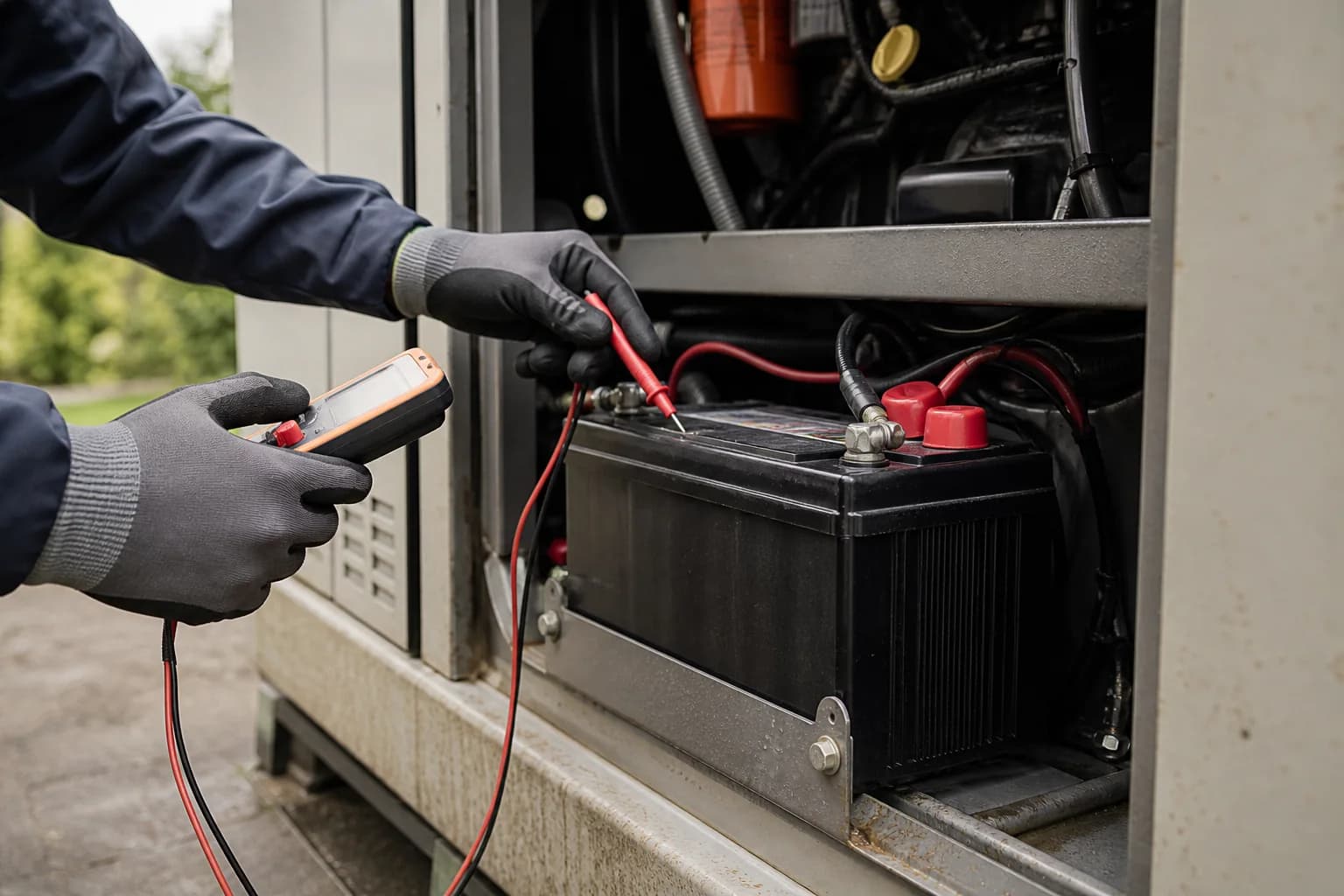
Test the battery as part of the starting system
Open-circuit voltage alone may not show whether a battery can deliver starting current. Use the generator manufacturer’s diagnostic procedure and an appropriate battery test. Inspect cable tightness, corrosion, ground paths, fuses, charger status, controller alarms, and exercise history.
If the battery fails again soon after replacement, stop treating the battery as the only cause. A charger, wiring, controller, temperature, storage, or starting-system problem can produce the same symptom.
Replace, document and recycle
Install only the specified replacement and secure it with the approved hold-down. Confirm terminal polarity before connection, restore the charger and controls in the manual’s sequence, clear only understood alarms, and complete a controlled start or exercise test.
Record the installation date, battery specification, measured condition, charger status, and next inspection. Recycle the old battery through an approved collection or recycling facility; do not place lead-acid batteries in household trash.
Frequently asked questions
Common questions
What battery does my generator need?
Use the model-specific manual and match voltage, physical size, hold-down, terminal orientation, capacity or cold-cranking rating, chemistry, venting, and charger compatibility.
Can I use any 12V battery in an electric-start generator?
No. Equal nominal voltage does not ensure the correct size, terminals, starting rating, chemistry, charger compatibility, or secure installation.
Why does my generator battery keep dying?
Possible causes include battery age, charger supply or failure, loose or corroded connections, controller or parasitic loads, temperature, and insufficient exercise. Diagnose the complete system.
How often should a standby generator battery be replaced?
Follow the generator and battery manufacturer’s inspection, test, and replacement criteria. Condition, temperature, charger operation, and exercise history matter more than a universal interval.
Primary references
CordFind summarizes connector specifications and public safety guidance. Always follow the instructions supplied with your equipment.
- Generac — Standby Generator Battery Troubleshooting and Maintenance
- Generac — Air-Cooled Standby Generator Owner’s Manual
- Honda — Generator Owner’s Manuals
- EPA — Used Household Batteries