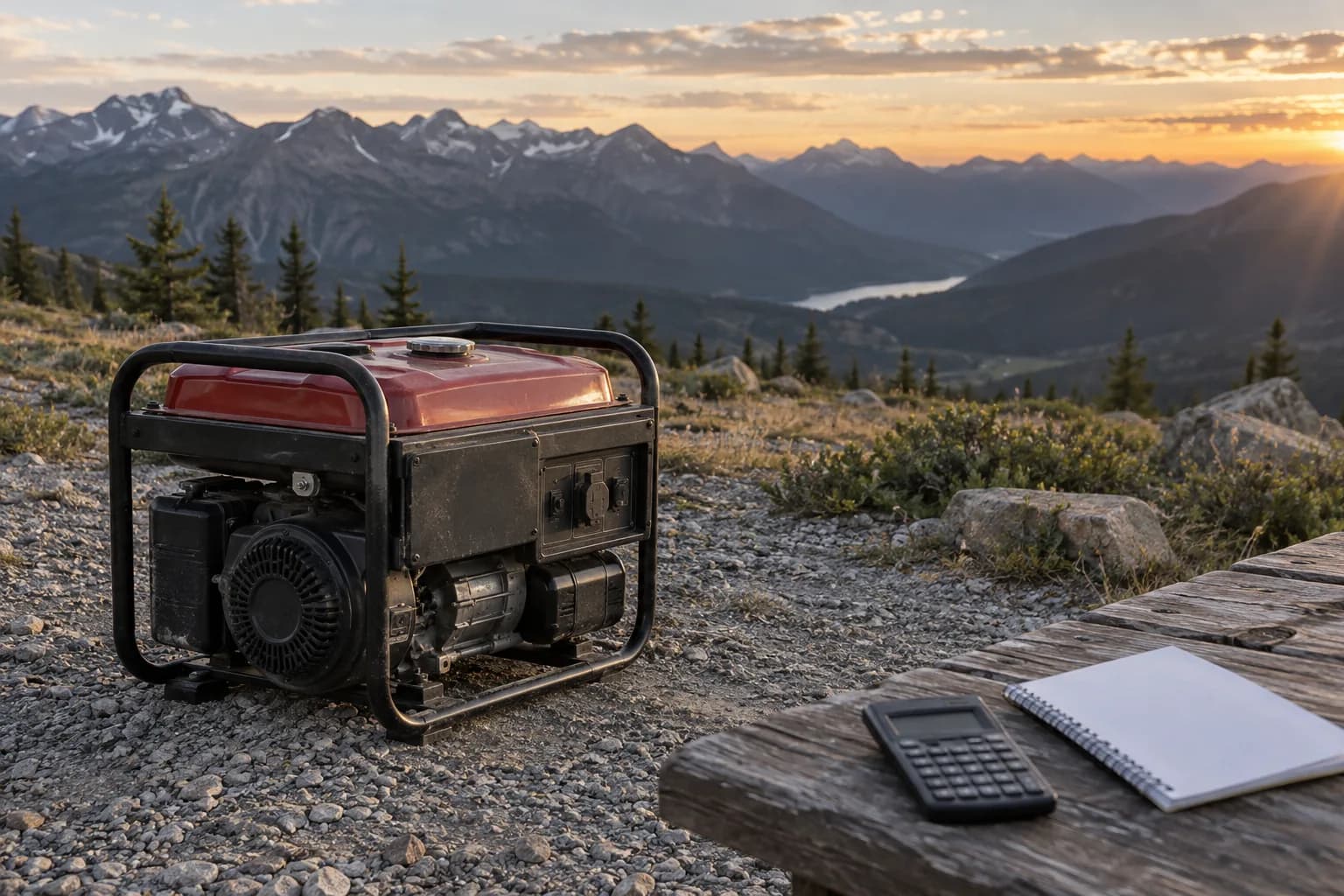
Quick answer
Find the published running rating on the fuel you will use, then copy the exact altitude and temperature baselines and percentage reductions from the model documentation. Apply reductions only above those baselines and preserve enough derated capacity for simultaneous running loads and the largest approved start event. Do not transfer a percentage from another generator.
Start with the rating that matches fuel, voltage, phase, and duty
Do not begin with the largest number on a product label. Record continuous or running output, starting or surge output, selected fuel, voltage configuration, phase, frequency, power factor when applicable, and whether the rating is standby, prime, continuous, or another defined duty.
Dual-fuel and tri-fuel generators can publish different output on gasoline, propane, and natural gas. Natural-gas pressure and heating value can matter on installed systems. Use the rating for the actual fuel and configuration before applying environmental adjustments.
The calculator above adjusts entered running watts. It does not create a new surge rating. After estimating available running output, the generator manufacturer still needs to confirm motor starting, voltage dip, frequency recovery, harmonics, unbalanced loads, and short-duration overload capability.
Apply altitude loss only above the documented baseline
One Generac portable inverter manual states an approximate 3.5 percent decrease for each 1,000 feet above sea level. A Generac mobile diesel manual uses full prime power through 1,640 feet, then a 2 percent reduction for each additional 820 feet. A liquid-cooled standby specification uses still different baselines for different ratings.
These are examples, not a universal table. Enter the baseline where derating begins and the percentage per elevation interval exactly as the model documentation states. If the manual provides a lookup table or requires manufacturer software, use that method instead of converting it to a generic percentage.
High-altitude engine adjustments, carburetor jets, or control calibrations do not automatically restore full electrical output. They may be required for emissions or engine operation and can create different low-altitude restrictions. Follow the serial-number-specific instructions.
Temperature derating begins at its own threshold
Temperature rules also vary. The cited portable inverter manual describes about a 1 percent decrease for each 10 degrees Fahrenheit above 60 degrees Fahrenheit. A cited liquid-cooled standby specification lists 1.65 percent for each 10 degrees Fahrenheit above 77 degrees Fahrenheit. Other equipment can use a maximum ambient table rather than a percentage.
Use the air temperature and location defined by the manufacturer. Ambient weather, enclosure inlet temperature, radiator air, and engine-room temperature are not always interchangeable. Sun exposure, recirculated hot air, restricted ventilation, dust, and nearby equipment can make the generator intake environment hotter than a weather report.
| Example document | Altitude statement | Temperature statement |
|---|---|---|
| Portable inverter owner manual | About 3.5% per 1,000 ft above sea level | About 1% per 10 °F above 60 °F |
| MDE570 mobile generator manual | Full prime power to 1,640 ft, then 2% per 820 ft | Maximum full-power ambient stated as a limit |
| 48 kW liquid-cooled standby spec | 3% per 1,000 ft above 600 ft | 1.65% per 10 °F above 77 °F |
Keep the combination method visible
The CordFind worksheet adds the two entered percentage losses to produce a conservative planning screen. It labels the method because the manufacturer may compound adjustments, use tables, apply a cap, change the baseline by model rating, or specify a different calculation entirely.
For example, a 10 percent altitude loss plus a 3 percent temperature loss appears as a 13 percent additive reduction in this worksheet. That is not permission to override a manufacturer result. Use whichever documented method produces the accepted rating for the exact configuration.
Round available output down for planning rather than up. Keep the original rating, each input, source page, calculation date, and resulting limit in the load plan so another reviewer can reproduce it.
Re-run the load plan against the reduced output
Compare all simultaneous running loads with the derated running capacity. Then test the largest permitted starting event against the generator transient capability. Pumps, compressors, air conditioners, refrigeration, and some tools can fail at elevation even when the steady-state sum remains below the adjusted watt figure.
Connection limits do not increase when the engine has spare capacity. Receptacles, breakers, conductors, cord voltage drop, transfer equipment, phase balance, and branch protection still apply. A 30A, 240V connection remains limited by its complete circuit even when the generator nameplate advertises a larger peak value.
Use staged loads or approved load management where appropriate. Do not use planning reserve to hide unknown nameplate data or assume that a short surge rating guarantees acceptable voltage for every motor.
Confirm the site result with the manufacturer and commissioning record
Ask the generator provider to confirm the expected available output for site elevation, maximum design temperature, selected fuel, enclosure, duty, and required load steps. Commercial and standby projects may require a formal sizing report rather than a web calculator result.
During commissioning, record voltage, frequency, current, load percentage, temperature, alarms, and response to the largest approved start. Repeat the review when fuel, generator configuration, enclosure, large loads, altitude, or operating duty changes.
A derated generator still produces carbon monoxide, heat, fire risk, and lethal electrical energy. Environmental derating does not change outdoor placement rules for portable generators or the need for approved transfer equipment when supplying building wiring.
- Save the exact model and serial-specific source
- Use selected-fuel running output
- Record altitude and temperature baselines separately
- Document the combination method
- Recheck motor starting and connection limits
Frequently asked questions
Common questions
How much power does a generator lose per 1,000 feet?
There is no universal percentage. Published examples range by model and may begin at sea level, 600 feet, 1,640 feet, 3,000 feet, or another baseline. Use the exact generator specification.
Does hot weather reduce generator output?
It can. Manufacturers publish model-specific temperature thresholds, reductions, or maximum ambient limits. Use the temperature location and method defined in the equipment documentation.
Should altitude and temperature percentages be added or multiplied?
Follow the exact manufacturer method. The CordFind tool displays an additive planning screen for transparency, but a manufacturer may compound, table, cap, or otherwise apply the adjustments.
Does changing a high-altitude jet restore full generator wattage?
Do not assume so. High-altitude adjustments address model-specific engine operation and may change allowable elevation ranges. The published electrical derating and operating instructions still control.
Do I apply derating to starting watts or running watts?
This calculator adjusts entered running output only. Ask the generator manufacturer to confirm surge or motor-start capability at the site conditions because transient performance is not described by one running-watt percentage.
Primary references
CordFind summarizes connector specifications and public safety guidance. Always follow the instructions supplied with your equipment.
- Generac: iQ3800DF Portable Inverter Owner Manual
- Generac: MDE570 Mobile Generator Owner Manual
- Generac: 48, 60, and 80 kW Liquid-Cooled Generator Specification
- Generac: Air-Cooled Standby Generator Owner Manual
- Generac: Basic Sizing for Mobile Generators