Quick answer
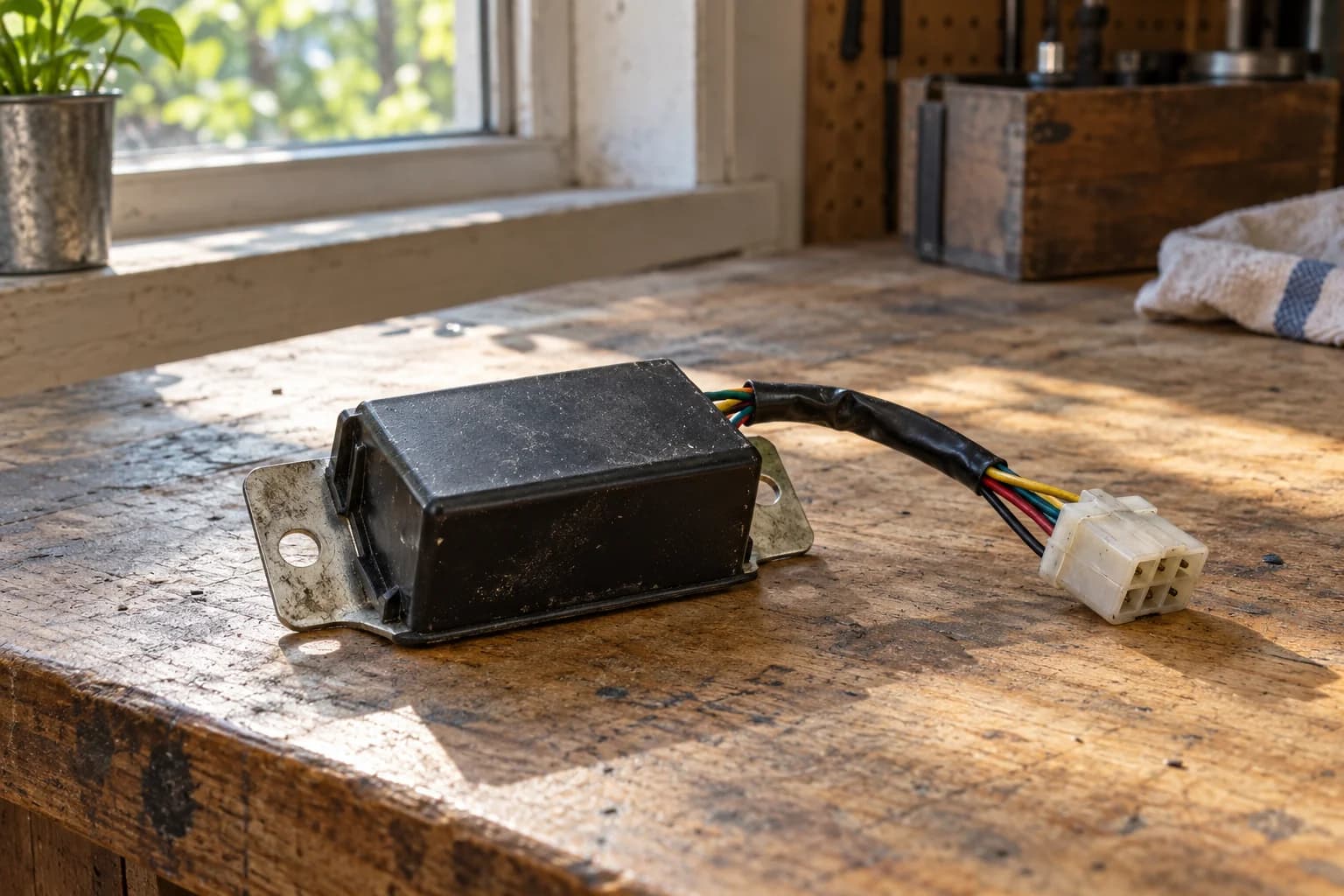
An AVR senses alternator voltage and adjusts excitation to regulate output in a supported alternator system. Identify the generator model, serial range, alternator and original OEM part number before ordering. Confirm any replacement or supersession through the applicable parts record or manufacturer support. Follow only documented operator checks; internal testing, adjustment and replacement belong to the exact service procedure and appropriately qualified personnel.
What the AVR changes when the load changes
An AVR is part of a feedback system. It monitors a voltage signal from the alternator and adjusts the excitation that creates its magnetic field. STAMFORD describes this relationship in its AVR documentation: a falling voltage calls for more excitation, while a rising voltage calls for less. The power source, sensing arrangement and protection features vary between regulators.
An AVR does not add engine power or increase a receptacle’s current limit. A load step still involves the engine, alternator, controls, wiring and connected equipment. Read the generator’s running rating separately from its regulation description.
AVR, governor and inverter describe different jobs
The governor manages engine speed as load changes. On a conventional synchronous alternator, rotational speed and pole count determine electrical frequency. The AVR primarily regulates voltage through excitation. These controls interact during a load change, so a voltage symptom can accompany an engine or loading problem without proving that the regulator has failed.
An inverter generator rectifies alternator output to DC and electronically produces the delivered AC, as WEN’s explanation describes. Its parts diagram may identify an inverter assembly instead of a separate AVR. Honda also distinguishes AVR, DAVR and iAVR systems. Those names are not interchangeable replacement-part categories.
| System or component | Main role | Evidence to request |
|---|---|---|
| Conventional AVR | Control alternator excitation and output voltage | Alternator identity, AVR part number and wiring record |
| Engine governor | Manage engine speed and response to load | Exact engine or generator service documentation |
| Inverter assembly | Convert generated power into electronically controlled AC | Model-specific inverter/control assembly listing |
| Integrated digital control | Coordinate functions defined by that design | Controller version and manufacturer-approved replacement |
Record the symptom before opening the parts catalog
Start with observations available through normal operation: did all outlets stop supplying loads, did one protected circuit trip, or did a connected appliance report an input fault? Record the load group, fuel, warning lights, displayed error and what changed just before the event. Separate an engine that stalls under demand from one that continues running with no apparent electrical output.
WEN’s FAQ identifies breakers and warning indications as initial checks and lists several possible causes of no output. A supported inverter reset is a control-panel action, not an AVR repair. Use the generator-runs-but-no-power guide to organize operator checks, then give the record to support. Do not reproduce the fault with valuable appliances connected.
Build a replacement worksheet with an evidence trail
Use the generator manual model-number lookup workflow to locate the exact parts record. Keep suffixes, regional versions and serial restrictions intact. A generator family can change components without changing the headline wattage. For larger sets, the alternator nameplate and controller details may be as important as the generator-set model.
Photos can help support identify a label, but do not remove electrical covers merely to obtain a shopping picture. Ask qualified service to record inaccessible details. Put the source document and revision next to the part number so the match can be checked again when the box arrives.
| Field | What to record | Acceptable confirmation |
|---|---|---|
| Generator identity | Complete model, suffix and serial number | Manufacturer model/serial record |
| Electrical arrangement | Rated voltage, frequency and phase | Nameplate and applicable manual |
| Alternator/control identity | Model and relevant version | Parts diagram or service confirmation |
| Original regulator | OEM part number and documented variant | Applicable parts list |
| Proposed replacement | Manufacturer and exact supplied number | Explicit model/serial fitment |
| Superseded part | Old-to-new number and restrictions | Written OEM supersession record |
A real parts listing shows how narrow a match can be
WEN lists automatic voltage regulator DF475-033 for the WEN DF475 generator. That is a useful documented model-and-part example, not a finding that every generator advertised as 4,750 watts accepts this regulator. A similar DF475 family name with another suffix still needs its own applicable record.
Suppose a seller offers a module for a range of generator wattages, while your worksheet identifies one OEM number. Ask the seller and manufacturer for a documented cross-reference covering your complete model and serial range. If none is available, keep the part unapproved. Connector count, wire color and mounting pattern can be comparison details after a documented match; none independently establishes the sensing, excitation or protection requirements.
A reset, an adjustment and a repair are separate decisions
There is no universal AVR reset sequence. A manual may describe resetting an overload condition, stopping to clear a regulator protection condition or using a specific control-panel button. Follow the instruction for the identified condition after resolving its cause. An adjustment screw is not a reset button, and moving it can change a safety-critical setting.
The STAMFORD AS440 manual requires trained, authorized service engineers for setup and warns about live terminals, stored energy and sealed controls. Its procedure cannot be transplanted to a portable generator with a different regulator. Do not use generic field-flashing, live-terminal probing or adjustment directions from a parts advertisement. Request a diagnosis and service scope appropriate to your machine.
Keep a service record that explains the result
Before authorizing a replacement, ask which checks established the fault and whether the alternator, connections, engine behavior or protective circuits need attention too. Ask who will install and commission the component under the applicable service documentation. A correctly matched part can still require setup and verification.
Retain the installed part number, supersession evidence, service findings and documented operating checks. Restore only the approved load plan. An AVR replacement does not establish a sensitive-electronics approval or measured THD result; consult the generator THD and sensitive electronics guide for that separate requirement.
Frequently asked questions
Common questions
What is an AVR on a generator?
It is an automatic voltage regulator that controls excitation to help regulate alternator output voltage in the system for which it is designed. The exact generator documentation determines whether your unit has a separate AVR or another control architecture.
Does no power mean the AVR is bad?
No. Protection, connections, alternator components, the control system or other faults can produce that symptom. Record the indicators and affected circuits, complete the permitted manual checks and obtain a model-specific diagnosis.
Can I use a universal generator AVR?
Treat a universal-fit claim as unverified until a documented cross-reference confirms your complete model, serial range and original part. Similar wattage, connectors and mounting holes do not establish electrical compatibility.
How do I reset a generator AVR?
Find the exact manual’s instruction for the identified condition. Some operator resets concern overload or inverter protection rather than the AVR. Do not adjust regulator controls or repeatedly reset a fault as a generic fix.
Will adding an AVR turn my generator into an inverter generator?
No. Voltage regulation and electronic AC conversion are different functions. An AVR listing does not establish inverter architecture, a THD limit or approval for every sensitive load.
Primary references
CordFind summarizes connector specifications and public safety guidance. Always follow the instructions supplied with your equipment.
- STAMFORD | AvK: AVR excitation and voltage regulation
- STAMFORD: AS440 manual A043Y697 Issue 2, controls and service safety
- Honda: Selecting a generator, AVR/DAVR/iAVR control systems
- WEN: Generator FAQs, no-output checks and model identification
- WEN: DF475-033 regulator listing for DF475
- WEN: How inverter generators convert power