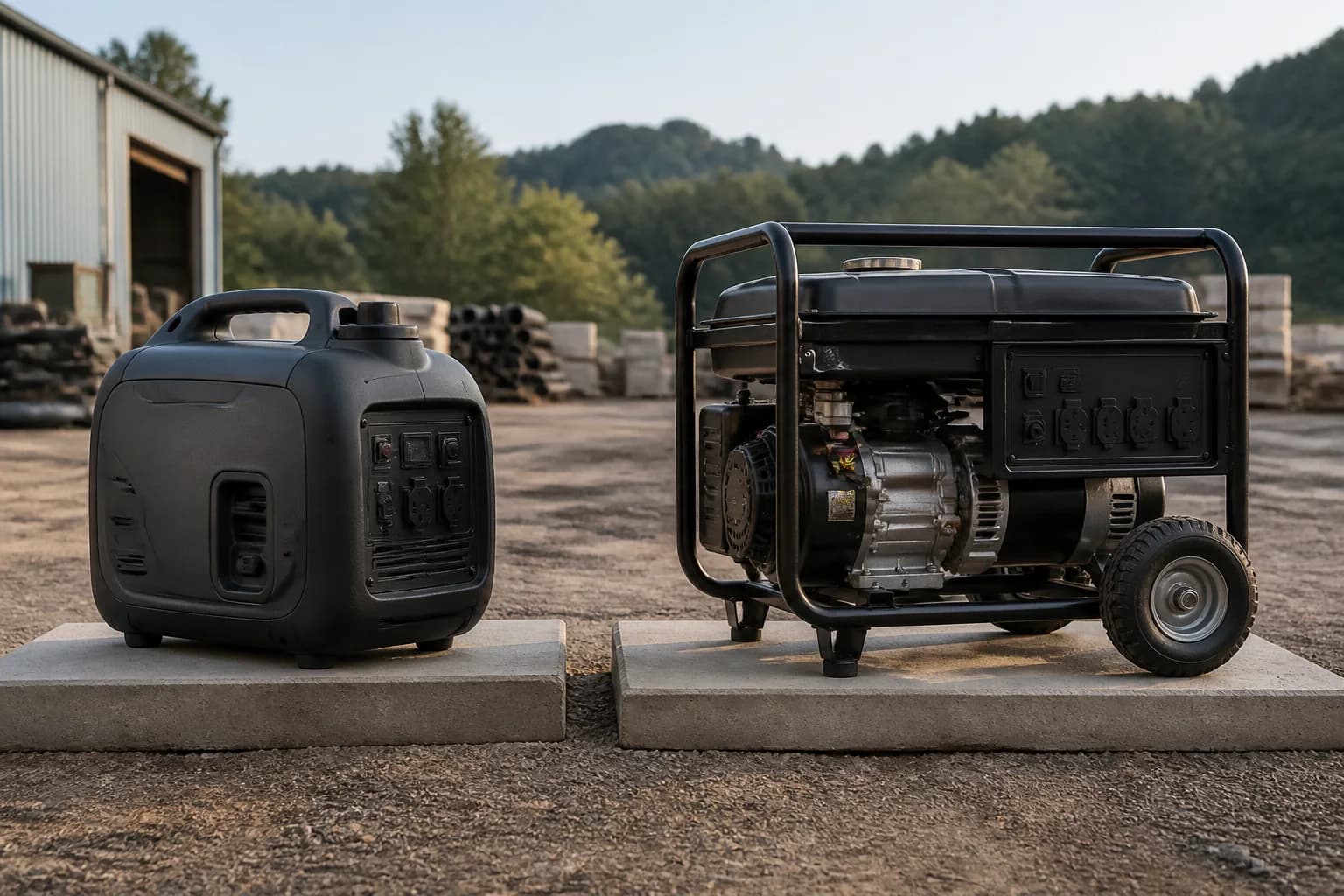
Quick answer
Choose from the load and application, not the technology label alone. Inverter generators commonly offer variable engine speed, lower noise under partial load, compact packaging, and conditioned output. Conventional generators commonly offer more high-output choices and simpler cost-per-watt options. Verify model-specific waveform, continuous and surge ratings, 120/240V capability, receptacles, runtime, and parallel-operation rules.
Compare the characteristics that affect the job
An inverter generator converts generated power through an electronic inverter stage. Many models adjust engine speed as load changes and use enclosed sound-control packaging. A conventional portable generator produces AC more directly and commonly runs at a speed selected to maintain output frequency.
These are category tendencies, not guarantees. Model design, alternator regulation, engine, enclosure, load, fuel, and test method determine the actual result.
| Decision factor | Inverter generator tendency | Conventional generator tendency |
|---|---|---|
| Power conversion | Electronic AC–DC–AC conditioning | AC produced more directly |
| Partial-load noise | Often lower with variable engine speed | Often more constant engine speed |
| Portability | Common in compact, enclosed models | Broad range including larger open-frame models |
| High-output / 240V choice | Available, but model range may be narrower | Common across many larger portable models |
| Parallel operation | Available only on compatible models and kits | Not a universal feature |
Evaluate power quality from published specifications
Inverter designs are commonly marketed for stable output and lower total harmonic distortion. That can be useful for electronics, variable-speed controls, communications equipment, and battery charging, but “clean power” should be confirmed from the model’s specification rather than assumed from the product name.
Sensitive or medically important equipment may have its own power-source requirements. Confirm grounding, neutral configuration, waveform, voltage regulation, and transfer behavior with the equipment and generator manufacturers.
Continuous output and starting capability still control
Technology does not replace sizing. Add simultaneous running loads and the appropriate motor-starting requirement, then compare the result with the generator’s continuous and surge ratings. Confirm whether output changes by fuel type and operating conditions.
Check the actual receptacles and their individual limits. A generator can advertise enough total watts while lacking a required 240V outlet, transfer-compatible neutral configuration, or sufficient capacity on the intended receptacle.
Compare two exact models before choosing a technology
Copy the model and product suffix from each equipment label, then save the matching owner manual and data sheet. An enclosed case does not establish inverter architecture, and an open frame does not rule it out. Confirm the power-conversion design from the manufacturer instead of classifying the machine from its shape or the word quiet in a listing.
Start the comparison with the loads that must run together and the next permitted motor start. Use continuous output on the intended fuel and check the individual outlet supplying the load. Then compare power quality and the practical work of moving, fueling and maintaining the machine. A failure at voltage or connection cannot be corrected by a better noise figure.
| Decision gate | Copy for each exact model | Resolve before purchase |
|---|---|---|
| Identity and design | Model suffix, sales region, manual revision and stated architecture | A listing or enclosure photo is the only evidence |
| Useful capacity | Continuous and starting ratings on the selected fuel; applicable derating | The required running or starting event remains unsupported |
| Connection | Output voltage, frequency, outlet code, breaker and shared-outlet limits | The load or approved inlet requires a different configuration |
| Power quality | Voltage/frequency behavior, THD conditions and equipment requirements | Only a clean-power marketing claim is available |
| Noise and runtime | Load percentage, measurement distance, fuel quantity and operating mode | Figures use different conditions and cannot be compared directly |
| Usability | Operating weight, lifting plan, fuel access, service schedule and parts support | The machine cannot be safely placed, moved or kept ready |
Match the category to the operating pattern
Camping, RV use, communications, and moderate essential-load backup often value low noise, portability, and partial-load efficiency. Larger home-backup, pump, tool, and jobsite plans may prioritize 120/240V output, high starting capacity, rugged construction, and cost per watt.
Compare the complete ownership plan: fuel storage, maintenance access, lifting, weather response, cords and inlets, transfer equipment, service network, and replacement parts. The purchase price alone does not describe the system cost.
Frequently asked questions
Common questions
What is the main difference between an inverter generator and a regular generator?
An inverter generator electronically converts and conditions the generated power, while a conventional generator produces AC more directly. Engine-speed and enclosure designs also commonly differ.
Is an inverter generator always better for electronics?
Many inverter models publish low-distortion output, but verify the exact generator specification and the equipment manufacturer’s power requirements.
Are inverter generators always quieter?
No. Many are quieter under partial load, but compare published decibel ratings under equivalent load and distance conditions.
Can an inverter generator power a house?
It can power compatible selected loads when its capacity, voltage, receptacles, connection system, and transfer equipment match. The inverter label alone does not determine suitability.
Primary references
CordFind summarizes connector specifications and public safety guidance. Always follow the instructions supplied with your equipment.
- Honda — What Is an Inverter Generator?
- Honda — Inverter Generator Advantages
- Honda — Selecting a Generator
- CPSC — Carbon Monoxide Safety Center