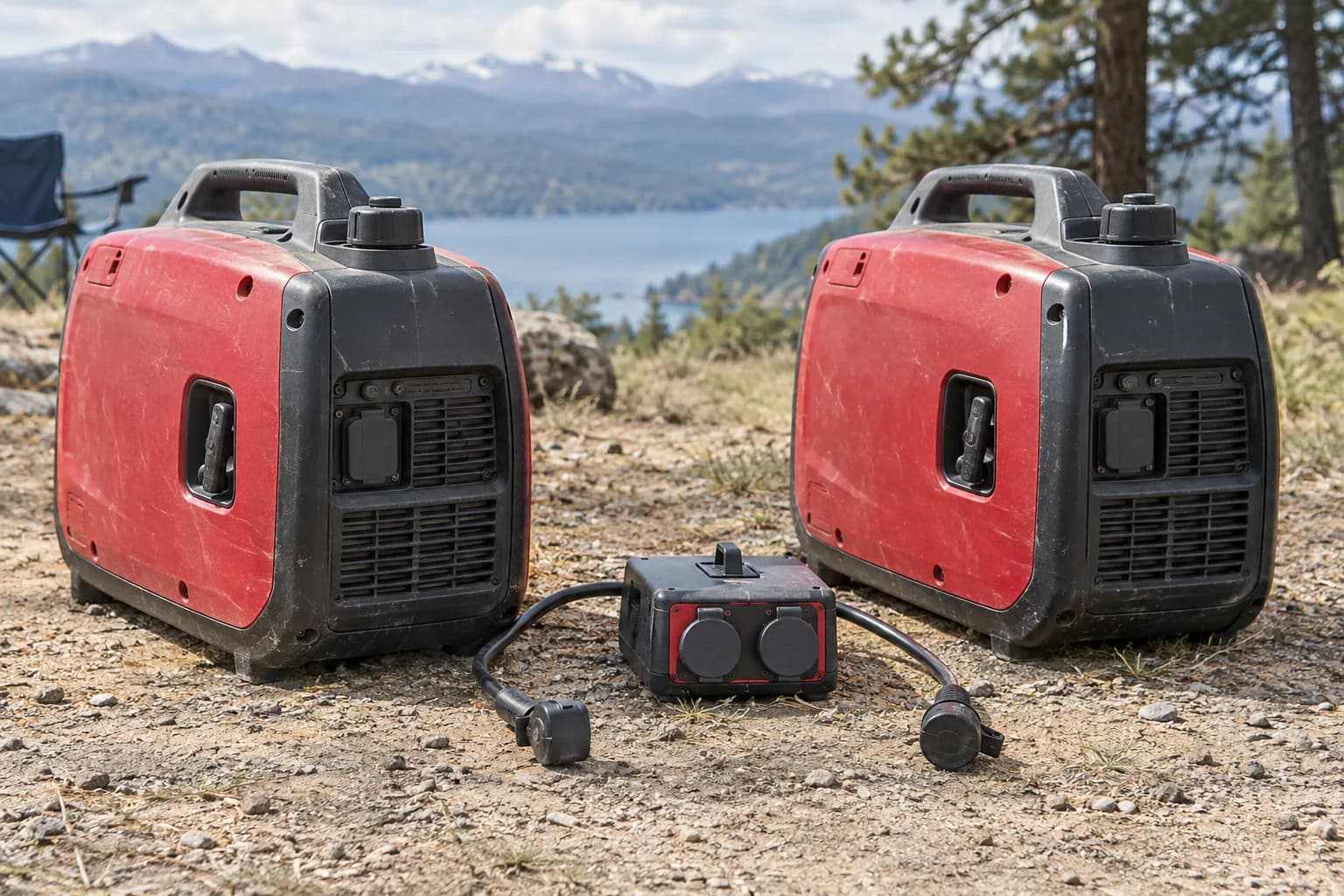
Quick answer
Parallel only models and serial ranges that the generator manufacturer explicitly approves together, using the specified cable or kit. Record the combined continuous and maximum output, then identify which receptacle delivers that output and its current limit. Connect, start, load, unload, stop, and disconnect the generators in the exact order in the manuals. Do not parallel household receptacles, different brands, or generators merely because their ports look alike.
Parallel operation requires generators designed to synchronize
Compatible inverter generators can coordinate voltage, frequency, phase, and load sharing through a manufacturer-defined parallel connection. That design can make two smaller units useful when a single larger unit would be harder to move or when only one unit is needed for light loads.
The parallel ports are not ordinary AC outlets. Never build a cable to join receptacles or assume that two generators with similar wattage and connector shapes can synchronize. An incorrect connection can create hazardous voltage, circulating current, equipment damage, fire, or exposed energized parts.
Compatibility can depend on model, version, and serial number
Read the owner manuals and the parallel-kit instructions for both generators. Honda, for example, publishes model and serial-range compatibility for certain EU2200i and EU2000i combinations and warns that an incompatible pairing can cause low voltage and equipment damage. That table applies only to the named Honda products.
Other manufacturers may permit identical models, selected companion versions, or a specific family with one named kit. Firmware, control hardware, output rating, or safety systems can change during a product run. If the current manufacturer documentation does not approve the exact pair, treat it as incompatible.
| Check | Record before use | Why it matters |
|---|---|---|
| Generator A | Model, serial, running watts, maximum watts | Establishes compatibility and capacity |
| Generator B | Model, serial, running watts, maximum watts | Establishes compatibility and capacity |
| Parallel hardware | Manufacturer part number and instructions | Defines safe connection and outlet path |
| Combined output | Continuous watts, maximum watts, amps and duration | Prevents using a short-term rating continuously |
| Load connection | Receptacle, voltage, cord and breaker rating | Identifies the real downstream limit |
Combined generator watts and usable outlet amps are separate limits
Two generators do not automatically provide exactly twice every rating. Use the manufacturer table for the specific pair. Distinguish continuous output from a limited maximum or starting output. Then check the receptacle through which the combined output is available.
Some companion models or parallel boxes provide a higher-current RV or locking outlet. Other arrangements remain limited by an individual receptacle even though the generators can produce more in total. The kit, breaker, outlet, adapter, and cord must all cover the intended current and voltage.
Build the load plan around continuous output and motor starts
Add the running watts that will overlap, then evaluate the largest additional motor start. Air conditioners, pumps, refrigerators, and compressors may need more power for startup. A second generator may improve the available starting margin, but the exact parallel system still has a stated limit.
Start with loads disconnected or off if the manuals require it. Apply loads in a deliberate sequence and observe overload indicators. If a breaker or overload protection operates repeatedly, remove load and diagnose the plan. Do not bypass protection or substitute a larger breaker.
Follow the approved connection and shutdown sequence
Manufacturer instructions commonly require the engines to be stopped for connecting or removing parallel hardware. The exact order for cable connection, grounding or bonding provisions, starting each unit, economy mode, load connection, unloading, stopping, and cable removal is model-specific.
Keep both manuals and the kit instructions with the equipment. Inspect ports, plugs, cables, insulation, strain relief, and enclosures before use. Stop if a connection is loose, hot, wet, damaged, or shows discoloration. Do not touch or alter the parallel connection while the system is energized.
Compare two small generators with one larger generator
Two units can offer easier handling, light-load flexibility, and some operational choice. They also add a second engine, fuel supply, maintenance schedule, battery or starter, storage location, security need, and set of operating steps. A parallel pair is not automatic redundancy if the only approved high-current outlet or parallel box becomes unavailable.
Compare total purchase price, kit, cords, fuel use at the actual load, noise data, service, weight per lift, combined footprint, setup time, outlets, voltage, and transfer compatibility. Choose the arrangement whose complete operating procedure remains practical during an outage or trip.
- Confirm exact model and serial compatibility
- Use the named manufacturer kit
- Record continuous and short-term combined ratings
- Identify the outlet that carries combined power
- Connect and disconnect only in the approved state
Frequently asked questions
Common questions
Can you parallel two different generators?
Only when the manufacturer documentation explicitly approves those exact models and, where applicable, serial ranges together with a specified kit. Similar wattage or ports are not evidence of compatibility.
Do two 2,000 watt generators make 4,000 watts?
Use the published table for the exact pair. Continuous combined output can be lower than the sum of advertised maximum numbers, and the usable outlet or kit may add another limit.
Can I parallel generators from different brands?
Do not do so unless both manufacturers expressly document the exact cross-brand combination and hardware. In practice, use the approved pair and kit identified by the manufacturer.
Can parallel generators power an RV?
Some approved systems provide a compatible RV outlet. Verify the RV service, combined continuous output, air-conditioner starting demand, outlet and cord ratings, neutral and grounding instructions, and campground rules.
Primary references
CordFind summarizes connector specifications and public safety guidance. Always follow the instructions supplied with your equipment.
- Honda: Generator Parallel Capability
- Honda: EU2200i and EU2000i Parallel Operation
- Honda: EU3000is Owner’s Manual
- Cummins Onan P4500i Product Specifications
- CPSC: Generators and Engine-Driven Tools