Quick answer
List the RV loads that must run together, then add the largest extra motor-starting demand. Confirm whether the coach is 120-volt 30A service or 120/240-volt 50A service and identify its approved generator connection. Compare built-in and portable options by fuel source, rated output, starting performance, runtime, noise data, service access, exhaust arrangement, transfer method, and maintenance. Never operate a portable generator in an RV compartment or improvise an adapter that changes the electrical system.
Built-in and portable RV generators are different installations
A built-in RV generator is selected for a compatible compartment, fuel system, cooling path, exhaust layout, controls, and coach connection. Its installation manual defines clearances, airflow, exhaust routing, wiring, transfer equipment, and service access. Replacement should match the application and installation requirements, not only the old unit's nominal watts.
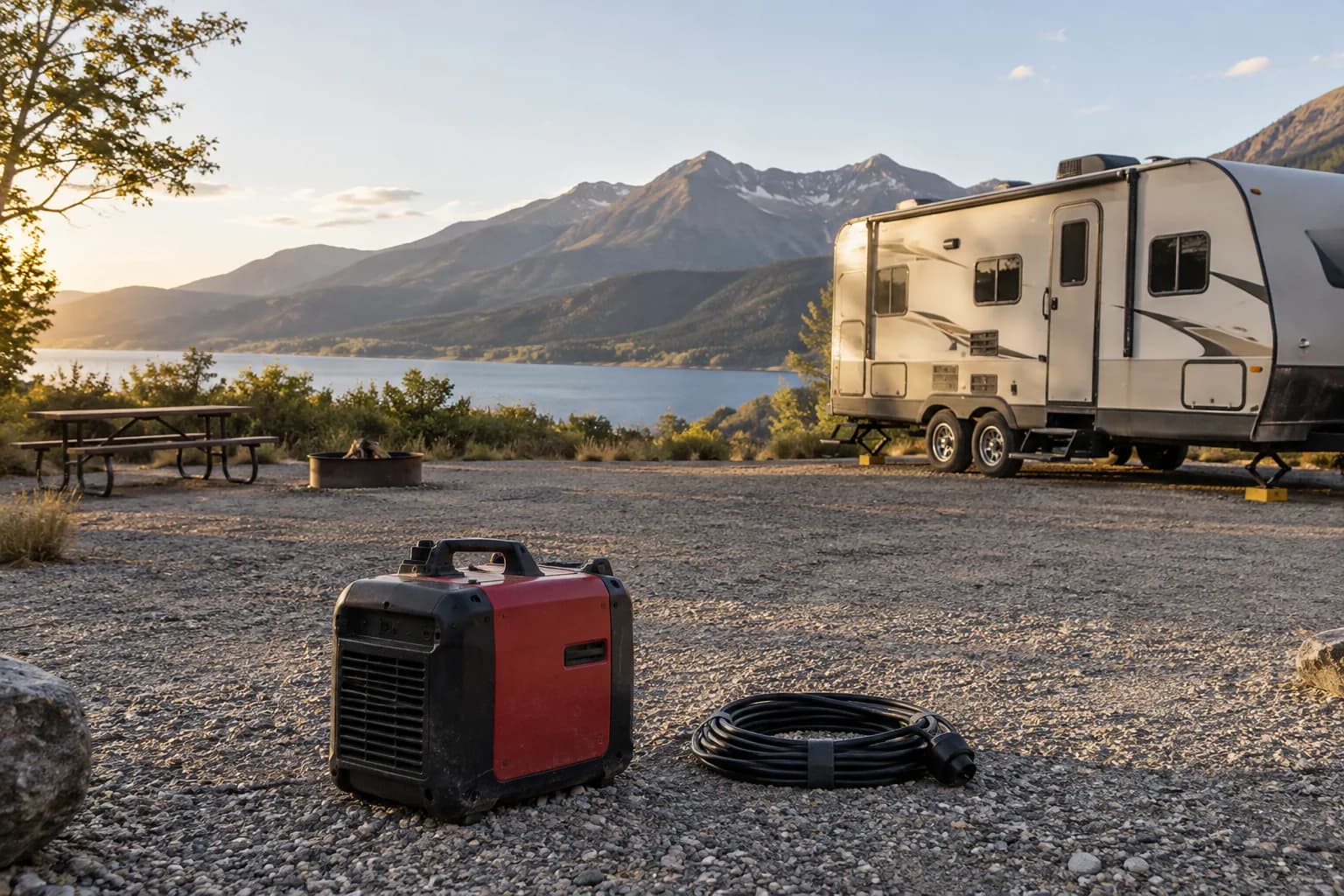
A portable generator remains separate from the RV. It must operate outdoors in the manufacturer-approved orientation, away from openings and occupied areas, with a secure placement and suitable cord path. Never place a portable unit in an onboard generator bay, cargo compartment, truck bed with a closed cover, tent, or screen room.
Identify the RV service before selecting adapters or outlets
A common 30-amp travel-trailer connection is TT-30, a 125-volt configuration. A common 50-amp RV connection is the 14-50 family, which can provide two 120-volt legs in a compatible RV system. These connection families are not interchangeable, and the coach may use transfer equipment or energy-management controls that affect generator operation.
Record the inlet or cord designation, coach main rating, transfer method, generator receptacle, voltage, grounding and neutral instructions, and every adapter designation. An adapter can change connector shape. It cannot create missing voltage, add a neutral, increase generator output, or make an unsupported parallel connection acceptable.
| Question | Built-in generator | Portable generator |
|---|---|---|
| Connection | Coach wiring and approved transfer system | Approved receptacle, cord and coach inlet path |
| Fuel | Vehicle fuel, propane, or model-specific supply | Carried gasoline, propane, or approved alternate fuel |
| Exhaust | Installed system designed for the coach | Outdoor placement away from all openings |
| Starting | Coach control panel or approved auto-start | Local or model-approved remote controls |
| Service | Access through installed compartment | Portable maintenance and secure storage |
Product to compare
Amazon · paid linksCamco 55195 Power Grip — 30 ft 50A RV extension cord
Compare this extension cord for a matching 50A RV connection after verifying both endpoint labels and the RV manufacturer’s instructions.
For this connection: This example is only for a matching 14-50 connection with a 14-50P RV cord. It does not fit TT-30 equipment or a CS-family building inlet, and it does not increase the generator’s output.
- 14-50P → 14-50R
- 30 ft
- 50A / 125–250V
- 6/3 + 8/1 copper
Amazon product code (ASIN): B0024ECIP0
See the current price and available sellers on Amazon.
Advantages
- 30 ft extension for matching 14-50 RV connections.
- Copper conductors in a 50A-rated cord assembly.
- 90-degree connector heads with grip handles.
Limitations
- Does not mate with a CS6375 building inlet.
- Does not fit a TT-30 connection.
- A 50A cord cannot increase the generator’s available output.
Check before buying: The female 14-50R does not mate with a CS6375 building inlet requiring a CS6364 cord connector. A 50A cord does not increase generator capacity.
Based on manufacturer specifications; not independently field-tested by CordFind. Confirm the model and both connector labels before buying.
Size the trip loads, not the shore-power maximum
List the air conditioner, converter or charger, refrigerator mode, microwave, water heater, coffee maker, hair dryer, entertainment equipment, and other loads. Use nameplates and manuals. Add the loads that can run together, then evaluate the largest additional start. A 30-amp shore connection does not mean the RV continuously needs 3,600 watts.
Air-conditioner starting performance depends on the compressor, ambient temperature, elevation, supply voltage, cord drop, other loads, and any manufacturer-approved starting aid. A generator that starts one air conditioner at sea level may not repeat the result at altitude with the battery charger and microwave online. Plan a load sequence and test it under realistic conditions.
Calculate runtime from the model and the camping schedule
Use the exact generator's consumption at a stated load, not an unrelated product's advertised maximum runtime. Estimate daytime and overnight loads separately, include battery charging, and reserve fuel for unexpected heat, cold, or delayed travel. For a built-in set that draws from the vehicle tank, confirm the manufacturer's fuel pickup behavior and any reserve design.
For portable fuel, include approved containers or cylinders, secure transport, storage rules, refueling or cylinder-change procedure, and campground restrictions. Shut down and cool gasoline equipment before refueling. Propane engines still produce carbon monoxide and still require outdoor operation.
Compare noise data with the actual campsite rules
A sound number is meaningful only with its test load, distance, measurement method, and operating mode. Compare published data on the same basis where possible. Economy mode can reduce engine speed on some inverter generators at light load, but air-conditioner starts and heavy loads can change the sound substantially.
Campgrounds may set generator hours, location rules, and sound limits. Exhaust cannot be directed toward neighboring sites, tents, windows, or air intakes. Do not build a box that restricts cooling or traps exhaust. Use only an enclosure or installed exhaust system approved for the application.
Use the model and specification number for every service decision
Cummins identifies RV generator manuals by product, series, and specification letter. That detail matters because oil, filters, intervals, controls, wiring, troubleshooting, and replacement parts can change within one product family. Photograph the data plate and store the current operator and installation manuals offline.
Before each trip, inspect fuel and exhaust components, wiring, mounting, oil, battery, air intake, cooling outlets, and fault history. Exercise and service the unit at the intervals and load conditions in the manual. A generator that starts in storage should still be tested with the planned coach loads before departure.
Frequently asked questions
Common questions
What size generator do I need for an RV?
Add the loads that must run together and the largest additional start, then compare the result with fuel-specific generator ratings, outlet limits, altitude effects, and the coach connection. The RV service maximum is not the required generator size.
Is a built-in RV generator better than a portable generator?
A built-in unit integrates fuel, exhaust, controls, and coach connection. A portable unit can be flexible and removable. The better choice depends on the approved installation, load, fuel, storage, noise, service, and camping plan.
Can I plug a 50 amp RV into a 30 amp generator?
Only through a compatible, approved connection plan that respects voltage, neutral, grounding, and the 30-amp source limit. The adapter does not provide 50 amps or power every coach load.
Can a portable RV generator run overnight?
Only if the manufacturer instructions, safe outdoor placement, fuel plan, local rules, noise limits, security, weather protection, and carbon-monoxide precautions are all satisfied. Never place it in or under the RV.
Primary references
CordFind summarizes connector specifications and public safety guidance. Always follow the instructions supplied with your equipment.
- Cummins: RV Generator Manuals
- Cummins: RV Generator Resource Library
- Cummins Onan P4500i Product Specifications
- CPSC: Generators and Engine-Driven Tools