Quick answer
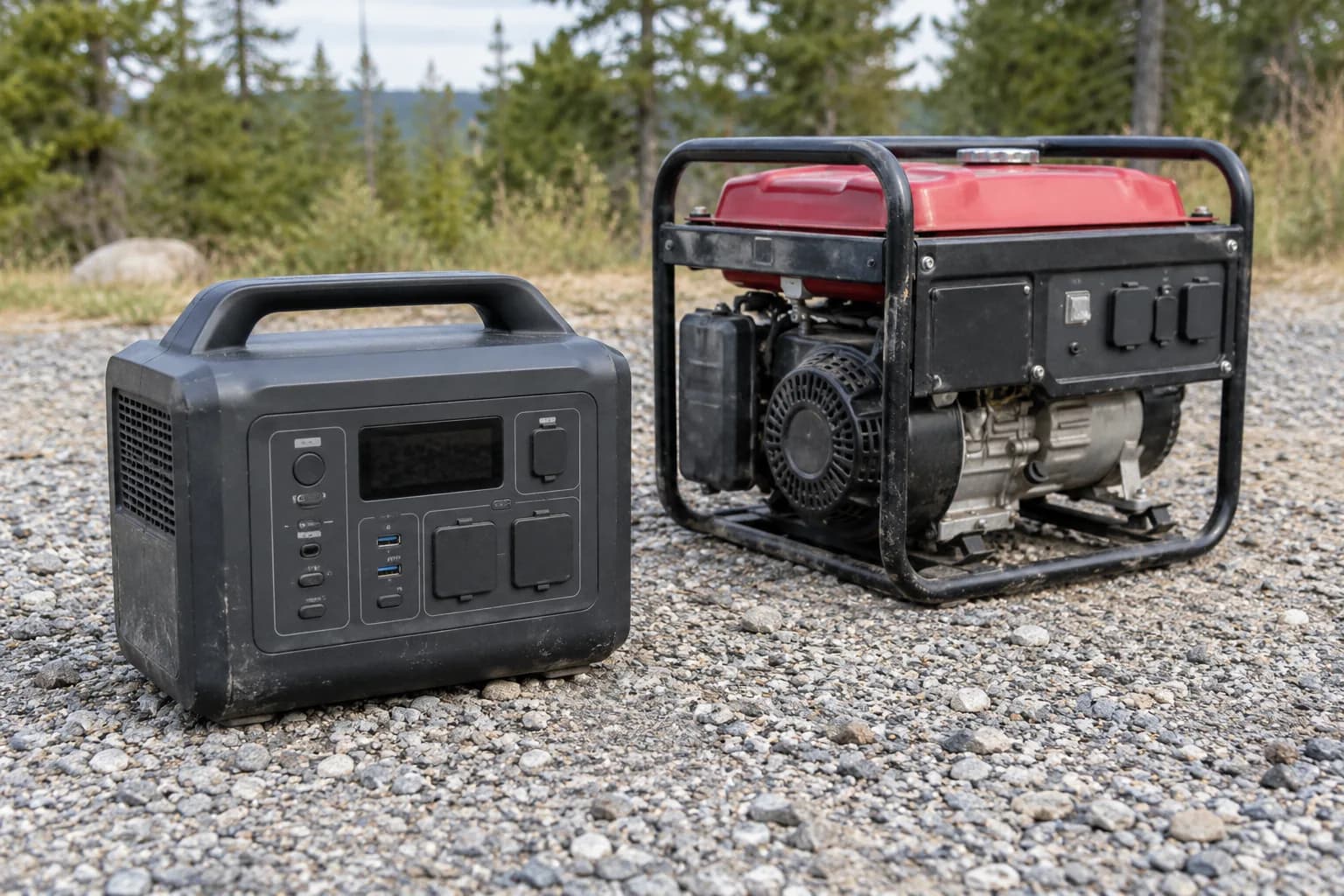
Choose from the loads and outage duration, not the product category alone. A power station can run compatible indoor electronics quietly without combustion exhaust, but its watt-hour capacity and inverter surge limit are finite. A fuel generator can support longer or heavier loads when fuel is available, but it must operate outdoors at least 20 feet from the home with exhaust directed away and requires fuel, engine maintenance, and safe cords or transfer equipment.
They produce backup electricity in different ways
A portable power station stores direct-current energy in a battery and uses an inverter to provide alternating-current outlets and other outputs. Its useful limits include continuous watts, surge watts, battery watt-hours, inverter behavior, charging input, battery management, temperature range, and product certification.
A portable generator uses an engine to turn a generator assembly. The engine consumes gasoline, propane, diesel, or another approved fuel while operating. Its useful limits include running watts, starting capacity, receptacle ratings, fuel consumption, duty limits, noise, emissions, maintenance, and the outdoor operating location.
Compare watts first, then compare energy over time
Watts describe how much power equipment demands at a moment. A refrigerator, pump, or air conditioner can also require a brief starting surge. Both a power-station inverter and a generator must carry the running load and the relevant starting event without exceeding the product or outlet rating.
Watt-hours describe stored battery energy. A 1,000 Wh battery does not automatically run a 1,000 W load for exactly one hour because inverter losses, battery protection, temperature, and reserved capacity matter. A fuel generator is planned from the manufacturer’s fuel-consumption rate at the expected load and the amount of safely available fuel.
| Decision | Portable power station | Portable fuel generator |
|---|---|---|
| Indoor operation | Follow product instructions; no combustion exhaust during discharge | Never indoors or in any enclosed or partially enclosed area |
| Runtime input | Usable battery watt-hours and load watts | Published fuel rate, available fuel, and load |
| Starting loads | Inverter surge rating and behavior | Generator starting capability and receptacle limits |
| Replenishment | Compatible charging source and time | Approved fuel, safe storage, shutdown, and cooling |
| Maintenance | Battery care, charging, storage temperature | Engine, fuel, oil, battery, and scheduled service |
Build runtime from the actual load schedule
For a power station, add the watts of simultaneous loads and estimate how long each will operate. Divide usable watt-hours by average watts for a first-pass runtime, then apply the manufacturer’s efficiency and operating guidance. A cycling refrigerator is not the same as a heater that stays on continuously.
For a fuel generator, use the fuel-rate table for the exact model and expected load point. Multiply rate by operating hours for fuel use or divide usable fuel by the rate for planning runtime. Do not compare a battery’s best-case low-load figure with a generator’s full-load fuel figure.
The safe operating locations are not interchangeable
CPSC says a portable fuel generator must operate outside, at least 20 feet from the home, with exhaust directed away from the home and other buildings. It cannot run in a garage, shed, basement, porch, or other enclosed or partially enclosed area. Fuel storage and refueling also introduce fire and vapor hazards.
A power station produces no combustion exhaust while discharging, but it is still high-energy electrical and battery equipment. Follow its instructions for ventilation, moisture, charging temperature, damaged batteries, compatible solar or wall inputs, cord loading, and storage. Look for certification that matches the product category and intended use. UL describes UL 2743 as a standard for portable power packs; it does not turn a portable unit into a permanently installed residential energy-storage system.
Assign each source a job in the outage plan
A power station often fits communications, lighting, medical devices that the manufacturer approves for the source, laptops, and other modest indoor loads where quiet operation matters. A fuel generator may fit longer outages, pumps, refrigeration, and larger scheduled loads when outdoor placement, fuel, maintenance, and connection requirements can be met.
A hybrid plan can use a fuel generator outdoors for heavier daytime loads and battery charging, then use a power station for smaller indoor loads after the engine is shut down. Verify that the generator output, charger input, cords, charging rate, and product instructions support that arrangement. The best plan is the one whose limits remain visible under the actual load schedule.
- List required loads, running watts, starting watts, and hours
- Check every outlet, inverter, cord, and generator rating
- Plan safe outdoor generator placement before counting on fuel power
- Plan recharge time and source before counting on battery capacity
- Keep a reserve for uncertainty rather than using the final watt-hour or fuel unit
Frequently asked questions
Common questions
Is a portable power station the same as a generator?
No. A power station stores electrical energy in a battery and supplies it through an inverter. A fuel generator converts engine power into electricity while it runs.
Can a portable power station run indoors?
It has no combustion exhaust while discharging, but it still must be used, charged, ventilated, and stored according to its product instructions. Damaged or overheated batteries require special caution.
Which lasts longer, a power station or a generator?
Runtime depends on the load, usable battery watt-hours, charging access, generator fuel rate, and available fuel. Compare both against the same hour-by-hour load schedule.
Can a portable power station run a refrigerator?
Only if its continuous and surge ratings cover the refrigerator and its usable energy supports the required runtime. Use the refrigerator nameplate and manufacturer starting information rather than a generic appliance estimate.
Primary references
CordFind summarizes connector specifications and public safety guidance. Always follow the instructions supplied with your equipment.
- UL Solutions: Portable Power Pack Testing and UL 2743
- UL Solutions: Portable Power Pack Installation Q&A
- CPSC: Generator and Engine-Driven Tool Safety
- EIA: How Electricity Is Generated