Quick answer
CPSC says to operate portable generators outside only, at least 20 feet from the home, with exhaust directed away from the home and other buildings. Never use one in a home, garage, basement, crawlspace, shed, porch, tent, or partly enclosed space. Keep windows, doors, and vents closed in the exhaust path, maintain battery-backed CO alarms on every level and outside sleeping areas, and move to fresh air and call 911 when poisoning is suspected.
CO cannot be detected by human senses
Carbon monoxide has no color or odor. Symptoms can include headache, dizziness, weakness, nausea, vomiting, sleepiness, and confusion. A person may become unable to move the generator or recognize the source as concentrations rise.
Do not rely on smell, an open door, a fan, or how briefly the generator has run. CPSC warns that portable generators can create deadly CO quickly and can produce emissions comparable to hundreds of cars.
Choose the outdoor operating point before the outage
Measure an outdoor location at least 20 feet from the home and consider neighboring buildings, doors, windows, vents, soffits, crawlspace openings, terrain, fences, and exhaust direction. Keep the exhaust pointed away from the home and other buildings that people could enter.
Wind can change. Recheck the exhaust path during operation and keep openings closed in that path. A detached garage, shed, porch, carport, breezeway, or generator box can still be enclosed or partly enclosed and is not a default operating location.
Use alarms as a second layer, not permission to move closer
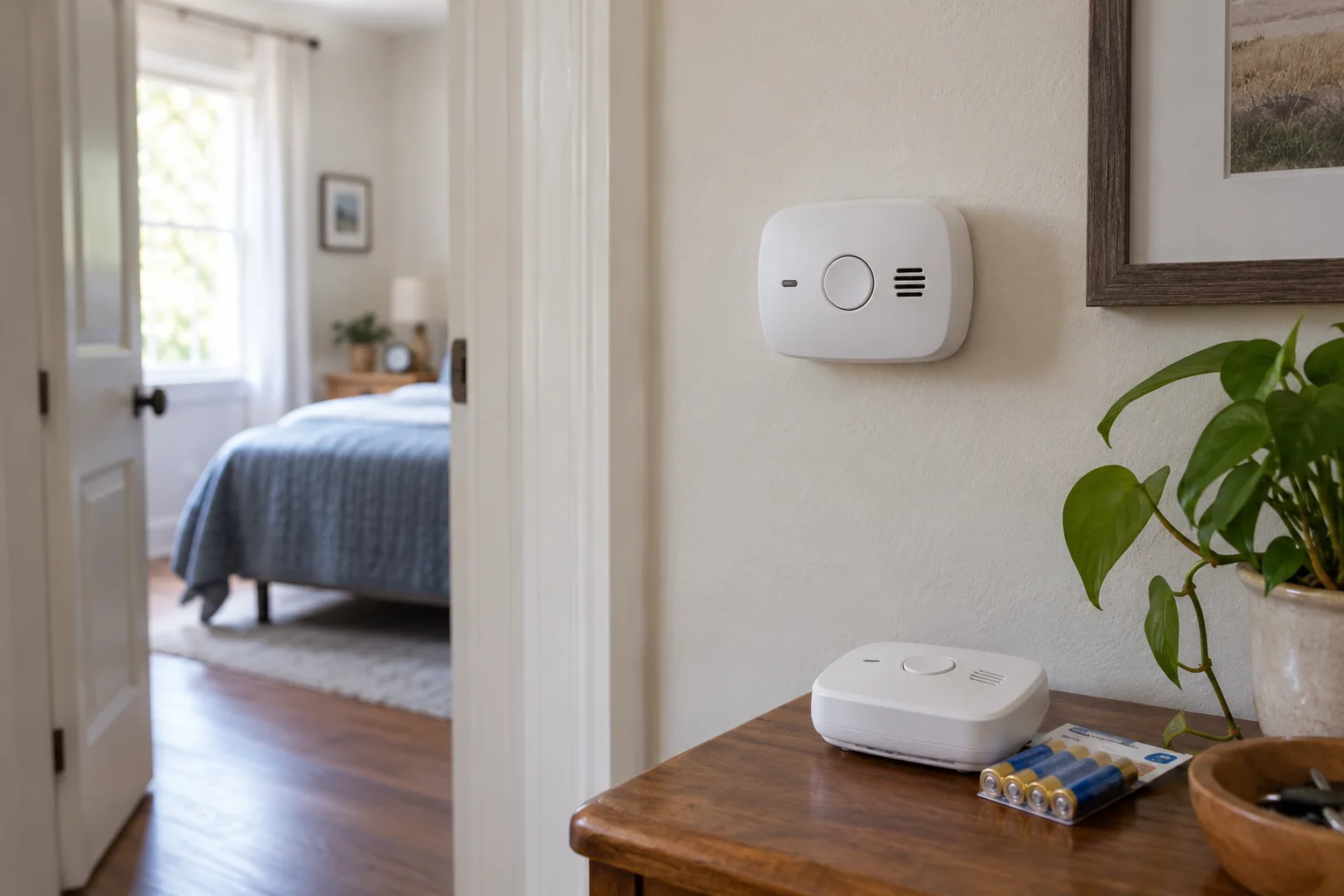
CPSC recommends battery-operated CO alarms or alarms with battery backup on every level and outside sleeping areas. Interconnected alarms can alert more of the home when one senses CO. Test and replace them according to the alarm manufacturer’s instructions.
A CO shutoff feature on a generator can add protection, but it does not replace outdoor distance, exhaust direction, alarms, maintenance, or supervision. Never restart repeatedly after a CO shutdown without correcting the placement and following the manual.
Write the alarm and symptom response in advance
If an alarm sounds or people develop symptoms, get everyone to fresh air immediately and call 911. Do not delay evacuation to investigate, ventilate, or retrieve equipment. Emergency responders can evaluate the scene and exposed people.
After the emergency, do not resume generator operation until the cause, placement, exhaust direction, openings, equipment condition, and alarm system have been reviewed. Preserve any fault indication or CO-shutoff event for qualified service.
Make safe placement practical in rain, snow, and darkness
Prepare approved weather protection, rated cords, lighting, wheel access, snow clearance, theft deterrence, and fuel handling before an outage. Weather pressure often causes people to move generators into garages or close to doors, so the safe outdoor plan must be usable under bad conditions.
Include every occupant, guest, tenant, and neighbor who may operate or be affected by the generator. Store the instructions offline and label the generator with the approved location and emergency response.
Frequently asked questions
Common questions
How far should a portable generator be from a house?
Current CPSC guidance says outside only, at least 20 feet from the home, with exhaust directed away from the home and other buildings. The manual and site conditions may require additional constraints.
Can I run a generator in a garage with the door open?
No. Open doors and windows do not make garage operation safe. Move the generator fully outdoors to the required location.
Do I still need CO alarms if the generator has CO shutoff?
Yes. A shutoff feature is an additional layer. Maintain alarms and follow all placement, distance, exhaust, and opening guidance.
What should I do if a CO alarm sounds?
Get everyone outside to fresh air immediately and call 911. Do not pause to investigate or retrieve the generator.
Primary references
CordFind summarizes connector specifications and public safety guidance. Always follow the instructions supplied with your equipment.
- CPSC: Carbon Monoxide Information Center
- CPSC: Generators and Engine-Driven Tools
- CPSC: Portable Generators Pose a Serious Carbon Monoxide Hazard
- CPSC: Portable Generator Labels