Quick answer
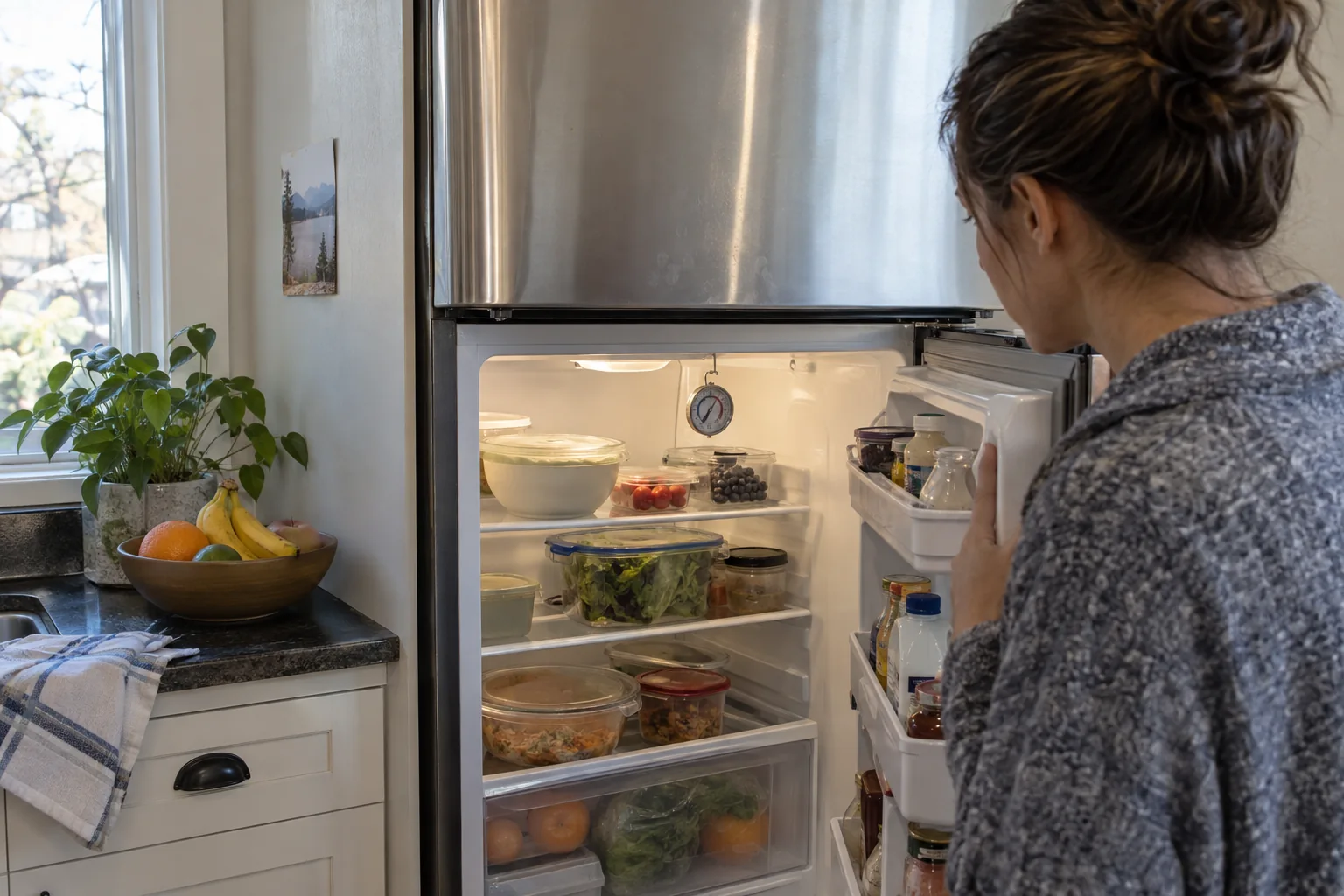
Use the refrigerator data plate and manual, plus measured or manufacturer starting information when available. Add all running outage loads, then one largest additional startup demand and a reserve. Verify the generator continuous and transient ratings, voltage quality, cord, fuel, and safe outdoor placement. Keep an appliance thermometer in the refrigerator: FDA says an unopened refrigerator keeps food cold for about four hours, but temperature history still controls the food decision.
Find the refrigerator load without guessing from size
Start with the model data plate and owner or service documentation. Record voltage, frequency, rated current or input, and any separate information for the compressor, defrost system, or electronic controls. An annual kilowatt-hour label is useful for energy comparison, but it does not state the short startup demand a generator must tolerate.
A plug-in power meter can help characterize running energy on compatible equipment, but many consumer meters do not capture a fast startup peak accurately. Use manufacturer data or qualified measurement when startup behavior is critical. Do not infer one universal multiplier from refrigerator capacity or age.
Modern refrigerators can use conventional, variable-speed, or inverter-driven compressors. Their starting behavior differs. This is why a search for a single refrigerator wattage produces answers that should be treated as examples rather than equipment specifications.
Add the loads that remain on when the compressor starts
Calculate the running watts for the refrigerator and every other load that will stay connected. Then add the refrigerator additional starting watts, or the largest additional startup among all connected motors. Add a planning reserve instead of sizing exactly to a laboratory number.
A 2,000 watt generator may run many household refrigerators, but the label alone cannot answer the question. A freezer, furnace blower, sump pump, or microwave on the same source can change the result. So can altitude, fuel choice, eco mode, extension-cord voltage drop, and generator transient response.
Stagger large loads. Let the refrigerator start and stabilize before adding another motor. Avoid operating heating appliances at the same time unless the load plan clearly covers them.
| Question | Input | Decision |
|---|---|---|
| Can it start? | Measured or published startup demand and generator transient response | Check voltage and compressor acceleration |
| Can it keep running? | Continuous refrigerator plus simultaneous loads | Stay within generator, outlet, and cord ratings |
| How long can it run? | Duty cycle, fuel rate or usable battery energy, recharge plan | Schedule fuel or charging with reserve |
| Is the food safe? | Appliance thermometer and time above safe temperature | Follow FDA food-safety guidance |
Add a freezer without counting its starting watts twice
A separate freezer adds another compressor that can restart without a person operating a switch. Record its running demand and total startup demand separately. Additional starting watts are total startup watts minus that appliance’s running watts; adding total startup to a running total that already includes the appliance counts its running portion twice.
The table uses invented inputs, not appliance averages: refrigerator 180 running watts and 1,200 total startup watts; freezer 150 running watts and 1,000 total startup watts; lights and communications 70 watts. Running demand is 400 watts. One start at a time produces a planning event of 400 + 1,020 = 1,420 watts. If both starts overlap, the screen becomes 400 + 1,020 + 850 = 2,270 watts. Actual transient duration, power factor, source response and reserve still have to be confirmed.
Starting the appliances separately during setup does not guarantee their thermostats will remain synchronized that way. Observe automatic restart behavior and use an approved load-management plan if the source cannot handle the possible overlap. For a battery power station, also collect each appliance’s watt-hours over representative cycles and plan approved recharging.
| Load | Running watts | Total startup watts | Additional starting watts |
|---|---|---|---|
| Refrigerator | 180 | 1,200 | 1,020 |
| Freezer | 150 | 1,000 | 850 |
| Lights and communications | 70 | 70 assumed | 0 |
| All running | 400 | — | — |
| Largest single start | 400 + 1,020 | 1,420W planning event | Verify actual response |
| Overlapping compressor starts | 400 + 1,020 + 850 | 2,270W planning event | Verify overlap or approved management |
Fuel generator and power station calculations use different limits
A fuel generator is usually compared by rated running watts, motor-start behavior, fuel consumption at a stated load, and available fuel. It must run outdoors at a safe distance. A battery power station is compared by continuous inverter watts, surge behavior, usable watt-hours, standby consumption, charging time, battery temperature, and the refrigerator duty cycle.
For a power station, energy is as important as power. A source can start the compressor yet run out of usable watt-hours before the next recharge. Estimate from measured watt-hours over a representative warm day when possible, then include inverter loss and reserve. Do not multiply the refrigerator running watts by 24 hours unless it truly runs continuously.
For either source, confirm grounding, GFCI behavior, cord instructions, output waveform, and compatibility with electronic controls. A successful five-minute test does not prove a full-day outage plan.
Protect startup voltage with the correct connection
Use an intact grounded cord rated for the environment and above the connected load. The run must be long enough to keep a combustion generator safely outdoors, but longer and undersized cords increase voltage drop. Keep connections dry and protected according to the product instructions.
Avoid daisy-chained household cords, overloaded multi-outlet strips, missing grounding pins, damaged jackets, and cords routed through doors or windows where they can be crushed. A cord does not permit the generator to move closer to the home.
If the refrigerator repeatedly clicks, fails to start, resets, or the cord or plug becomes warm, stop. Check voltage, connections, generator loading, and the appliance rather than continuing repeated compressor attempts.
Use temperature, not generator runtime, to judge food safety
FDA recommends appliance thermometers and says a refrigerator should be at or below 40°F and a freezer at or below 0°F before an outage. Keep doors closed as much as possible. An unopened refrigerator keeps food cold for about four hours; a full freezer can hold temperature for about 48 hours and a half-full freezer about 24 hours when the door remains closed.
Those are planning windows, not permission to ignore temperature. When power returns or backup operation begins, check appliance and food temperatures. FDA says to discard refrigerated perishable food that has been above 40°F for four hours or more. Do not rely on smell or appearance to decide that food is safe.
Prepare coolers, ice, frozen gel packs, and a thermometer before storm season. Starting a generator after the refrigerator has warmed does not reverse unsafe time and temperature exposure.
Run a documented test before the next outage
Place and operate the generator according to its manual, then connect only the approved refrigerator cord and observe several compressor cycles. Record generator mode, other loads, ambient temperature, voltage where safely measured, any faults, and fuel or battery use.
Repeat with the actual essential load schedule, not every household appliance. Store the circuit and cord plan near the equipment. Include the food thermometer, cooler supplies, generator maintenance, fuel rotation, and shutdown procedure in the same outage checklist.
Frequently asked questions
Common questions
What size generator will run a refrigerator?
Use the exact refrigerator running and starting data, add other simultaneous loads, and verify generator continuous and transient performance. There is no single wattage for every refrigerator.
Will a 2,000 watt generator run a refrigerator?
It may, but only the exact refrigerator startup, other loads, generator ratings, voltage behavior, fuel and altitude derating, and connection can confirm the plan.
Can a solar generator run a refrigerator?
A battery power station can if its inverter handles startup and its usable watt-hours cover the refrigerator duty cycle until recharge. Use measured energy and a recharge plan with reserve.
How long is food safe in a refrigerator during an outage?
FDA says an unopened refrigerator keeps food cold for about four hours. Use an appliance thermometer and discard refrigerated perishables that have been above 40°F for four hours or more.
Should a refrigerator stay connected when starting a generator?
Follow the generator manual. Many portable generators should start with loads disconnected or the output breaker off, warm up, and then receive loads in a controlled sequence.
Can one generator run a refrigerator and a separate freezer?
Potentially. Add both running loads and the other connected loads, then check the possible compressor startup overlap against the exact generator, outlet and cord requirements. Initial staged connection does not guarantee later thermostat cycles will never overlap.
Primary references
CordFind summarizes connector specifications and public safety guidance. Always follow the instructions supplied with your equipment.
- FDA: Food and Water Safety During Power Outages
- FDA: Refrigerator Thermometers and Food Safety
- ENERGY STAR: Refrigerators
- OSHA: Using Portable Generators Safely
- Honda: EU3200i Manual, Appliance and Receptacle Ratings