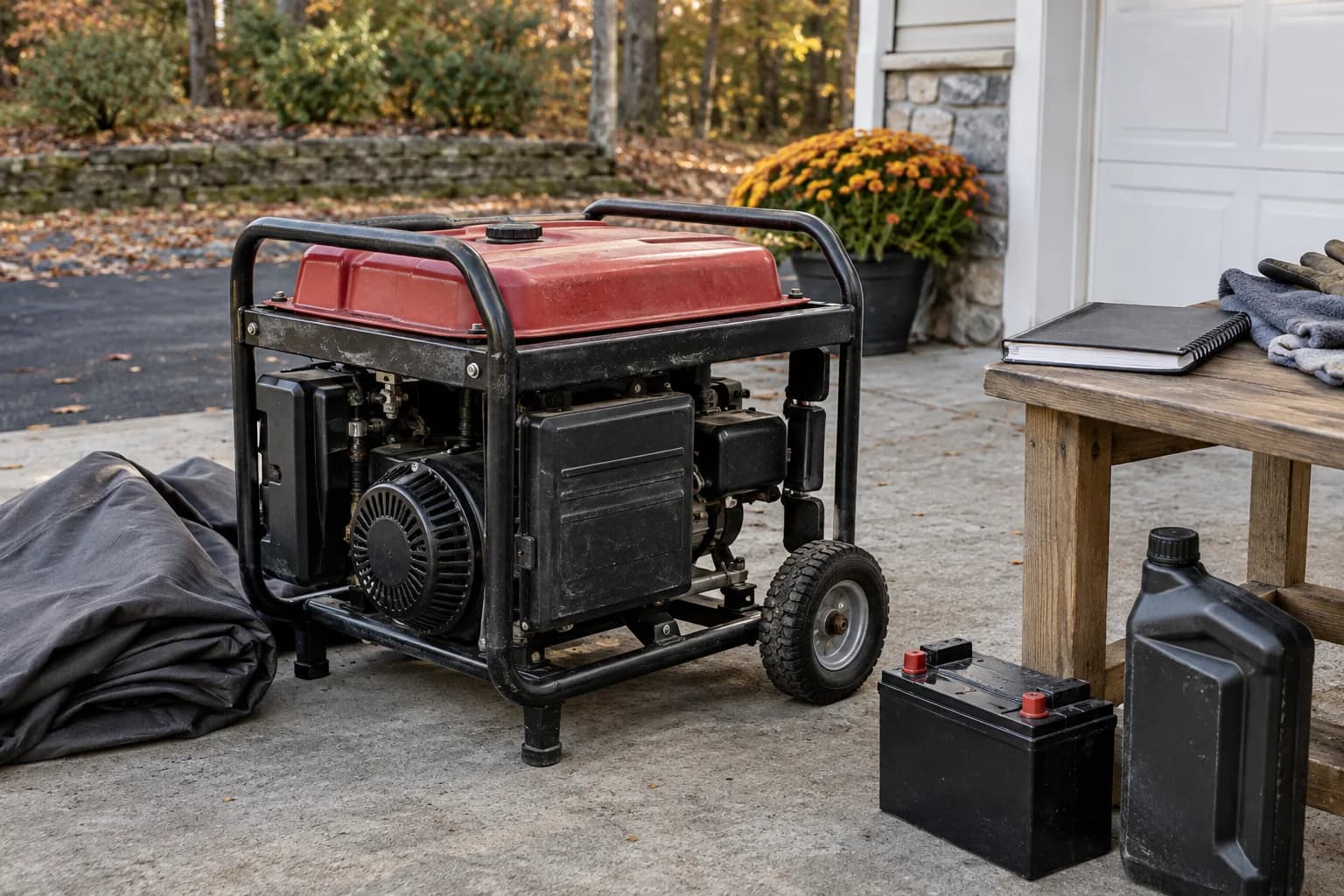
Quick answer
Use the storage section of the exact owner manual and define the expected storage interval. Follow its fuel-tank, carburetor, stabilizer, oil, battery, cleaning, cooling, ventilation, valve, and orientation instructions. Store fuel only in approved containers and under applicable rules. Label the date and actions completed, preserve the starting and maintenance records, and perform the manual’s return-to-service inspection outdoors before relying on the generator.
Choose the procedure by storage interval and fuel system
Manuals can distinguish a few weeks, several months, and more than a year. A carbureted gasoline model, fuel-injected model, dual-fuel model, diesel set, and battery-start system can require different actions. Record the fuel in the machine and the last date it operated.
Honda notes that treated gasoline can still deteriorate during long storage and provides model-family procedures that change with time. Do not assume stabilizer restores stale fuel or makes an indefinite storage period safe. The exact manual controls.
Complete the fuel procedure instead of only closing the valve
The manual may call for fresh stabilized fuel for a defined interval, draining the carburetor bowl, draining the tank, running treated fuel through the system, closing a tank vent, or another model-specific sequence. Fuel-injected systems can have different preservation steps. Never run an engine indoors to circulate or consume fuel.
Date approved fuel containers and store them according to container instructions and applicable fire rules, away from ignition and occupied space. Plan rotation before the fuel becomes questionable. Do not pour fuel onto the ground, into drains, or into household waste. Use an approved local disposal path for unusable fuel.
Match fuel stabilizer to the manufacturer’s storage interval
Honda’s fuel-storage page names EU1000i, EU2000i and EU3000i Handi and separates its advice by interval. The table summarizes that named model-family example; it is not a storage rule for every carbureted, fuel-injected or dual-fuel generator. Check the exact manual, serial range and current support guidance before choosing a procedure.
Honda says stabilizer will not restore stale fuel and the additive itself has a shelf life. Keep a record of the fuel purchase date, stabilizer product and expiry, treated quantity, storage start date and completed manual steps. A bottle’s advertised preservation period does not override the generator manufacturer’s shorter fuel-system procedure.
| Published interval | Manufacturer direction to verify | Record |
|---|---|---|
| 1–2 months | Fresh stabilized fuel; specified outdoor circulation and vent procedure | Fuel date and completed model-specific steps |
| 2–12 months, or use less than monthly | Carburetor draining and vent procedure in the manual | Procedure completed and return-to-service date |
| More than one year | Tank and carburetor draining in the manual | Both fuel-system steps completed |
Inspect oil, cooling, intake and corrosion points
Let the generator cool before storage. Clean debris without forcing water into electrical components or the fuel system. Check the oil procedure, air filter, cooling openings, spark plug or cylinder-preservation instructions where specified, exhaust condition, frame, fasteners, wheels, handles, and any visible leak.
Store the generator upright in a dry, secure, well-ventilated location allowed by the manual. Protect it from weather and pests without sealing fuel vapors into an unsafe enclosure. A running cover and a storage cover are different products; never operate the unit under a storage cover.
Preserve the starting battery and charger safely
Record battery type, installation date, terminal condition, and resting or tested condition as supported by the manual. Use only an approved maintainer and connection method. A charger plugged into an unmonitored or unsuitable circuit can create a different failure mode.
For models with remote or electric start, a discharged battery can make an otherwise sound engine unavailable. Include remote fobs, controller batteries, and charger indicators in the storage record. Follow manufacturer instructions for battery removal, temperature, ventilation, and periodic inspection.
Use a written return-to-service sequence
Before fueling or starting, inspect for pests, damaged wiring, blocked cooling paths, leaks, corrosion, loose parts, stale fuel, battery damage, and overdue maintenance. Restore drained components and fluids exactly as instructed. Move the generator to its safe outdoor operating location before starting.
Start with the output breaker off, observe warmup, check voltage or frequency indicators where provided, and add a controlled test load permitted by the manual. Stop for leakage, unstable operation, abnormal exhaust, alarms, damaged cords, or unexpected trips. Update the storage and maintenance record after the test.
Frequently asked questions
Common questions
Should I drain gas before storing a generator?
It depends on the exact model and storage interval. Some manuals specify stabilized fresh fuel for a limited period and draining the carburetor or tank for longer storage. Follow the exact storage section.
Is fuel stabilizer enough for a year?
Do not assume so. Honda states that even treated gasoline can deteriorate in the fuel system during long-term storage and calls for model-specific draining procedures for extended periods.
Can I store a generator in a garage?
Storage conditions must follow the manual and local fuel rules. The generator must be cool, upright, secure, and protected from ignition and vapor accumulation. It must never be operated there.
How do I test a generator after storage?
Inspect and service it first, move it outdoors, start with the breaker off, observe warmup, and apply only a controlled permitted load. Stop for any leak, alarm, instability, or damage.
Primary references
CordFind summarizes connector specifications and public safety guidance. Always follow the instructions supplied with your equipment.
- Honda: EU Generator Fuel Recommendations
- Honda: Generator Operation and Storage
- Honda: Fuel Recommendations and Storage Tips
- CPSC: Generators and Engine-Driven Tools