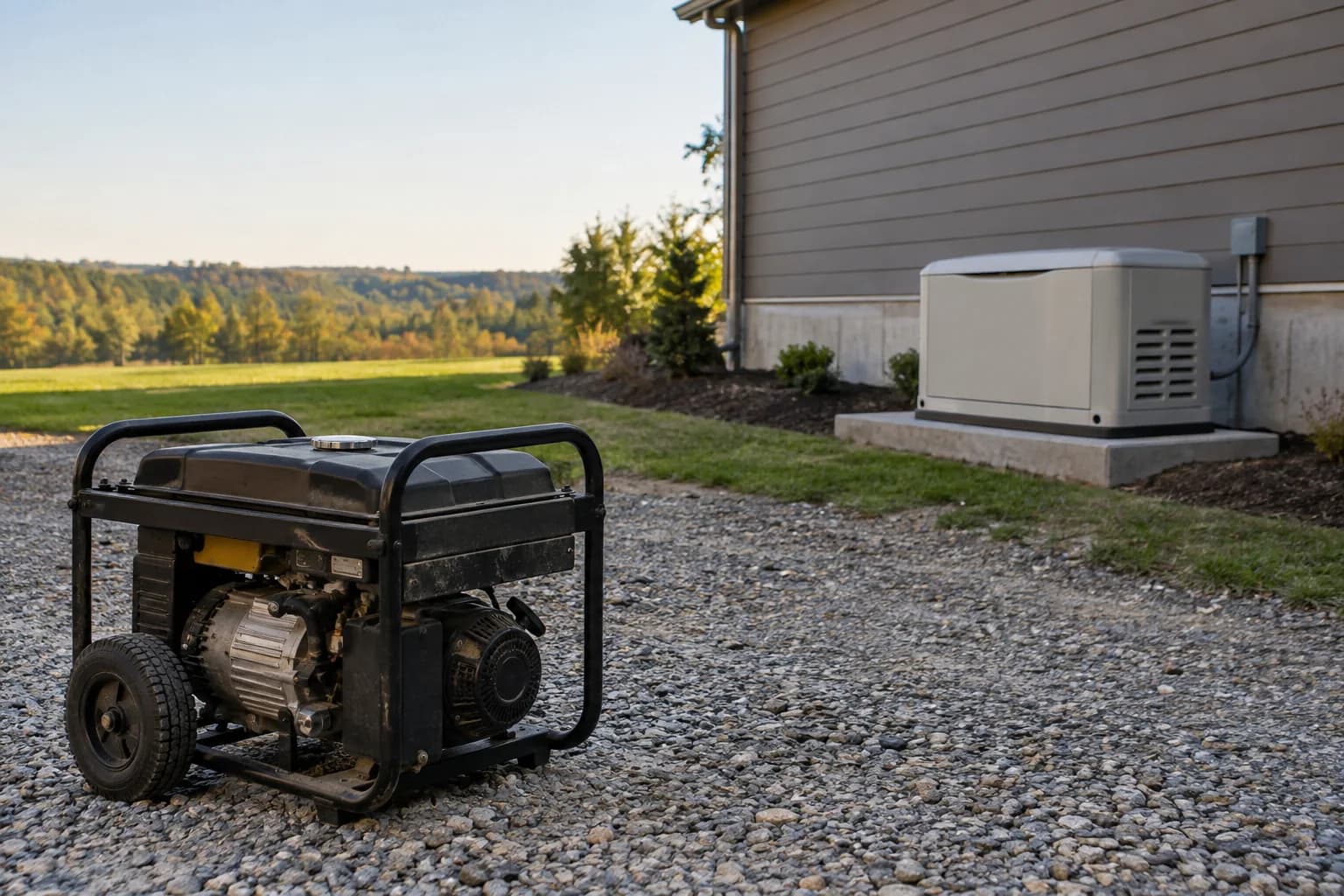
Quick answer
Choose a portable system when a trained operator can safely place, start, connect, load, monitor, refuel, and secure it during every outage. Choose a permanently installed standby system when automatic response, unattended operation within its design, fixed fuel delivery, or broader building coverage justifies the installation and ownership cost. In either case, size from actual simultaneous loads and motor starts, and use approved transfer equipment for building circuits.
Compare the same load plan, not headline wattages
Build an essential-load and a broader-load scenario. Record running watts, starting demand, voltage, circuit, and expected hours for refrigeration, pumps, heating or cooling, medical needs, communications, lighting, cooking, and other priorities. A portable generator may cover scheduled essentials, while a standby design may use load management to support a wider set of circuits.
A product advertised as whole house does not guarantee that every load can start together. Likewise, a portable generator with a high peak number may be limited by its continuous rating, outlet, breaker, 120/240-volt configuration, cord, inlet, or transfer equipment. Compare the complete path.
Decide who performs the outage sequence
Portable operation requires a person who can move the unit to a safe outdoor location, inspect it, start it, connect approved cords or an inlet, apply loads in order, monitor weather and carbon monoxide boundaries, refuel after shutdown and cooling, and shut the system down correctly. That plan must still work at night, in severe weather, or when the usual operator is away.
A standby system can detect an outage, start, transfer selected loads, manage demand, and return to utility automatically. Automatic does not mean maintenance-free or risk-free. The site still needs safe placement, fuel, periodic inspection, controller and battery readiness, service, and a documented response to alarms.
Treat the connection method as a primary cost and safety decision
Direct cord-connected loads can keep a portable plan simple, but hardwired equipment and building circuits require an approved inlet and transfer method installed for the exact panel and generator. A household receptacle is never an inlet, and a male-to-male cord is never an alternative to transfer equipment.
A standby installation normally includes a permanent generator, automatic transfer equipment, conductors, protection, fuel work, foundation, controls, permits, and commissioning. Compare installed systems rather than a portable retail price against a standby equipment-only price.
Model the full outage duration and refueling burden
For a portable generator, calculate fuel from a manufacturer rate at a stated load and preserve a reserve. Include safe storage limits, regional rules, fuel rotation, container handling, cooldown before refueling, and the possibility that fuel stations are unavailable. Portable propane systems also depend on tank size, vaporization, temperature, and regulator compatibility.
A standby system may use natural gas or a larger propane supply, but it is not independent of fuel constraints. Natural-gas pressure and meter capacity must support the generator under concurrent demand. Propane runtime and cold-weather vaporization must be calculated. Long outages bring more frequent inspection and maintenance for either system.
Compare ten-year ownership work, not only purchase price
List equipment, transfer hardware, electrical and fuel installation, permits, site work, weather protection allowed by the manufacturer, maintenance parts, batteries, monitoring, service visits, fuel, and eventual replacement. Also value the labor and availability required to operate a portable system during each outage.
Run an outage drill before relying on the system. For portable equipment, verify placement, cords, inlet, load order, fuel, alarms, and shutdown. For standby equipment, verify transfer, load management, alarms, fuel delivery, exercise, maintenance records, and return to utility. Record unresolved conditions and close them before the next storm.
Frequently asked questions
Common questions
Is a standby generator worth it compared with a portable generator?
It can be when automatic response, unattended needs, fixed fuel, or broader load coverage justify the installed and ongoing cost. Compare the same load and outage scenarios.
Can a portable generator power a whole house?
Some can supply selected house circuits through approved transfer equipment, but whole-house capability depends on simultaneous load, motor starts, voltage, outlet and breaker limits, fuel, and load management.
Which option is safer?
Either can be safe only within a correct system and operating plan. Portable generators demand safe outdoor placement and manual handling; standby systems demand correct permanent placement, fuel, transfer, maintenance, and commissioning.
Which costs less over time?
Portable equipment usually has a lower initial system cost, but the answer depends on transfer hardware, fuel, maintenance, operator labor, outage frequency, and useful life. Compare a complete ownership budget.
Primary references
CordFind summarizes connector specifications and public safety guidance. Always follow the instructions supplied with your equipment.
- CPSC: Generators and Engine-Driven Tools
- OSHA: Grounding Requirements for Portable Generators
- Generac: Home Standby Generator FAQ
- Honda: Generator Operation