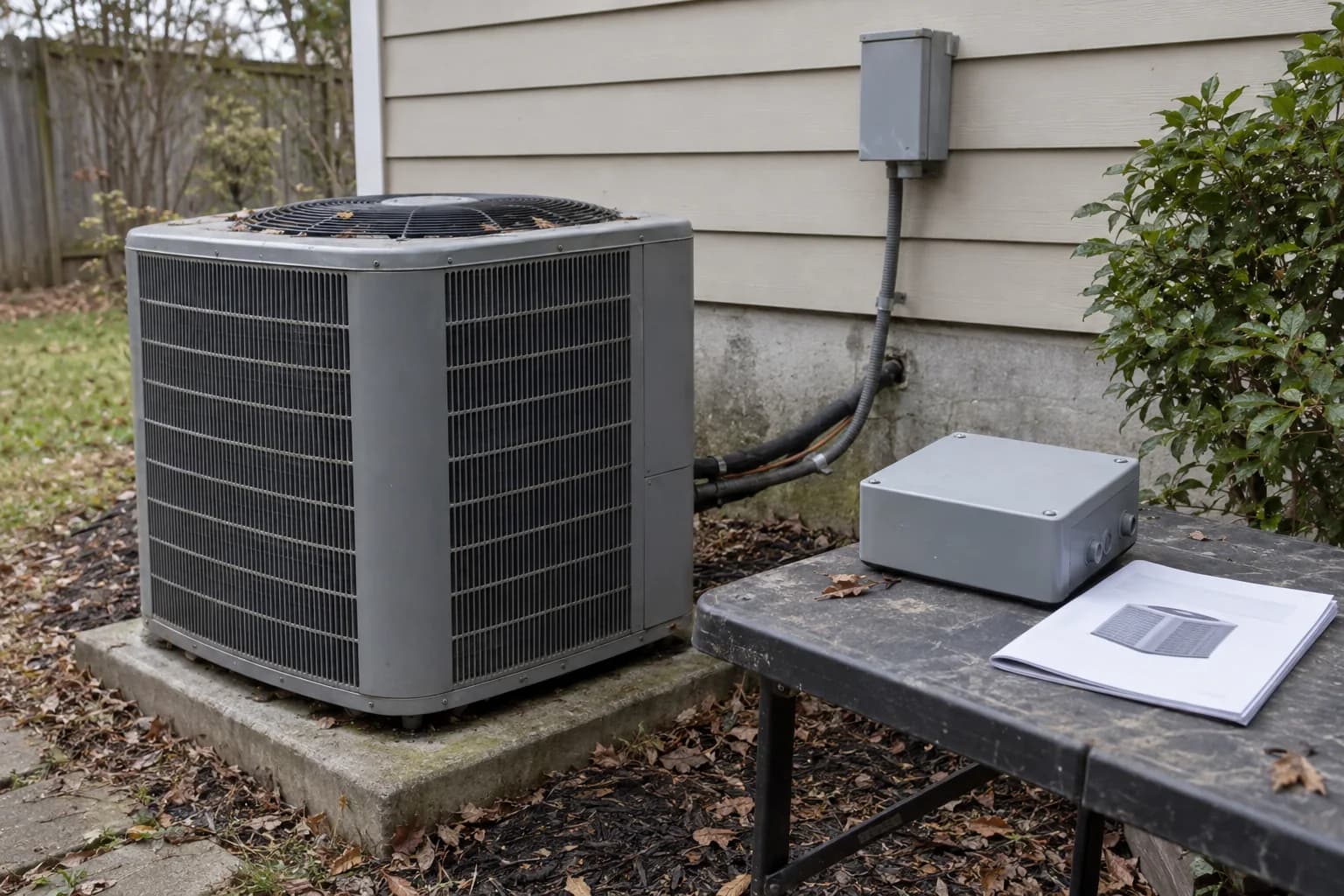
Quick answer
Start with the exact outdoor-unit data plate, compressor and control design, and the soft-start manufacturer compatibility instructions. Compare verified before-and-after starting current under similar conditions, then check generator transient response, continuous HVAC load, indoor blower, other running loads, 240V output, transfer equipment, fuel-specific rating, and site derating. Commission the complete system before an outage.
The compressor start can exceed the steady HVAC load
A central air conditioner combines an outdoor compressor and fan with an indoor blower and controls. The compressor can demand a short current event that is much higher than its normal running current. A generator may have enough continuous watts for the running equipment yet experience excessive voltage dip, frequency change, overload, or a failed start during that event.
Record supply voltage, phase, rated or measured running current, locked-rotor current when provided, minimum circuit ampacity, maximum overcurrent protection, indoor-unit demand, and any crankcase or control loads. These labels serve different design purposes. Minimum circuit ampacity should not be presented as measured running current, and breaker size should not be treated as normal load.
A compatible soft starter manages the starting sequence
A residential soft starter is installed as part of the compressor control path and uses model-specific electronics to manage startup. Current manufacturers market products for limited power sources such as generators and inverters, but their compatibility limits, voltage range, compressor types, control requirements, learning cycles, fault behavior, and installation steps differ.
Use only documentation for the exact soft starter and HVAC equipment. Confirm single-stage, two-stage, variable-speed, inverter-driven, heat-pump, communicating-control, and accessory compatibility rather than assuming that tonnage alone selects the device. Preserve every compressor protection and disconnect requirement.
A lower starting current does not create generator capacity
The compressor, condenser fan, indoor blower, controls, and permitted accessories still draw power while the system runs. Other generator loads such as refrigeration, pumps, lighting, water heating, and battery charging remain part of the simultaneous total. A soft starter does not increase generator continuous output, receptacle current, transfer-switch rating, fuel delivery, or conductor capacity.
The calculated volt-amps from starting current are a screening value. Generator selection also depends on the duration and shape of the start, acceptable voltage and frequency dip, alternator and inverter control behavior, power factor, fuel-specific rating, altitude, temperature, and the recovery before another load starts.
Heat pumps require an operating-mode plan beyond compressor startup
A heat pump can operate in cooling, heating, defrost, and recovery conditions. An indoor air handler may include electric auxiliary or emergency heat stages that exceed the generator plan even when a soft starter helps the compressor. Decide which stages the transfer and load-management design permits during an outage.
Variable-speed and inverter-driven HVAC systems may use a different starting strategy and can have manufacturer restrictions for external soft starters. Obtain written compatibility confirmation. Do not add a generic device to control equipment whose manufacturer does not approve that application.
Commission with measured results and the real outage sequence
After qualified installation, complete every learning or setup cycle in the soft-start instructions. Record before-and-after starting current where the product and test procedure permit it. During the approved generator test, observe generator voltage, frequency, alarms, HVAC faults, compressor start, indoor blower, other running loads, and the transfer and load-management sequence.
Repeat the relevant permitted modes, including a heat-pump defrost or auxiliary-heat lockout verification when applicable. Stop for repeated failed starts, abnormal noise, low voltage, contactor chatter, overheated conductors, protection trips, or control faults. Save the final readings and equipment settings with the outage procedure.
Frequently asked questions
Common questions
Will a soft start let a smaller generator run central air?
It may reduce the limiting compressor start event for an approved equipment pairing, but the generator still must support continuous HVAC load, other loads, voltage recovery, 240V output, fuel and site derating, and the complete connection.
Does a soft starter reduce air-conditioner running watts?
Its primary purpose is the starting event. Do not assume a material continuous-load reduction. Use measured or published running data for the exact HVAC equipment.
Can I put a home AC soft start on a heat pump?
Only when the soft-start and heat-pump manufacturers approve the exact equipment and operating modes. Defrost, auxiliary heat, variable-speed controls, and communicating systems need separate review.
Should I size the generator from LRA after adding a soft start?
Use verified before-and-after starting data for the approved installation, then have the generator manufacturer confirm transient performance. Original LRA, entered arithmetic, and a surge-watt label do not independently prove compatibility.
Primary references
CordFind summarizes connector specifications and public safety guidance. Always follow the instructions supplied with your equipment.
- Micro-Air: EasyStart Flex Home AC Soft Starter Specifications
- Generac: SureStart Soft Starter Technical Documents
- Department of Energy: Heat Pumps
- Cummins: Liquid-Cooled Generator Set Application Manual