Quick answer
Use the outdoor-unit, indoor-unit, heater-kit, and control documentation. Record voltage, phase, published running current, locked-rotor or approved starting current, blower demand, crankcase and control loads, auxiliary-heat stages, and every other load that may operate. Decide whether auxiliary heat will be blocked, staged, or supplied, then obtain written HVAC, generator, and transfer-system confirmation for startup, voltage recovery, load management, fuel, and site derating.
Map the complete heat-pump system
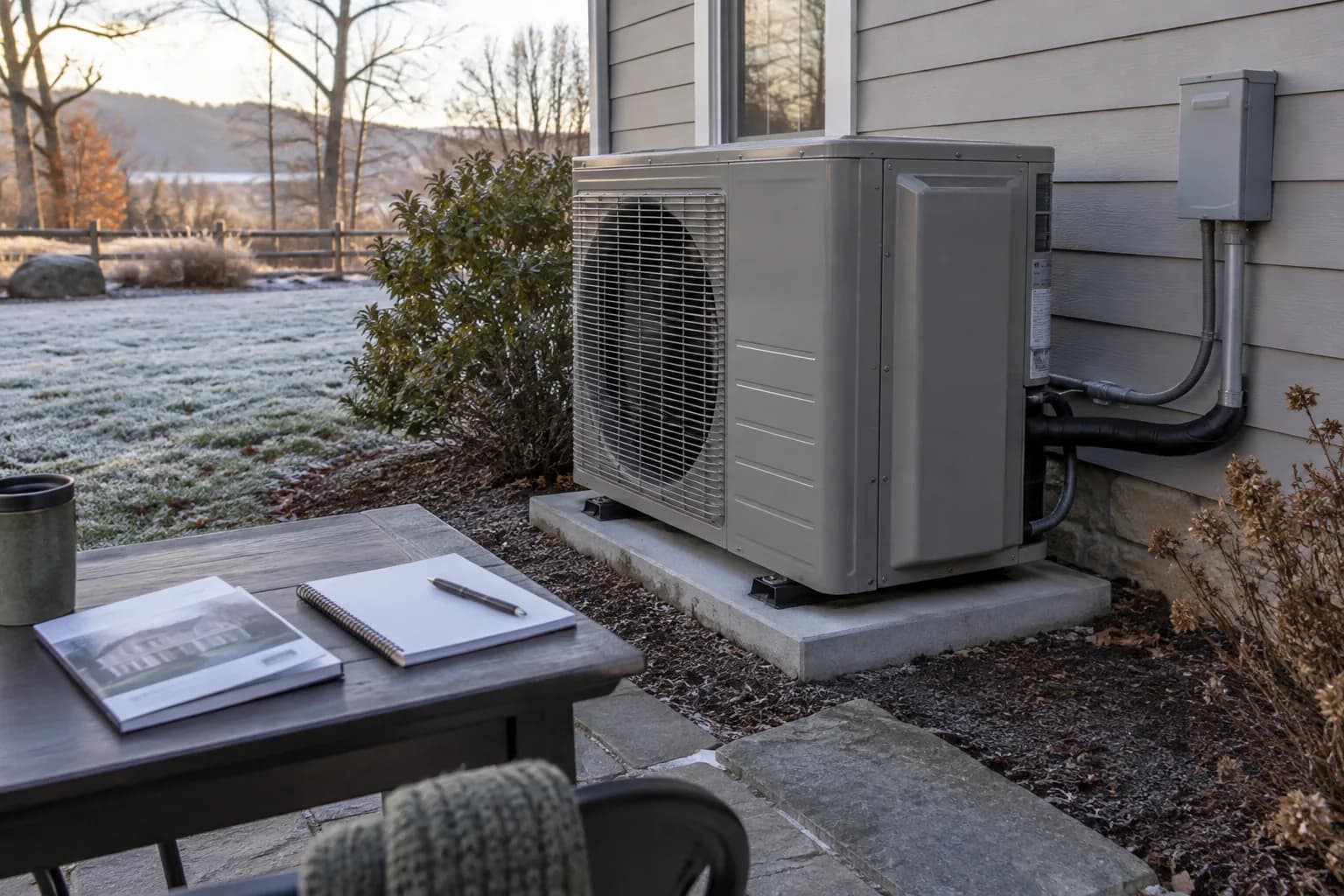
The outdoor compressor and fan, indoor air handler or furnace blower, controls, thermostats, condensate equipment, crankcase heat, defrost controls, and any electric heater kit can all affect the source. A hybrid or dual-fuel system may use a furnace instead of electric auxiliary heat under selected conditions.
Record exact model numbers and current documents. If the system is variable-speed or inverter-driven, ask the manufacturer for generator-source requirements and startup behavior. Do not assume it behaves like a conventional fixed-speed compressor or that low running current eliminates all source-quality requirements.
Separate running, starting, circuit, and heater values
Use published or measured running current for the operating screen and locked-rotor or manufacturer-approved starting data for the compressor event. MCA and MOCP are installation values with different purposes; they are not direct substitutes for actual running watts.
Identify each auxiliary-heat stage in kilowatts and amperes. Heat strips can exceed the compressor running demand and remain on for extended periods. A plan that handles cooling startup may still fail during defrost or emergency-heat operation.
| Equipment data | Planning role | Common mistake |
|---|---|---|
| Voltage and phase | Must match source and transfer system | Assuming watts create missing 240V |
| Published running current | Simultaneous operating-load screen | Using breaker size as actual load |
| LRA or approved start data | Compressor transient screen | Ignoring loads already running |
| Heater-kit kW and stages | Sustained auxiliary-heat load | Leaving emergency heat automatic |
| Indoor blower and controls | Required system loads | Counting only outdoor unit |
Decide how auxiliary heat and defrost will be handled
The HVAC designer may block, stage, or load-manage electric auxiliary heat during generator operation, or may use an approved alternate heat source. The control strategy must preserve equipment protection, freeze protection, ventilation needs, and occupant safety. Do not disconnect heater circuits or controls from a generic article.
Write the expected modes: heating, cooling, defrost, emergency heat, and transition back to utility. Confirm what can start automatically and which other loads can be present. A manual plan that depends on perfect thermostat timing may not be reliable.
Check generator transient performance and the full 240V path
The generator must hold acceptable voltage and frequency during the compressor event and carry the sustained system load afterward. Verify the selected-fuel rating, 120/240V output, outlet or feeder, breaker, conductors, inlet, transfer equipment, load balance, neutral treatment, and grounding.
An approved soft-start device may change compressor startup, but it does not erase blower, controls, auxiliary heat, other loads, or generator and transfer limits. Use model-specific approval and measured before-and-after evidence.
Apply site derating and test every permitted mode
Reduce available generator output according to the exact fuel, altitude, ambient temperature, enclosure, and duty instructions. Cold weather can simultaneously increase heating demand and affect generator or fuel-system capability.
Commission the approved system while observing compressor start, defrost, blower, load management, voltage, frequency, controls, alarms, protective devices, generator temperature, fuel pressure where applicable, and return to utility. Stop for repeated trips, unstable voltage, control faults, overheated connections, or abnormal engine response.
Frequently asked questions
Common questions
What size generator will run a heat pump?
There is no reliable tonnage-only answer. Use exact running and starting data, indoor equipment, auxiliary heat, other loads, fuel-specific generator ratings, transient response, and site derating.
Can I turn off emergency heat to use a smaller generator?
Only through a manufacturer-approved HVAC and load-management design that preserves equipment and building protection. Do not disable heater stages or controls from generic advice.
Does a soft start help a heat pump run on a generator?
It may reshape startup for an approved pairing, but continuous loads, defrost, auxiliary heat, voltage recovery, and transfer limits remain. Verify with model-specific data and commissioning.
Can a portable generator run a 240V heat pump?
Only if the exact generator, outlet, breaker, connection, transfer equipment, conductors, load plan, and HVAC requirements support it. Peak watts alone do not prove compatibility.
Primary references
CordFind summarizes connector specifications and public safety guidance. Always follow the instructions supplied with your equipment.
- Generac: Basic Sizing for Mobile Generators
- Carrier: Electrical Data Definitions for RLA, LRA, MCA, and MOCP
- Champion: Generator Wattage Chart
- CPSC: Carbon Monoxide Information Center