Quick answer
Sometimes, but only when the exact vehicle, charging equipment, and generator permit the proposed source and connection. Some chargers explicitly prohibit generator charging. If the instructions are silent, obtain written manufacturer confirmation before relying on it. Then verify voltage, frequency, charging current, continuous generator output, grounding, protection, power quality, permitted cables, outdoor placement, and fuel. A fitting plug or successful charging session is not proof of approval.
Check whether the exact charger permits generator power
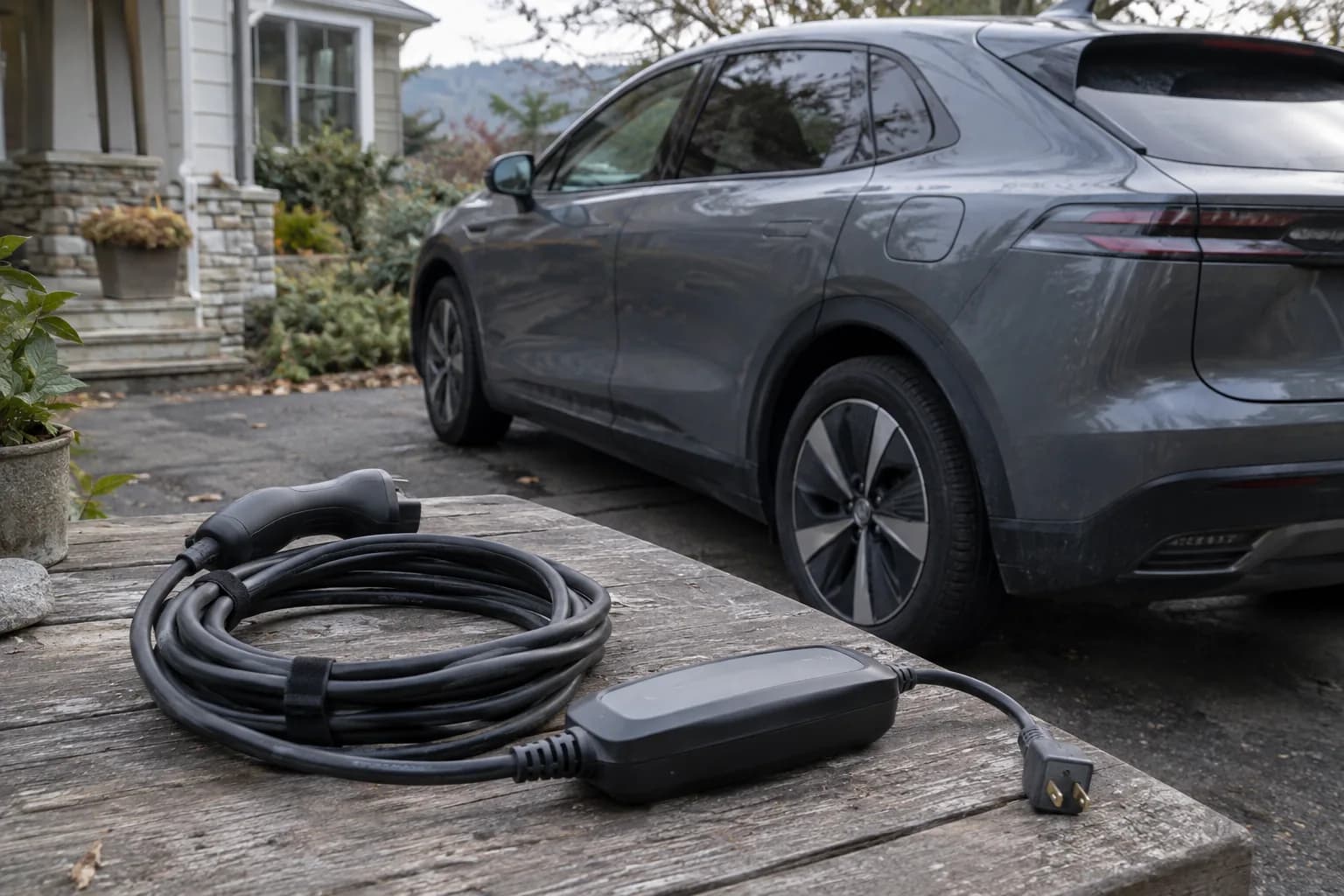
Start with the current vehicle and EVSE instructions for the correct model, generation, and market. For example, Tesla’s Gen 3 Mobile Connector North America manual prohibits using private power generators for charging. It also prohibits extension cords and conversion plugs. That equipment is not a candidate merely because a generator supplies a matching outlet.
A manual that lists 120V or 240V does not necessarily allow every source at that voltage. When generator use is not addressed, ask the vehicle and EVSE manufacturers for written confirmation covering the exact generator, charging current, neutral and grounding arrangement, protection, and connection. Treat the answer as unresolved until it is confirmed. A video, forum report, or session that happens to start cannot override a restriction.
Map the source, receptacle, EVSE and vehicle as one path
Record generator model, selected fuel, continuous rating, voltage, frequency, receptacle, breaker, neutral configuration, grounding, GFCI, and waveform data. Record the exact EVSE model, plug, input voltage, maximum and selectable current, cord limits, environmental rating, and manufacturer instructions. Then record the vehicle’s accepted AC charging limits.
A connector adapter can change physical fit but cannot create missing voltage, current, grounding, neutral, source quality, or manufacturer approval. Use only cables and adapters specifically permitted by the equipment instructions, and never bypass the EVSE control or protective functions.
Choose Level 1 or Level 2 from approved source capability
The U.S. Alternative Fuels Data Center describes Level 1 as 120-volt AC and Level 2 as 208- or 240-volt AC. Level 1 usually draws less power and adds range slowly. Level 2 can draw several kilowatts to more than many portable generators can continuously supply.
Use the EVSE’s approved current setting and applicable continuous-load circuit requirements. Do not assume the car will automatically reduce current enough to protect an undersized generator. If adjustable current is supported, confirm how the setting is locked and restored after power interruption.
Verify neutral, grounding, GFCI and power-quality behavior
EVSE safety checks can reject a source whose neutral and grounding relationship does not match its expectations. Do not remove a ground pin, defeat GFCI protection, or add a homemade neutral bond to force charging. Have the proposed source and protective arrangement reviewed.
Voltage or frequency excursions, overload, poor regulation, or incompatible waveform can stop charging or stress equipment. Manufacturer approval is more useful than a generic low-THD claim because the complete vehicle and EVSE controls decide whether charging proceeds.
Separate generator input power, battery energy and added range
Generator sizing uses the electrical demand at the EVSE input, together with every other simultaneous load. Battery charging uses what remains after charging conversion and vehicle accessory demand. A 1.2 kW charging input therefore does not promise 1.2 kWh added to the battery each hour. The vehicle may also use energy to heat or cool the battery, and its charging rate can change with conditions.
For a single-phase screen, volts multiplied by amps gives apparent power in VA. Use a manufacturer input-power value or suitable measured kW for real power; multiplying V by A represents watts only when power factor is effectively one. Keep input energy in kWh separate from battery-side energy and from miles.
A conditional arithmetic example: suppose an otherwise approved arrangement draws 120V at 10A with an assumed power factor of 1 for two hours. Its AC input is 1.2 kW and 2.4 kWh. If 85% reaches the battery, the battery gains 2.04 kWh. At an assumed battery-side driving consumption of 0.30 kWh per mile, that represents about 6.8 miles. These are invented example inputs, not measured performance or approval for any EV, charger, or generator.
Use your own confirmed charging efficiency and vehicle consumption on the same measurement basis. If a consumption figure already includes charging losses, do not deduct those losses again. Generator fuel consumption is a separate calculation using its published rate at the actual total electrical load; engine fuel-to-electric losses should not be subtracted a second time from measured AC charging energy. Compare the result with evacuation distance, available public charging, battery state, and other critical generator loads.
| Quantity | Assumption or calculation | Example result |
|---|---|---|
| AC input power | 120V × 10A × assumed power factor 1 | 1.2 kW |
| AC input energy | 1.2 kW × 2 hours | 2.4 kWh |
| Battery energy | 2.4 kWh × assumed 85% efficiency | 2.04 kWh |
| Added range | 2.04 kWh ÷ assumed 0.30 kWh/mile | About 6.8 miles |
Budget approved charging against the other outage loads
Apply this worksheet only after the exact vehicle and EVSE permit the source. It cannot make Tesla’s prohibited Gen 3 Mobile Connector arrangement acceptable. The charging current must also meet the approved circuit and continuous-load requirements; spare generator watts alone do not approve an outlet.
Suppose an otherwise approved source has 3,600 continuous watts available after the applicable fuel and site adjustments. At an assumed power factor of one, a supported 240V, 12A charging setting uses 2,880 watts. Another 250 watts of essential loads bring the running total to 3,130 watts, leaving 470 watts before any additional planning reserve. That remainder is not proof that a motor start will succeed. Increasing the charging setting to 24A would demand 5,760 watts before the other loads and fail this example immediately.
Record the setting that returns after a power interruption, what happens when charging resumes, and which other loads may start automatically. Generator charging of a portable power station is a separate manufacturer-permission question; it does not establish an approved intermediate source for an EVSE.
| Item | Example input | Result |
|---|---|---|
| Available continuous output | Assumed fuel/site-adjusted rating | 3,600W |
| Approved EVSE setting | 240V × 12A × assumed power factor 1 | 2,880W |
| Other running loads | Assumed 250W | 3,130W total |
| Remaining arithmetic budget | 3,600W − 3,130W | 470W; starting event still unresolved |
| Higher charging setting | 240V × 24A × assumed power factor 1 | 5,760W; exceeds the example source |
Confirm and test the permitted plan before an emergency
Do not make an outage or evacuation your first compatibility test. Complete the permission and electrical review first; if any manufacturer prohibits the arrangement, stop there. For a permitted setup, follow the approved connection and charging sequence and preserve a test record.
A successful test confirms behavior under the conditions observed. It cannot guarantee the same result in different weather, with a colder battery, a different current setting, more generator loads, another fuel, or changed equipment. Keep a charging-location or roadside-assistance alternative when the planned source is unavailable.
- Save the exact vehicle, EVSE, and generator manuals and any written source allowance.
- Have the approved outlet, protection, neutral, grounding, cable, and current-setting requirements checked; use no extension or adapter that the instructions prohibit.
- Choose a dry, permitted outdoor operating location that preserves generator exhaust safety and access to the vehicle.
- Test only the approved charging setting with the other loads allowed by the outage plan; record actual AC demand, duration, and the vehicle’s charging indication.
- Stop for repeated faults, trips, hot or damaged connectors, unstable operation, or unsafe weather. Follow the model’s fault instructions rather than changing the bond or defeating protection.
- Record fuel needs, supervision, shutdown and cooldown steps, the range objective, and the alternative charging or evacuation plan.
Protect the carbon-monoxide and weather boundaries
Operate the generator outside only, at least 20 feet from the home under CPSC guidance, with exhaust directed away from buildings and openings. Keep it far from garages, carports, vehicles, tents, neighboring openings, and occupied areas. The charging cord must not lead exhaust toward people.
Use only approved outdoor equipment and weather protection that preserves airflow and exhaust safety. Monitor the generator, EVSE, plug temperature, alarms, fuel, and weather. Stop for repeated charging faults, hot connectors, unstable engine operation, leakage, or damaged cables.
Frequently asked questions
Common questions
Can you charge an electric vehicle with a generator?
Only if the exact vehicle, EVSE, and generator permit the arrangement and all electrical and operating requirements are met. Some chargers prohibit generator power. If the manuals are silent, obtain written confirmation instead of assuming that a matching outlet or successful session is approval.
What size generator is needed to charge an EV?
Start with the approved EVSE input power and current setting, then add other simultaneous loads and verify generator continuous output on the selected fuel, outlet and breaker limits, site derating, protection, and power quality. Do not size from battery capacity or generator starting watts alone.
Can an inverter generator charge a Tesla through a Gen 3 Mobile Connector?
Tesla’s Gen 3 Mobile Connector North America manual prohibits private power generators as a charging source. An inverter label, low THD, or an online demonstration does not remove that restriction. Check the current instructions for the exact charging product.
Is Level 1 charging easier on a generator?
It usually draws less power than Level 2, but approval, grounding, neutral, GFCI, waveform, continuous rating, fuel, and runtime still must be verified.
Can I use a neutral bonding plug to charge an EV?
Do not add a bond from generic advice. It changes the electrical system and can create shock or objectionable-current hazards. Use an approved source arrangement reviewed for the exact equipment.
How many miles can a generator add to an EV?
It depends on approved charging power, charging duration, losses, vehicle efficiency, temperature, and battery conditions. Calculate energy first and treat range as a vehicle-specific estimate.
Primary references
CordFind summarizes connector specifications and public safety guidance. Always follow the instructions supplied with your equipment.
- U.S. Alternative Fuels Data Center: EV Charging Stations
- U.S. Alternative Fuels Data Center: EV Readiness Guide
- Tesla: Gen 3 Mobile Connector North America Owner’s Manual
- U.S. DOE and EPA: EV Charging Efficiency and Energy Use
- OSHA: Grounding Requirements for Portable Generators
- CPSC: Generators and Engine-Driven Tools