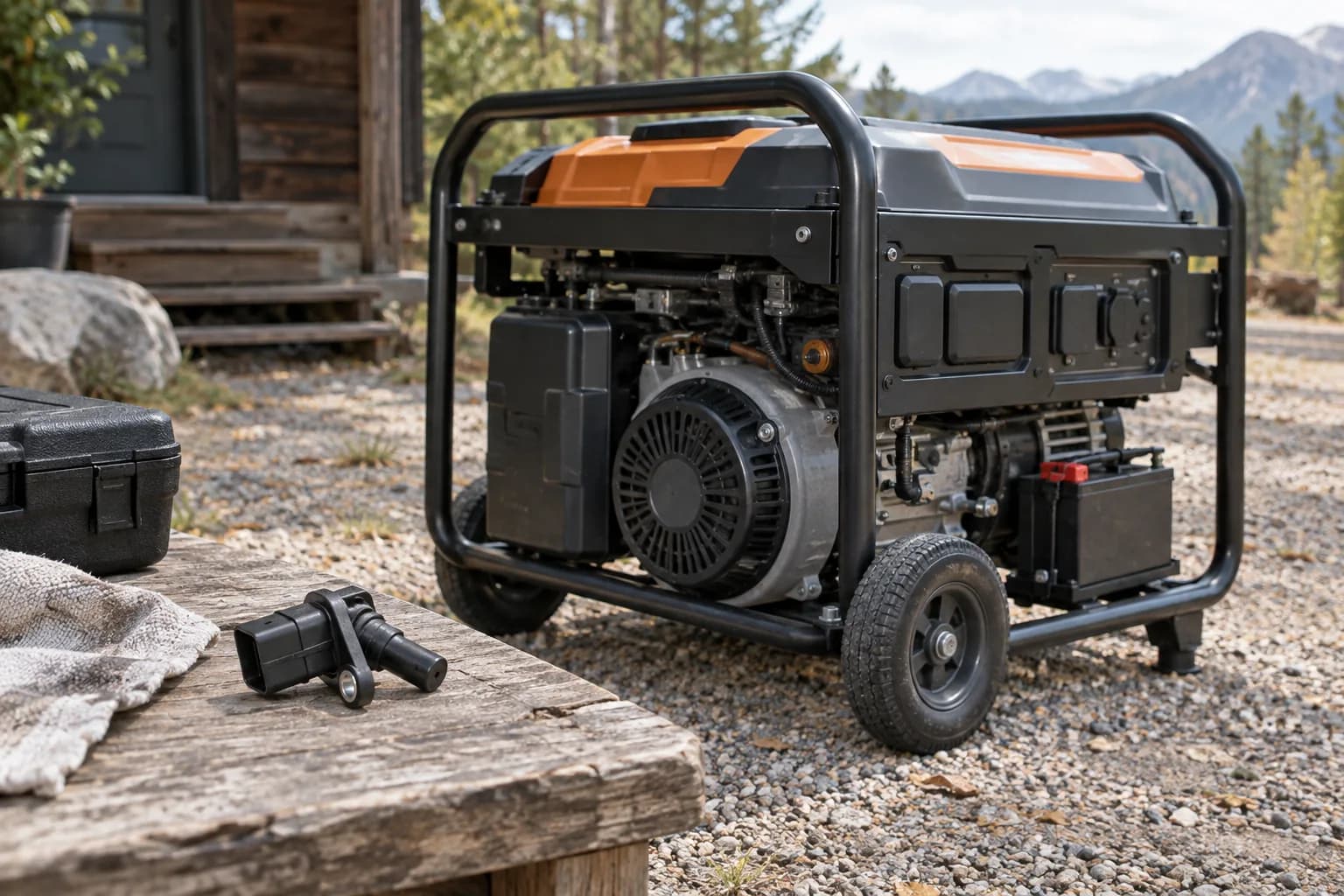
Quick answer
EFI can provide chokeless starting, controlled fuel metering, and fewer carburetor-related storage problems on models designed around it. Compare the complete generator, not EFI alone. Check battery requirements, manual-start limitations, fuel-pressure service, fault indicators, parts and dealer support, fuel specification, rated output, runtime data, outlets, noise, warranty, and total cost.
How EFI changes a portable generator engine
A carburetor meters fuel through mechanical passages and typically uses a choke to enrich the mixture for cold starting. An EFI system uses electronic controls and an injector to meter fuel. The exact sensor set and control strategy vary by model, so a general automotive description should not be assumed to match a portable generator.
Honda states that electronic fuel injection on its EU7000iS increases fuel efficiency, eliminates the engine choke, and reduces fuel-associated carburetor problems. Generac support likewise notes that its EFI portable units do not use a carburetor or choke. Those are manufacturer claims about specific product families, not proof that every EFI generator will deliver the same benefit under every load.
Check the starting system and battery dependency
EFI needs electrical power for its controller and fuel delivery. The Generac XT8500EFI manual states that its electronic system requires at least 10 volts at the battery connections even for recoil starting, and the engine will not start without the required power for electronics and the fuel pump. Other models can use different arrangements, so verify the exact manual rather than assuming a pull cord bypasses a weak battery.
Ask what happens after months in storage, whether a wall charger is supplied, how the battery is maintained, whether replacement is user-serviceable, and which fault indicators appear during low voltage or an EFI fault. Include the battery in the outage-readiness checklist and test starting under the manual’s schedule.
| Question | Why it matters | Evidence to request |
|---|---|---|
| Can it start with a discharged battery? | EFI controls and fuel pump may need minimum voltage | Owner-manual starting and battery section |
| What fuel and storage procedure applies? | EFI reduces some carburetor issues but fuel still ages | Fuel specification and storage procedure |
| How are faults diagnosed? | Electronic faults may require codes, tools or dealer service | Indicator chart, diagnostic section and service network |
| Does it save fuel for my load? | Runtime claims depend on tank, load and test conditions | Model-specific fuel rate or runtime at comparable loads |
EFI reduces carburetor concerns but does not make fuel permanent
An EFI engine has no carburetor bowl or jets to drain and clean, which removes a familiar storage failure point. It still has a tank, lines, pump, injector, filters, seals, and fuel whose quality changes with time and storage conditions. Follow the manufacturer’s fuel specification, stabilizing instructions, storage period, and run or drain procedure for the exact model.
Do not add unapproved cleaners or alter the fuel system based on advice for a carbureted engine. Keep fuel in approved containers, rotate the supply under local rules, and refuel only after shutdown and cooling as instructed. An injector problem, leak, contaminated fuel, or fuel-pressure fault can require authorized service.
Plan diagnostics, parts and qualified service
Review the manual’s indicator lights, fault patterns, battery charging, fuse locations, maintenance schedule, and permitted owner tasks. Confirm that the manufacturer has parts and service support in the area. Electronic control and high-pressure fuel components can change the cost and tools required for diagnosis compared with a simple carbureted model.
EFI does not remove routine engine maintenance. Oil, air filtration, spark plug, valve service, cooling airflow, fasteners, fuel inspection, battery care, and exercise still follow the manual. Keep model, serial number, hours, fuel, fault indications, and service actions in the maintenance record.
Decide from the complete generator specification
Compare continuous and starting output, voltage, receptacles, inverter or conventional architecture, total harmonic distortion where published, load-specific runtime, tank size, noise test basis, carbon-monoxide shutoff system, weight, transport, warranty, parts, and transfer-equipment compatibility. EFI may be useful, but it cannot correct a generator that is the wrong size or has the wrong connections.
For standby readiness, compare how each candidate behaves after storage and during a weak-battery condition. For frequent use, compare published fuel data at similar loads and the expected service interval. Use the premium price, replacement battery, diagnostic access, and repair support in the lifecycle comparison rather than treating EFI as an automatic upgrade.
Frequently asked questions
Common questions
Is an EFI generator better than a carbureted generator?
It can offer easier chokeless starting and reduce carburetor-related fuel problems, but value depends on the exact model, battery behavior, service support, fuel data, cost, load, and storage plan.
Does a fuel-injected generator need a battery?
Many EFI systems need electrical power for controls and a fuel pump. Some models require minimum battery voltage even for recoil starting. Check the exact owner’s manual.
Can old gas still damage an EFI generator?
Yes. EFI removes carburetor jets and a bowl, but stale or contaminated fuel can still affect the tank, pump, injector, filters, lines, and engine. Follow the model-specific fuel and storage instructions.
Does EFI always use less fuel?
Manufacturers may report efficiency benefits for particular models. Compare model-specific runtime or fuel-rate data at equivalent loads, tank capacity, output, and test conditions before drawing a conclusion.
Primary references
CordFind summarizes connector specifications and public safety guidance. Always follow the instructions supplied with your equipment.
- Honda: EU7000iS Generator and Electronic Fuel Injection
- Honda: Generator Technology Brochure
- Generac: XT8500EFI Portable Generator Owner Manual
- Generac Support: Portable Generator Choke and EFI