Quick answer
Use only an interlock kit documented for the complete panel catalog number and breaker arrangement. The mechanism must prevent the utility main and generator breaker from being on together with the panel cover in place. Have the inlet, breaker, conductors, neutral and grounding arrangement, labels, load plan, permits, and inspection handled as one qualified installation. If the exact match is missing, stop and use approved transfer equipment instead.
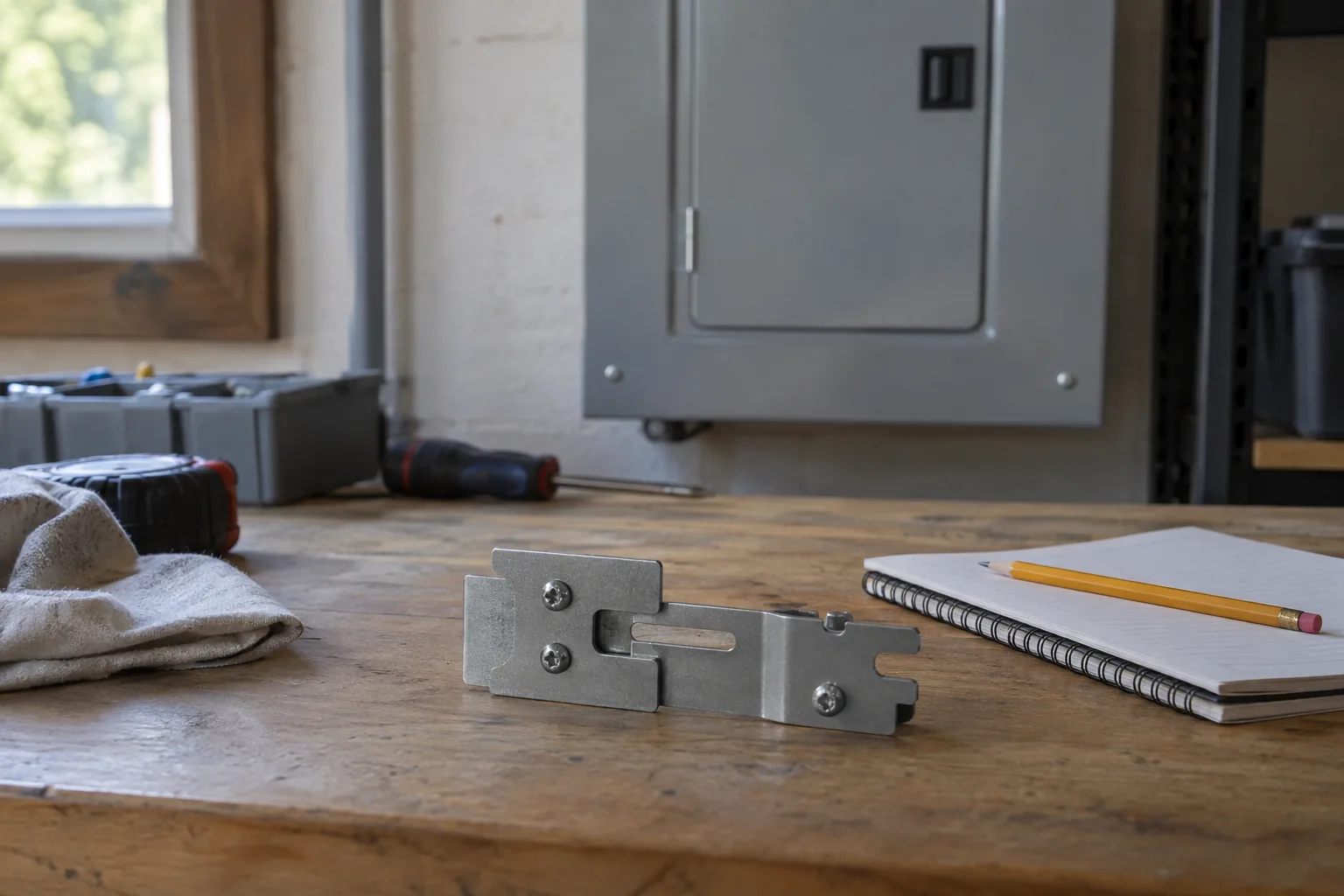
What a generator interlock kit does
An interlock coordinates two breaker handles so the utility source and generator source cannot energize the panel at the same time. In normal operation, the utility main is on and the generator breaker is blocked. During an approved outage sequence, the utility main is switched off before the mechanism allows the generator breaker to be switched on.
That mechanical function addresses source isolation. It does not create a power inlet, size conductors, select a breaker, manage the neutral, correct generator grounding, limit the number of loads, or make a generator safe to operate near a building. Those are separate parts of the system and each still has to be correct.
OSHA warns that connecting a generator directly to a structure without properly installed transfer equipment can energize wiring beyond the property and expose utility workers and other people to electrocution. The practical test is not whether a kit looks sturdy. It is whether the approved assembly maintains source separation in every permitted handle position.
Match the kit to the full panel identity
Start with the load center manufacturer, series, catalog number, main-breaker arrangement, bus rating, cover or trim, and breaker positions. Record the generator breaker type and the retaining hardware called for by the kit instructions. Similar enclosures from one manufacturer can use different interiors, covers, main locations, and approved accessories.
Schneider Electric states that some of its generator interlock kits apply only to listed combination service entrance device catalog numbers and that other catalog numbers do not allow the kit. Its QO handle-interlock instructions also identify required breaker positions and retaining components. This is why a broad label such as Square D, Siemens, Eaton, or GE is not enough.
Do not drill, bend, relocate, substitute, or combine parts to make an unverified kit fit. Do not rely on a marketplace title that lists many panel families without the manufacturer documentation. Ask for the exact instruction sheet and verify every catalog number before purchasing or scheduling work.
- Photograph the complete panel label, not only the breaker handles
- Record the main breaker and load center catalog numbers
- Find the kit instruction sheet from the panel manufacturer
- Confirm the required generator breaker position and retaining device
- Reject a match based only on brand, dimensions, or an online photo
The interlock is one part of the complete connection
A complete portable-generator connection normally includes an outdoor power inlet, a compatible inlet cord, a generator breaker, conductors sized and routed for the installation, source-isolation equipment, required markings, and a written operating sequence. The inlet is a power-entry device. It is not a household receptacle, and it must not expose energized male pins.
The generator receptacle, cord, inlet, breaker, and conductors must agree on voltage, amperage, hot conductors, neutral, and equipment grounding. An L14-30 source and a 30A inlet describe a different capacity and connector family than a 14-50 arrangement. An adapter cannot create a missing neutral, additional hot leg, higher capacity, or approved transfer function.
Neutral switching and generator bonding require a system-specific review. Do not remove a bonding connection or add a grounding electrode based on a generic diagram. Use the generator manual, transfer or interlock equipment instructions, and the installation design accepted by the local authority.
| Part | Job | Verification record |
|---|---|---|
| Interlock mechanism | Prevents simultaneous source breakers | Exact panel and kit instructions |
| Generator breaker and retainer | Protects and secures the back-fed source connection | Approved breaker type, rating, and hardware |
| Power inlet and cord | Provides a protected generator connection point | Connector, voltage, amp, wire, and environment ratings |
| Conductors and panel work | Carries power within the installed system | Qualified design, permit, torque, and inspection records |
| Load plan | Keeps running and starting demand within limits | Circuit list and staged operating sequence |
Interlock kit vs transfer switch
An interlock generally lets an operator choose among existing panel circuits while manually controlling total load. A manual transfer switch often presents a defined set of circuits with source selectors or a dedicated emergency-load panel. An automatic transfer switch is part of a system that senses utility conditions and transfers approved loads automatically.
None is universally better. An interlock may fit a compatible panel and an operator who can manage circuits. A selected-circuit transfer switch can make the outage load set easier to understand. An automatic system may be appropriate when unattended response is required, but it adds generator, fuel, load-management, installation, exercise, and service requirements.
Compare the systems by approved panel compatibility, circuit coverage, neutral treatment, available power, operator steps, inspection path, and future service. Do not compare only the accessory price.
Write the outage sequence before the outage
The operating sequence must come from the installed kit, generator, and inlet system instructions. It should identify how to remove loads, isolate the utility source, connect and start the generator in its safe outdoor location, warm it up, add circuits gradually, monitor load, and return to utility power. Store the approved sequence at the panel.
Load management matters because an interlock does not limit the number of branch breakers an operator can select. Start with essential circuits and add one load at a time. Large motors, pumps, heating equipment, water heaters, ranges, and air conditioners can exceed generator or receptacle limits even when the panel bus can carry more.
Test the approved system on a regular schedule without defeating any protection. Stop for a mechanism that binds, missing hardware, loose inlet, damaged cord, repeated breaker trip, abnormal voltage, fuel leak, exhaust problem, or CO alarm. Repairs and modifications belong to qualified personnel.
Legality depends on the approved installation, not the product name
Searchers often ask whether generator interlock kits are legal. The useful answer is that acceptance depends on the exact equipment, listing and labeling, installation instructions, adopted rules, utility requirements, permits, and the authority having jurisdiction. A kit sold online is not automatically approved for a particular service panel.
Ask the installer or local authority what documentation is required before work begins. Keep the permit, inspection result, kit instructions, panel schedule, generator information, and operating sequence together. If the panel has no documented compatible kit, a transfer switch or emergency-load panel may provide a clearer approved path.
Frequently asked questions
Common questions
What is a generator interlock kit?
It is a panel-specific mechanical device that prevents the utility main breaker and generator source breaker from being on at the same time. It is only one component of a complete approved generator connection.
Are generator interlock kits legal?
Acceptance is installation and jurisdiction specific. The exact kit must be suitable for the exact panel, installed according to its instructions, and accepted under applicable permits, inspection, code, and utility requirements.
Can I use a universal generator interlock kit?
Do not assume any kit is universal. Verify a manufacturer-documented match to the complete load center catalog number, breaker arrangement, cover, and required retaining hardware.
Is an interlock kit the same as a transfer switch?
Both can provide source isolation, but the equipment and operating method differ. An interlock coordinates panel breakers, while a transfer switch transfers defined circuits or a service between sources.
Does an interlock kit prevent generator overload?
No. The operator still needs a circuit and load plan that keeps running watts, motor starts, receptacles, cord, inlet, breaker, and generator within their ratings.
Primary references
CordFind summarizes connector specifications and public safety guidance. Always follow the instructions supplied with your equipment.
- OSHA: Using Portable Generators Safely
- Schneider Electric: QO2DTIM Retaining Kit and Handle Interlock Instructions
- Schneider Electric: Compatible CSED Generator Interlock Kits
- CPSC: Carbon Monoxide Information Center