Quick answer
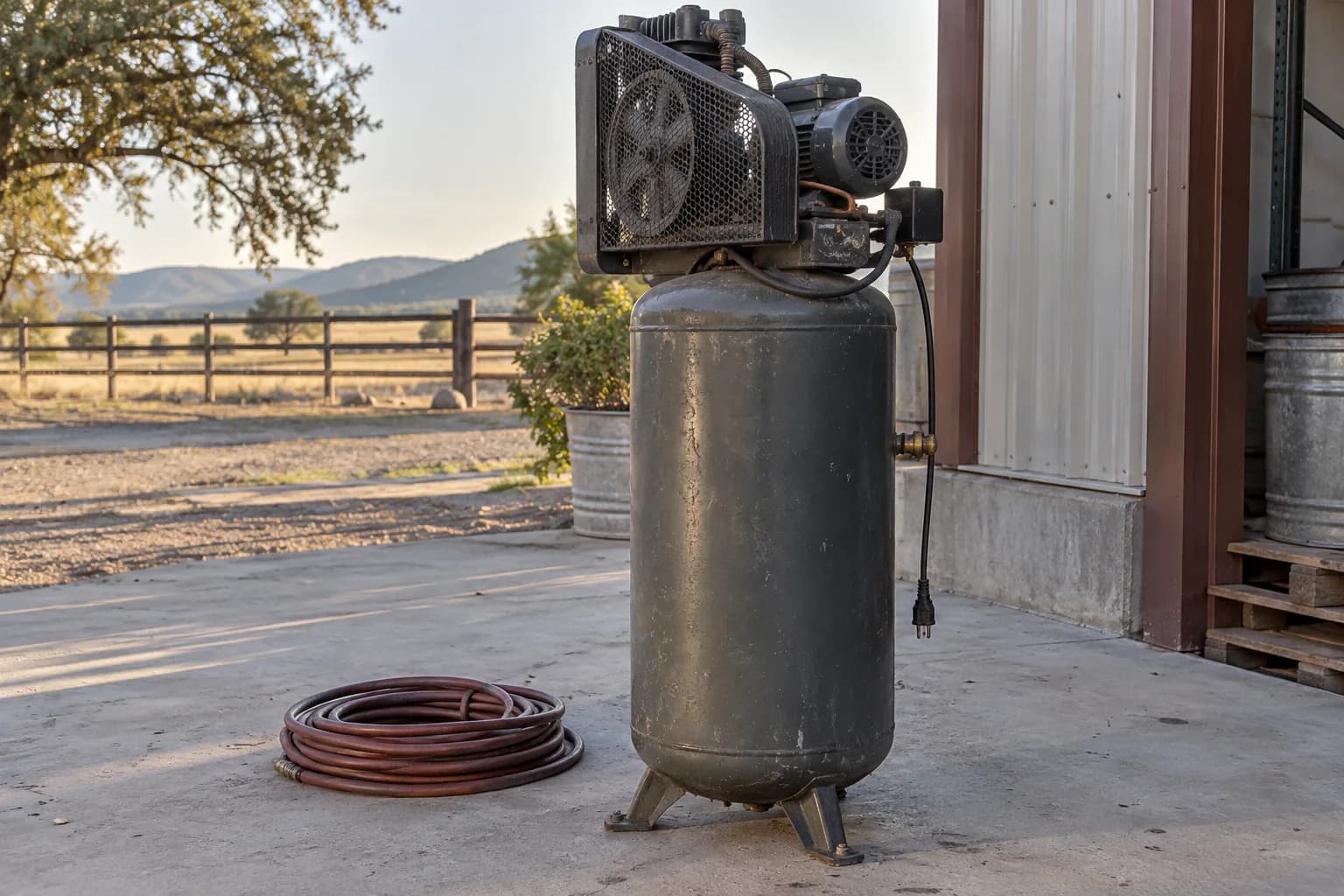
Use the compressor manufacturer’s voltage, phase, running current and starting or locked-rotor data. Add the other loads already running, calculate the entered start event in volt-amps, preserve a planning reserve, and send that data to the generator manufacturer for a motor-starting check. Horsepower, breaker size, and running watts alone are not enough. Test only an approved connection with the compressor in its documented starting condition.
Treat compressor starting as a separate event
Cummins notes that motor and compressor loads require additional power during starting. Atlas Copco describes direct starting as a high-current method and explains that reduced-voltage or soft-start methods change both current and torque. The generator has to keep enough voltage and frequency for the motor and controls to accelerate correctly.
Record whether the compressor starts against pressure, uses an unloader, cycles automatically, has a soft starter or variable-speed drive, and may restart while other tools are operating. A compressor that starts from an empty tank during a demonstration may behave differently when its pressure switch calls during work.
Collect motor and compressor data instead of using horsepower alone
Record input voltage, phase, frequency, motor horsepower, full-load or service-factor amps, starting or locked-rotor amps, starter type, minimum voltage, control requirements, and manufacturer generator guidance. For packaged compressors, use the complete equipment manual rather than a replacement motor table alone.
Horsepower describes mechanical output and does not establish one universal electrical input or starting current. Branch-breaker size includes protection and starting considerations but is not the normal operating load. When starting data is unavailable, ask the compressor manufacturer instead of applying a generic multiplier as a final answer.
| Input | Why it matters | Do not substitute |
|---|---|---|
| Voltage, phase and frequency | Must match source and controls | Plug shape or adapter |
| Running amps | Sustained motor apparent power | Breaker rating |
| Starting or locked-rotor amps | Transient source screen | Horsepower multiplier |
| Starter and unloader behavior | Current, torque and restart condition | Empty-tank test |
| Other simultaneous loads | Generator base load during compressor start | Total tool count |
Keep running VA and starting VA visible
For a single-phase motor, multiply voltage by the entered current to screen apparent power. A balanced three-phase motor uses the square-root-of-three multiplier. Add other running loads to the motor starting VA, then preserve a documented reserve. This is a transparent worksheet, not a prediction of voltage dip or acceleration time.
The generator manufacturer may require a larger alternator or specific excitation system to hold acceptable voltage during the start. Cummins application guidance notes that reduced-voltage methods can reduce starting kVA but also reduce torque. A starter change must therefore be approved for the compressor, not added solely to make a generator calculation smaller.
Check the receptacle, cord and distribution path under start current
Verify generator voltage and phase, receptacle rating, breaker, cord assembly, conductor count, length, voltage drop, plugs, grounding, GFCI requirements, and jobsite distribution. A long or undersized cord can deepen voltage drop during starting even when steady running current appears acceptable.
Keep cords protected from water, traffic, sharp edges, hot surfaces, and physical damage. Do not alter a plug, bypass a protective device, or use an adapter to supply a voltage or phase the generator does not produce. Hardwired compressors require approved connection equipment and qualified installation.
Test automatic restart with the permitted work load
Commission the approved setup with the generator stabilized and the intended base load present. Observe the compressor start from the pressure condition specified by its manufacturer, then verify cycling, unloader action, voltage, frequency, overload indicators, motor acceleration, cord and connector temperature, and control operation.
Stop for slow acceleration, contactor chatter, repeated trips, generator hunting, dimming, overheated connections, motor-protection operation, or abnormal compressor sound. Reduce simultaneous loads and obtain manufacturer review rather than repeating a marginal start until a protective device opens.
Frequently asked questions
Common questions
How many watts does a generator need for an air compressor?
Use the compressor’s exact running and starting data plus other simultaneous loads. A steady watt figure does not describe the motor-starting event.
Can I size a generator from compressor horsepower?
Not reliably. Motor efficiency, voltage, phase, starter, starting current, unloader behavior and controls vary. Use the packaged compressor’s electrical data.
Why does the generator run the compressor but fail when it restarts?
A restart under tank pressure or with other tools already operating can create a more demanding condition than the initial empty-tank test. Verify unloader operation and the full load sequence.
Will a soft starter let a smaller generator run the compressor?
It may change starting current and torque, but only compressor and generator manufacturer approval can establish whether the motor will accelerate and the source will remain stable.
Primary references
CordFind summarizes connector specifications and public safety guidance. Always follow the instructions supplied with your equipment.
- Cummins: Generator Set Application Manual, Motor Starting
- Atlas Copco: Electrical Installation in Compressor Systems
- Cummins: Portable Generator Sizing and Motor Loads
- OSHA: Using Portable Generators Safely