Quick answer
Find the pump model and use its published voltage, running watts or amps, and starting watts or current. Add every load that may already be running, then add the pump startup above its normal running demand. Verify the generator continuous and surge ratings, receptacle and cord limits, voltage drop, weather plan, runtime, fuel, and an automatic backup path for unattended flooding.
Identify the installed pump before choosing a generator
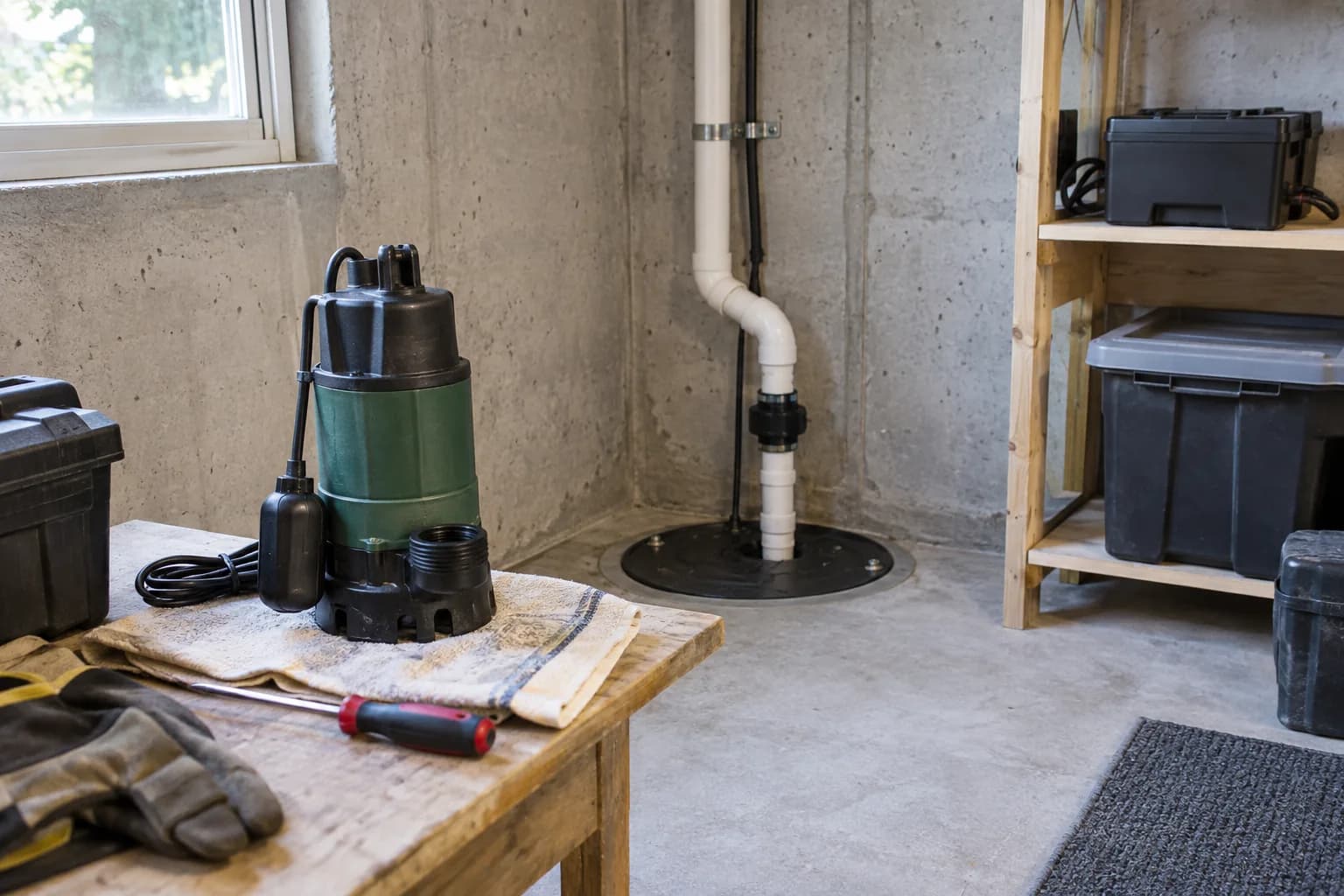
Record the manufacturer, model, horsepower, voltage, current, phase, cord and plug, float-switch arrangement, discharge configuration, and manual. A one-third horsepower and a one-half horsepower pump can have overlapping or very different electrical demands depending on motor design and operating conditions.
Champion currently lists broad reference ranges of 500 to 800 running watts and 1,000 to 1,600 starting watts for a one-third horsepower sump pump. Its one-half horsepower range is 800 to 1,050 running watts and 1,300 to 2,150 starting watts. Those ranges explain why a single multiplier is weak evidence. The installed pump data controls.
Inspect the pump and basin as a pumping system. A restricted discharge, failed check valve, debris, worn pump, incorrect float travel, or high head can create a problem that a larger generator will not correct.
Keep total starting watts separate from extra starting watts
Some references publish total starting watts. CordFind subtracts the entered pump running watts from that total to find the additional startup amount, then adds the extra amount to all loads already running. This prevents the pump running load from being counted twice.
If the pump documentation lists volts and amps instead of watts, volts multiplied by amps produces an apparent-power screen. Motor power factor and starting behavior mean that this arithmetic is not a complete generator selection. Ask the pump or generator manufacturer for starting information when it is missing.
Consider which other loads will be active during heavy rain. A refrigerator, freezer, furnace blower, dehumidifier, second pump, battery charger, lighting, or communications equipment can remain on when the sump pump starts. Add them to the operating plan rather than leaving them as an unspoken reserve.
A sump pump plan is not a well pump plan
A sump pump removes groundwater from a basin, commonly at 120V with a cord-and-plug connection. A well pump supplies pressurized water and may be a 240V submersible motor with a control box or variable-speed controller. Their wiring, controls, head, duty, and start data differ.
Use the separate CordFind well-pump guide when the load is a water-supply pump. Do not borrow a well-pump horsepower table for a sump pump or assume that an adapter can solve a voltage difference.
| Planning item | Sump pump | Well pump |
|---|---|---|
| Job | Remove water from a basin | Supply pressurized building water |
| Common connection | Often 120V cord and plug | Often hardwired, frequently 240V |
| Control | Float or electronic basin control | Pressure switch, control box, or drive |
| Outage consequence | Basement or crawlspace flooding | Loss of water service and pump-system risk |
| Data source | Exact sump pump and backup manuals | Motor, pump, control, and generator tables |
Plan for the time before the generator is running
A portable generator does not start, move outdoors, connect, and refuel itself. Water may rise while no one is home, while the generator is being positioned, or after fuel is exhausted. A battery-backup pump, water-powered backup where permitted, alarm, remote notification, or permanently installed backup system can cover a different part of the failure timeline.
A battery backup has its own pump capacity, battery condition, charger, alarm, maintenance, and runtime limits. Liberty and Wayne publish combined primary and battery-backup systems, which illustrates that the backup pump is a separate engineered layer rather than a battery attached casually to the existing AC pump.
Estimate inflow and outage duration conservatively. A generator runtime claim at a partial test load does not equal runtime while cycling a pump plus other household loads. Use the fuel-consumption calculator with a published rate for the intended load point.
Keep the generator dry without moving combustion indoors
Use the pump plug and connection method permitted by its manual. Confirm generator receptacle voltage, breaker rating, GFCI instructions, grounded cord construction, cord current rating, and voltage drop. Keep plug connections away from standing water and stop using damaged or wet equipment.
A hardwired pump circuit requires approved transfer equipment and qualified installation. A household receptacle is not a generator inlet, and a male-to-male cord is never an acceptable way to energize the pump circuit.
CPSC says portable generators belong outside only, at least 20 feet from the home, with exhaust directed away. A garage, basement, porch, crawlspace, or sump area is not an operating location. Follow the exact generator wet-weather instructions and use only an approved outdoor protection arrangement that preserves cooling and exhaust safety.
Test the full water-removal plan before storm season
Test the pump using the procedure allowed by its manual, confirm float travel and discharge, and record running behavior. Then test the approved backup-power sequence with other intended loads. Verify that the generator starts the pump without a repeated breaker or GFCI trip, abnormal voltage, overheated cord, stalled motor, or control fault.
Exercise and maintain the generator, rotate fuel, test alarms, and maintain the battery-backup system on their separate schedules. Store the pump model, electrical data, generator startup instructions, connection diagram, fuel plan, and emergency contacts together.
Stop for rising water near electrical equipment, damaged wiring, repeated protective-device trips, a pump that hums without moving water, a blocked discharge, fuel or exhaust concerns, or any connection that is not documented for the equipment.
- Record exact running and starting data
- Test the pump and discharge path
- Verify cord or transfer equipment under load
- Calculate fuel for the expected outage
- Maintain an unattended backup and alarm path
Frequently asked questions
Common questions
What size generator do I need for a one-half horsepower sump pump?
Use the exact pump data. Current generic references span roughly 800 to 1,050 running watts and 1,300 to 2,150 total starting watts, but the installed model, voltage, other loads, and generator response control the result.
Will a 2,000 watt generator run a sump pump?
It may run some pumps but can be below the starting requirement of others, especially with another load already operating. Compare exact running and total starting data with both generator ratings and the receptacle limit.
Can I use an extension cord for a sump pump during an outage?
Only when the pump and generator manuals allow it and the grounded cord, plug, current rating, length, environment rating, voltage drop, and dry routing are suitable. Do not use a cord in standing water.
Is a battery backup better than a generator for a sump pump?
They cover different failure periods. A battery backup can operate automatically for a limited duration; a generator may support longer operation when it is safely started, connected, and fueled. A layered plan can use both.
Is a sump pump the same load as a well pump?
No. They serve different systems and commonly use different voltages, controls, motor data, connections, and duty. Size from the exact pump documentation.
Primary references
CordFind summarizes connector specifications and public safety guidance. Always follow the instructions supplied with your equipment.
- Champion: Generator Wattage Chart
- Wayne: Current Sump Pump and Battery Backup Manuals
- Liberty Pumps: Primary and Battery Backup Sump Pump Systems
- Generac: Manual Transfer Switch for Essential Circuits
- CPSC: Carbon Monoxide Information Center