Quick answer
Enter a published A-weighted sound level and its measurement distance, then choose another distance. The worksheet uses the free-field relationship L2 equals L1 minus 20 log10 of the distance ratio, which is approximately 6 dB lower for each doubling of distance. Treat the result as a screening estimate. Generator placement must first satisfy carbon-monoxide, exhaust, airflow, fire, service, weather, property, and manufacturer requirements. Measure the installed or proposed site under representative load.
Read the complete published sound statement
Record dBA value, distance, load percentage, eco or normal mode, fuel, enclosure, test surface, microphone position, and standard where provided. A value at 23 feet cannot be compared directly with one at 7 meters or at a different load without normalization and caution.
Sound power and sound pressure are not interchangeable. Consumer specifications often report sound pressure under a particular test. Keep the exact wording and do not label a screening conversion as a new certified rating.
Use the distance formula only inside its assumptions
For a small source in a free field with no important reflections, NIOSH describes a 20 log10 distance relationship. Doubling distance produces approximately a 6 dB reduction. Halving distance increases the estimate by the same amount.
A generator is not a perfect point source. Engine, exhaust, cooling fan, alternator and enclosure surfaces radiate in different directions. Near-field behavior and reflective sites can depart materially from the estimate.
Map receivers and reflective paths before choosing a location
Mark bedrooms, doors, windows, neighboring property, tents, work positions, medical or communication areas, hard walls, fences, slopes, and prevailing wind. A wall can block one direct path while reflecting sound toward another receiver or trapping exhaust and cooling air.
Do not move the generator closer to a building to gain shielding. Carbon-monoxide and manufacturer clearance requirements take priority. CPSC portable-generator guidance calls for outside operation at least 20 feet from the home with exhaust directed away.
Reduce sound without creating heat, exhaust or electrical hazards
Start with quieter approved equipment, correct maintenance, stable mounting, lower permitted load, distance, and manufacturer-approved accessories. Barriers or enclosures require engineered airflow, exhaust, fire, weather, service, and structural design.
Never use a sealed box, improvised muffler, exhaust hose, or storage cover around a running generator. Do not place it in a garage, shed, crawlspace, carport, tent, or near openings to make it less audible.
Measure the receiver under representative operation
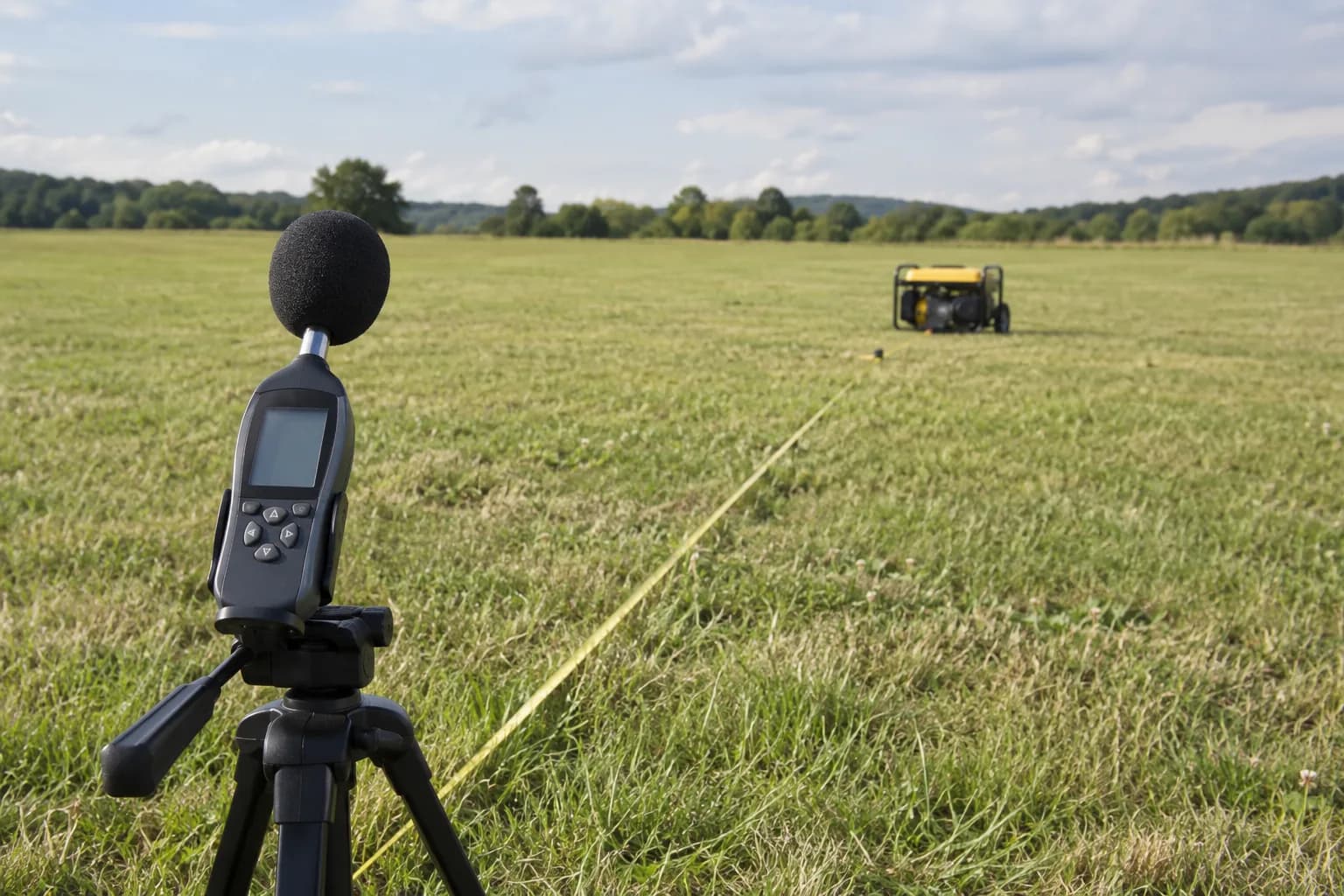
Use an appropriate calibrated or verified meter and record instrument, weighting, response, weather, background level, generator load and mode, distance, height, direction, and time. Measure at the receiver rather than assuming a near-source value represents exposure or property impact.
Repeat for important loads and operating modes. A small change in orientation, exhaust direction, barrier, or reflective surface can change the result. Use local requirements and qualified acoustic help when compliance or community impact matters.
Frequently asked questions
Common questions
How much quieter is a generator at twice the distance?
The free-field estimate is about 6 dB lower for each doubling, but reflections, direction, barriers, terrain, load, and weather can change the actual result.
Can I compare generator dBA ratings from different brands?
Only after checking distance, load, operating mode, test method, surface, and metric. A single number without its conditions is not a fair comparison.
Does a wall make a generator quieter?
It may change the direct sound path, but it can also reflect sound, restrict cooling, trap exhaust, or create unsafe placement. Use an engineered site plan.
Is the calculator a code or hearing-safety measurement?
No. It is a free-field screening estimate. Verify actual sound at the receiver with appropriate measurement and apply local and occupational requirements.
Primary references
CordFind summarizes connector specifications and public safety guidance. Always follow the instructions supplied with your equipment.
- NIOSH: Industrial Noise Control Manual, CDC Stacks Archive
- NIOSH: Administrative Noise Controls
- NIOSH: Understand Noise Exposure
- CPSC: Carbon Monoxide Information Center