Quick answer
For automatic home backup, investigate a permanently installed standby system with compatible transfer equipment and fuel infrastructure. For selected outage loads, job sites, or mobile work, compare portable conventional and portable inverter generators. For larger temporary projects, towable units may fit but require professional distribution and site controls. For modest indoor loads, compare battery power stations, which store energy rather than generate it from fuel. Size and connect every category from the actual loads.
Classify the source on more than one axis
EIA defines an electric generator broadly as a device that converts another form of energy into electricity. Small backup products commonly use an internal-combustion engine as the prime mover, while batteries store electricity produced elsewhere and supply it through power electronics. Marketing categories then describe mobility, output conditioning, fuel, enclosure, duty, and installation.
Write five headings before shopping: load, duration, location, connection, and operator. Add fuel and noise after the first five are clear. This prevents one attractive feature, such as inverter, quiet, or tri-fuel, from hiding a missing voltage, inadequate starting capacity, unsafe location, or incompatible outlet.
| Category | Typical role | Primary checks |
|---|---|---|
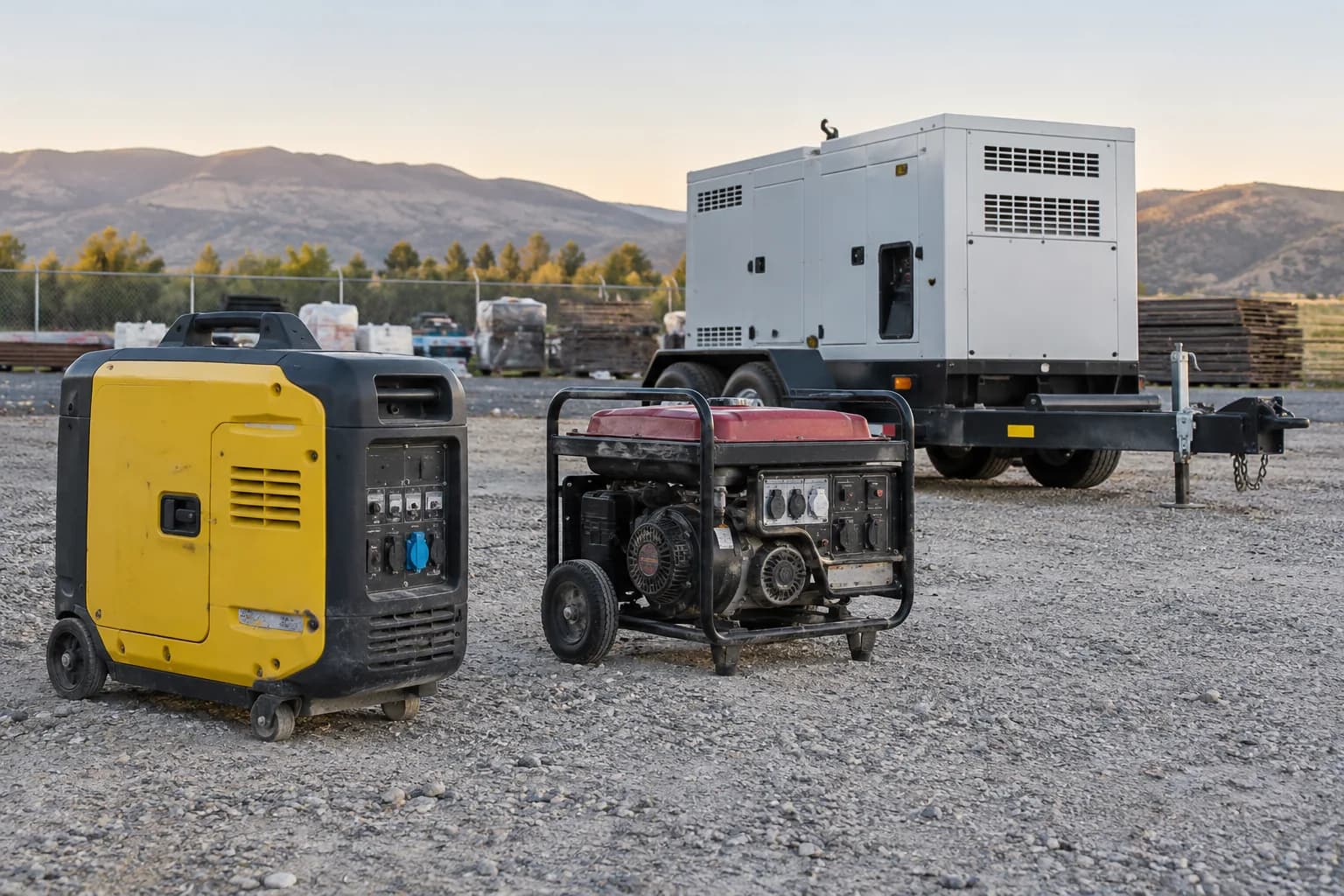
| Portable conventional | Selected outage loads, tools, temporary outdoor power | Running/start watts, outlets, noise, fuel, placement, cords or transfer path |
| Portable inverter | Changing light loads, recreation, sensitive-load planning | Continuous/surge output, economy behavior, waveform data, outlets, parallel limits |
| Home standby | Automatic building backup | Load plan, ATS, fuel, placement, service, permits, commissioning |
| Towable/mobile | Construction, events, restoration, commercial temporary power | Voltage configuration, distribution, grounding, transport, security, qualified operation |
| PTO generator | Farm or site power using a compatible tractor | PTO speed/power, guarding, grounding, connection, operator training |
| Portable power station | Battery-backed indoor-compatible loads | Continuous/surge watts, usable Wh, charging, certification, battery care |
Portable conventional and inverter generators share the same outdoor rule
An inverter generator can be quieter or more fuel-efficient at light load on a particular test, but it still has a combustion engine when fueled by gasoline or propane. It must follow the same carbon-monoxide placement boundary as another portable generator. Use the inverter-versus-conventional guide to compare waveform quality, engine speed, noise, parallel operation, and price.
For both categories, compare fuel-specific output, starting demand, receptacles, 120/240-volt capability, GFCI, neutral arrangement, grounding instructions, runtime test point, weather instructions, emissions eligibility, maintenance access, and parts support. Portable does not mean suitable for indoor operation or direct backfeed into building wiring.
Standby generators are designed as installed systems
A home standby generator normally works with an automatic transfer switch, control wiring, an approved fuel supply, a permanent site, and a maintenance program. Capacity may cover selected circuits or a broader service with load management. Automatic operation makes battery, fuel, exercise, fault monitoring, and professional service part of the selection.
The system must be sized on the intended fuel and installation conditions. Natural-gas pressure, propane storage and vaporization, altitude, temperature, conductor routing, service equipment, and placement can constrain the result. Buy the system design rather than a generator carton.
Towable, mobile, and PTO units add distribution and site risk
Larger mobile generators can offer multiple voltages, three-phase output, long runtime, and job-site durability. Those features also introduce configuration, grounding, overcurrent protection, temporary distribution, cable ramps, load balancing, fuel logistics, transport, theft, and trained-operator requirements. A 50-amp household cord guide is not a distribution design for a commercial mobile set.
PTO generators depend on a compatible tractor and correct shaft speed, guarding, power, grounding, and operating procedure. Both categories should be selected with the equipment manuals and the site’s qualified electrical and safety personnel.
Choose the category, then size the exact model
First decide whether combustion can be placed safely, whether automatic operation is required, and whether building circuits or direct cord-and-plug loads will be served. Next inventory running watts, starting watts, voltage, hours, and load priority. Then compare fuel availability, published consumption, service, noise, mobility, and purchase plus installation cost.
The result should be a short list of categories, not a purchase recommendation. Use the linked specialist guides to finish sizing, fuel planning, connector identification, placement, and transfer decisions. A product is suitable only when every part of that chain agrees.
Frequently asked questions
Common questions
What are the main types of home generators?
The common home categories are portable conventional generators, portable inverter generators, and permanently installed standby systems. Battery power stations are a separate stored-energy option.
Is an inverter generator a portable generator?
Many are portable, but the terms describe different things. Portable describes mobility; inverter describes the electrical conversion architecture.
What type of generator starts automatically?
A compatible installed standby system with automatic controls and transfer equipment can start and transfer after a qualifying outage.
Which generator type can run indoors?
No combustion generator should run indoors. A battery power station has no combustion exhaust while discharging, but it still has product, charging, wattage, and battery-safety limits.
Primary references
CordFind summarizes connector specifications and public safety guidance. Always follow the instructions supplied with your equipment.
- U.S. Energy Information Administration: How Electricity Is Generated
- CPSC: Generators and Engine-Driven Tools
- U.S. Department of Energy: Prepare for Utility Disruptions